What's new

Artillery fuse.

Kosciuszko

Greenie
Joined
Nov 24, 2013
Messages
14
Reaction score
2
Golden Thread
0
Primary Interest:
All Treasure Hunting
Anyone know what type this artillery fuse is ?
Picture was made in Norway.
Thank You.
 

Attachments

  • image.webp
    image.webp
    32.7 KB · Views: 332
Welcome to TreasureNet. :)

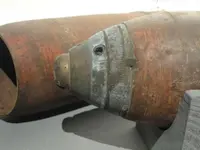
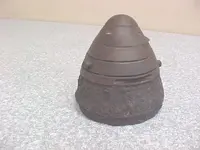
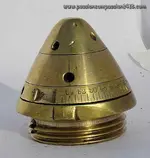
The fuze's dome-shaped "cap" sitting atop four tapered brass rings, with multiple tiny lines (time-duration markings) on the third ring, indicate to me that it is a European (possibly British) copy of the Model-1907 US 21-second Timefuze for Shrapnel-Shells. A very similar version of it was used in World War 2.

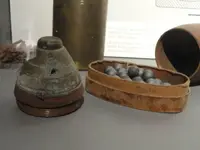
Explosive "blasting" shells had a thick-walled body. The fuze-less projectile in your photo shows its body is very thin, which proves it is a Shrapnel shell. (The term "Shrapnel" means the shell contained may small antipersonnel balls or slugs.). Shrapnel shells always used a Timefuze, like yours, so that they would explode in the air, scattering their antipersonnel balls among enemy troops, instead of exploding when they struck the ground. The thin-bodied shell in your photo indicates my identification of your fuze as a Timefuze is correct.

About the three images I'm posting (below):
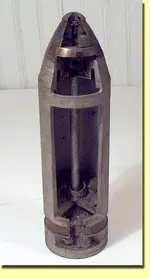
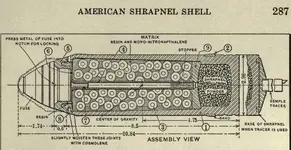
The closeup photo of the US-made version (whose cap is slightly different from yours) unfortunately does not show the time-marking lines on the 3rd ring very well. The other photo shows the fuze in a Shrapnel shell which has been cut open to show the interior of the fuze and the shell. (The antipersonnel balls in it have been removed.) The third image is a British diagram made in 1915 which shows your type of fuze in a Shrapnel shell, with the antipersonnel balls in the shell. But as I said above in this post, the "cap" on your fuze is shaped a bit differently, so I believe it is a European (perhaps British) copy of the American 21-second Timefuze.
 

Attachments

  • fuze_1907M_US_21-second_made-by-ScovillMfgCo_sideview_photobyPhotoman_Mvc-001f.webp
    fuze_1907M_US_21-second_made-by-ScovillMfgCo_sideview_photobyPhotoman_Mvc-001f.webp
    35 KB · Views: 222
  • WW1_shell_halfsection_ww1_75mm-Shrapnel-shell_1907-Scovillfuzed_thinwalled_20070902BombSh (2).webp
    WW1_shell_halfsection_ww1_75mm-Shrapnel-shell_1907-Scovillfuzed_thinwalled_20070902BombSh (2).webp
    39.4 KB · Views: 315
  • diagram_1915_ShrapnelShellManufacure_1907fuze_cartridgecolle.webp
    diagram_1915_ShrapnelShellManufacure_1907fuze_cartridgecolle.webp
    63.7 KB · Views: 494
Last edited:
Upvote 0
Pretty close to this Krupp 77mm AA fuse. The calibrations are every 50 meters of altitude.


BelgeA1.webp
 
Upvote 0
Thank you for your replays,i know most of wwI fuses,i got Austo-Hungarian, German,English,Imperial Russia fuses but i never saw one like this,its not even on passioncompasion,Im looking for exact type and country that this fuse was made.
I add one more picture
 

Attachments

  • image.webp
    image.webp
    28.2 KB · Views: 235
Upvote 0
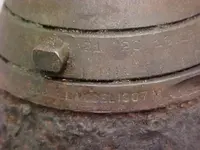
20th-Century artillery projectiles and fuzes almost always have manufacturer identification markings (and often, a time-date) on them. For example, the US Model-1907 timefuzes have identification markings stamped into the brass on the lowest ring -- see the photo at the end of this reply. I suggest you gently clean the greyish-white oxidation off your fuze and look for any identification markings.

Also, the brass powder-casing for artillery projectiles usually have manufacturer and time-date markings stamped into the casing's base. If you have the powder-casing for the shells in your photos, look for the manufacturer's markings stamped into them.
 

Attachments

  • fuze_1907M_ScovillMfgCo_sideview_closeup_photobyPhotoman_Mvc.webp
    fuze_1907M_ScovillMfgCo_sideview_closeup_photobyPhotoman_Mvc.webp
    38.4 KB · Views: 248
Upvote 0
I'm not sure on this one, but the little hole above the lines is where the fuse wrench goes to set the time. It is similar to the ones I've used on 60mm, 81mm, 4.2 in mortar and the 120mm.
 
Upvote 0

Users who are viewing this thread

Back
Top Bottom