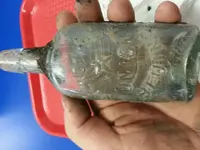
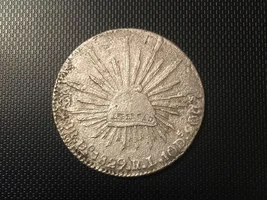
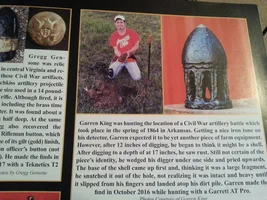
Hey swingbeep,
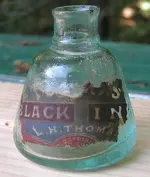
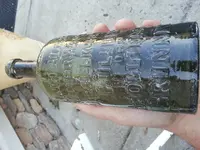
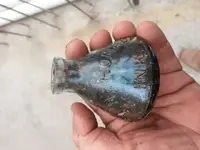
I like both of those. The Thomas ink is a good one. Bluing bottles just don't get the love that they are due.
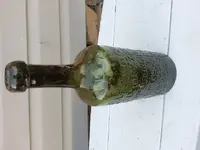
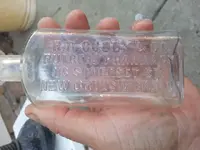
The bottle guys always want to see photos of the base and the junction of the side seams and the lip finish. It helps in the dating and maker identification.
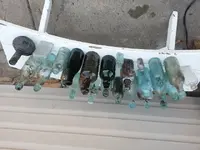
You've got some bottle cleaning to do...

Here's a simple and pretty effective method:
the CHUCKLES CLEANING METHODâ?¢ | Antique Bottles Forum
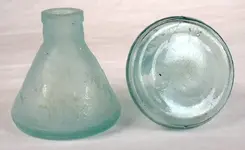
"The very similarly shaped cone ink bottles in aqua glass pictured in the image to the left - although made 40+ years after the previous example - are both embossed with L. H. THOMAS' / INK. These bottles (side view and base view) are 2.5" (6.3 cm) tall, were both blown in the same cup-base mold, have tooled patent finishes, and lack obvious evidence of mold air venting. There might possibly be some faint air venting marks integrated into the heel mold seam although such is usually hard to discern from normal mold seam irregularities. There are, in fact, differences in this mold seam "roughness" between these two bottles indicating that the mold seam bumps are not air venting marks. These bottles were made in many colors including varies shades of green and amber glass as well as colorless glass (Faulkner 2009).
(It should be noted here that small, mouth-blown ink bottles from the era of mold air venting - i.e., mid 1880s to the mid to late 1910s - very often lack mold air venting marks. Why? The author believes that the very small mold size and the quickness that a small parison could be expanded did not necessitate - or result in any substantive benefits - from mold air venting. The open mold top and/or mold seam joints likely provided adequate hot gas escape during bottle inflation.)
This particular style of L. H. THOMAS cone ink bottle dates from the late 19th century, i.e., the 1880s to possibly the first decade of the 1900s based on the manufacturing related diagnostic features noted above. The company was founded sometime in the 1860s by Dr. Levi H. Thomas, a homeopathic physician in Waterbury, VT., where he began his ink business in a nearby barn. He moved to Reading, MI. in 1872, then to Chicago, IL. in 1879. The company used an assortment of ink and bulk ink bottles beginning in the 1860s into at least the mid to late 1910s as machine-made bottles have been observed by the author (Covill 1971; Faulkner 2009; empirical observations). (The machine-made Thomas ink bottles observed by the author were very similar in manufacture to the two machine-made, cylindrical inks discussed in the "mold seam anomalies" box later in this section.) Of additional interest in regards to this company is the labeled L. H. Thomas ink bottle listed further down the page which dates pretty firmly from 1871 or 1872."
Household Bottles