What's new

British Military ??

NickA17

Tenderfoot
Joined
Jul 21, 2023
Messages
3
Reaction score
7
Golden Thread
0
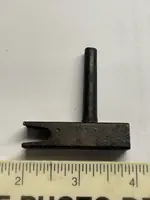
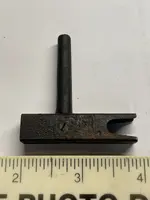
Any help identifying would be appreciated. I dug this item the other day and from what I can get off of it is the stamp “B.B.” “IV” and the British broad arrow stamp. Not sure if anyone can assist me with this what it was used for. Thanks in advance.
IMG_4324.webp
IMG_4325.webp
 
Upvote 13
Interesting for sure! Someone on here will know.
 
Welcome to Tnet.

I have no idea what that is but, yes, the broad arrow (pheon) mark denotes it as British Crown property/Government issue and is mostly seen on military equipment (but not exclusively so).

In addition to the 'B.B. IV' mark there appears to a maker mark that looks like it might be 'W CO' in monogram style, but I don't know who that might be.

On the side, there also seems to be a letter 'Z'. Crown property items from WWII often have a date letter and 'Z' was used in 1945, although the letter is usually below or in the same field as the broad arrow.
 
Welcome to Tnet.

I have no idea what that is but, yes, the broad arrow (pheon) mark denotes it as British Crown property/Government issue and is mostly seen on military equipment (but not exclusively so).

In addition to the 'B.B. IV' mark there appears to a maker mark that looks like it might be 'W CO' in monogram style, but I don't know who that might be.

On the side, there also seems to be a letter 'Z'. Crown property items from WWII often have a date letter and 'Z' was used in 1945, although the letter is usually below or in the same field as the broad arrow.
Awesome. Thanks for information! The permission is an old church and mausoleum. I know that one of the buried occupants was a high ranking officer in George Washington’s Army. I know that this relic is not that old but now I’m just curious about the British history and how it ended up here.
 

Attachments

  • IMG_4332.mov
    828.3 KB
  • IMG_4334.webp
    IMG_4334.webp
    546.2 KB · Views: 64
  • IMG_4335.webp
    IMG_4335.webp
    569.2 KB · Views: 56
Old thread, and the OP is no longer around, but I now know what this is and provide this update for posterity.

It’s a British T Friction Tube, Mark IV. This was a single-use brass igniter designed for breech-loading artillery guns with bagged charges, functioning via a pulled lanyard. The tubular part containing an explosive compound fitted into the breech vent, and a yank on the lanyard attached to a metal loop pulled a friction wire through it for ignition to detonate the main charge.. The loop is missing on the found item because it has been fired.

The Mark I friction tube was designed around 1897 for artillery pieces such as 5 inch and 5.4 inch howitzers among others, and Britain entered WWI with a number of old 15-pounders that still used these igniters, updated to the Mark IV in 1914, and largely phased out by 1916.

Friction Tube.webp
 
Old thread, and the OP is no longer around, but I now know what this is and provide this update for posterity.

It’s a British T Friction Tube, Mark IV. This was a single-use brass igniter designed for breech-loading artillery guns with bagged charges, functioning via a pulled lanyard. The tubular part containing an explosive compound fitted into the breech vent, and a yank on the lanyard attached to a metal loop pulled a friction wire through it for ignition to detonate the main charge.. The loop is missing on the found item because it has been fired.

The Mark I friction tube was designed around 1897 for artillery pieces such as 5 inch and 5.4 inch howitzers among others, and Britain entered WWI with a number of old 15-pounders that still used these igniters, updated to the Mark IV in 1914, and largely phased out by 1916.

View attachment 2261323
As always, nice job Red-Coat!
 

Users who are viewing this thread

Back
Top Bottom