What's new

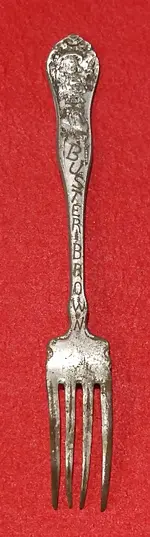
Buster Brown Coin Silver Fork.

Dirty Digger Doug

Hero Member
Joined
Jul 17, 2020
Messages
527
Reaction score
3,007
Golden Thread
0
Location
Grand Rapids Michigan
Detector(s) used
Equinox 800
Garrett ATPro
Primary Interest:
All Treasure Hunting
Found this stunning Buster Brown Coin Silver fork today. Saw s played coin silver on the back.
 

Attachments

  • IMG_20211204_182451466~2.webp
    IMG_20211204_182451466~2.webp
    398.7 KB · Views: 353
Upvote 20
That’s a bit of fun and they’re quite scarce (but only in nice condition) although, as said on the back of yours, it’s not solid coin silver but a type of silver plate. The usual mark is “Extra Coin Silver Plate”, like this:

Extra Coin Silver.webp


This was a trademark of the Niagara Silver Company (formed 1899) that became the intellectual property of William A Rogers in 1902 by acquisition.

When you electroplate silver onto base metal, you get a layer of essentially pure silver (.999 fine or better). One alternative is to cover a sheet of base metal with a very thin sheet of silver (one or both sides) and then apply heat and pressure to bond the layers together. That’s how “Old Sheffield Plate” was made before electroplating was perfected. If you use this kind of process, you can choose the purity of the silver… and reduce your costs by using, for example, coin silver at .900 fine as the plating alloy.

Rogers began making these ‘Buster Brown’ items as sets of knife/fork/spoon sometime around 1905, through to perhaps the 1920s (they were acquired by Oneida in 1929).
 
That’s a bit of fun and they’re quite scarce (but only in nice condition) although, as said on the back of yours, it’s not solid coin silver but a type of silver plate. The usual mark is “Extra Coin Silver Plate”, like this:

This was a trademark of the Niagara Silver Company (formed 1899) that became the intellectual property of William A Rogers in 1902 by acquisition. When you electroplate silver onto base metal, you get a layer of essentially pure silver (.999 fine or better). One alternative is to cover a sheet of base metal with a very thin sheet of silver (one or both sides) and then apply heat and pressure to bond the layers together. That’s how “Old Sheffield Plate” was made before electroplating was perfected. If you use this kind of process, you can choose the purity of the silver… and reduce your costs by using, for example, coin silver at .900 fine as the plating alloy. Rogers began making these ‘Buster Brown’ items as sets of knife/fork/spoon sometime around 1905, through to perhaps the 1920s (they were acquired by Oneida in 1929).
Great information Red-Coat. :thumbsup:
I'm always interested in learning about plated cutlery, mainly because I find so much of it.
Dave
 
Found this stunning Buster Brown Coin Silver fork today. Saw s played coin silver on the back.
What a unique find.
Likely a fork that a child treasured and was devastated when they realized it was lost. :sadsmiley:
 

Users who are viewing this thread

Back
Top Bottom