The additional photos and additional cleaning are helpful. Thanks.
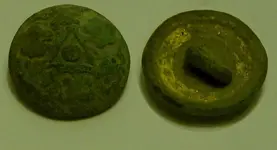
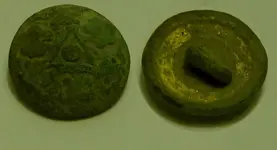
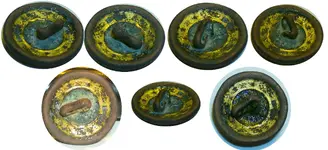
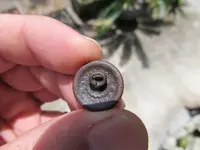
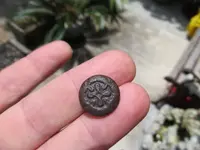
1- In the area at each end of the word "extra" (let's call it 8-to-10-o'clock and 2-to-4-o'clock), I can see several patterns of four raised dots that form a cross.
2- In the middle of the area above the word "extra" (let's call it 12-o'clock), I can see an ampersand symbol (a &, now known as the "at" sign).
3- One of the letters on each side of the "&" might be a "B".
One of the few "prolific" American button-makers in the era of your button was the firm of Benedict & Burnham, in business from 1834-to1843. Previously, from 1829-to-1834, its name was Benedict & Coe.
1- Benedict produced large quanitities of your "type" of button.
2- Benedict typically used a raised-letters backmark on those buttons.
3- Some of Benedict's backmarks are known to have included the "pattern of four dots which form a cross." (See info in the McGuinn-&-Bazelon backmark-book.)
4- That book lists a "B & B / Extra" (in raised-letters) backmark among Benedict & Burnham's backmarks.
So, although the letters on each side of the "&" symbol on your buttons are not clear enough for absolute certainty of ID, I would say "the odds favor" your button being a Benedict product, made sometime between 1829 and the very-late 1830s (after which time, these 1-piece cast brass civilian-clothing Fashion buttons were replaced by cheaply priced 2-piece stamped brass buttons).





















![button17[1].webp](/data/attachments/509/509286-a25e600460a708b275a4a97d7fd11924.jpg?hash=RyxcZDY002)

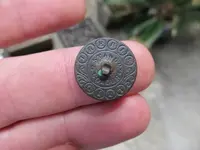
 (1812-1823)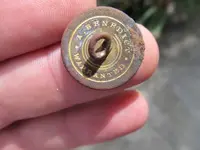
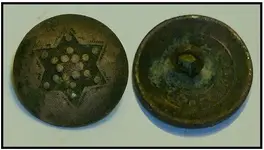
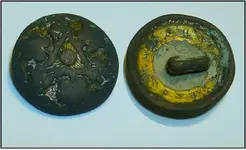
 But you can get a feel for things just by how they are made.Just like buckles, buttons tend to get made of lighter material the futher up in date.
![3%20(1)[1].webp](/data/attachments/511/511645-4eb518cbdfddf189f52e2004a24dea40.jpg?hash=-2RBQwRQay)


