What's new

Button ID needed.

West Jersey Detecting

Gold Member
Joined
Oct 23, 2006
Messages
5,249
Reaction score
1,102
Golden Thread
1
Location
Philadelphia Area
🥇 Banner finds
1
Detector(s) used
Nokta Legend, Excalibur 1000/II (hybrid) , Teknetics T2 SE
Primary Interest:
Other
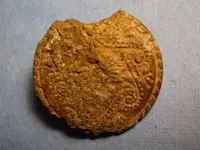
I found this beat up button today. It is flat, one piece, with an alpha shank. It has no back mark. My first thought was a victorian age fashion button, but the more I look at it I keep thinking that I have seen something like it posted before. Maybe a municipal button?

Let me know your thoughts please!
 

Attachments

  • P8040051.webp
    P8040051.webp
    21.6 KB · Views: 194
I strongly suspect that it's an early civilian button. Is it pewter?
 
Upvote 0
BuckleBoy said:
I strongly suspect that it's an early civilian button. Is it pewter?

The VDI was fairly high, near the penny region and the coloring is copper, which makes me think brass or copper alloy, but it seems to be brittle, which is a characteristic of pewter(?).
 
Upvote 0
Hmmmm... I have found some tombac buttons that looked like that when dug, and it took a lot of toothbrush scrubbing to get the crust to finally give way revealing the shiny tombac. I'm not saying that's what you button is made of, but it is a possibility depending on soil type.
 
Upvote 0
Looks Civvy to me - maybe 1830ish
 
Upvote 0
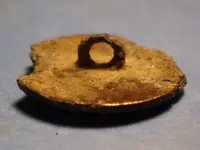
Here is another pic. It is a cast eye, molded button. You can see the copper coloring in this photo along the edge. The mold seam is also visible, but not in the photo. Cast eye, molded buttons typically date from the 17th to the mid 18th century. This makes sense because the site is one of the oldest inhabited areas in the region.

I found this on the web: ...most cast buttons from the early 18th century are pewter, but by the mid-18th century large numbers of cast brass and copper (i.e. copper alloy) buttons were produced.

Being that this was about 10 inches deep, I think this one is a keeper!
 

Attachments

  • P8050046a.webp
    P8050046a.webp
    11.7 KB · Views: 158
Upvote 0
Neil, first of all that is a really neat button. After seeing he verso and the shank I think it's definately 18th century also, or perhaps earlier. You mentioned tombac. We do often find tombac buttons broken in half or with a large portion missing, but never do you see a tombac button degrade away like this one has. As well, I've never seen a tombac with such a shank as your's, as they are almost always cast into a raised dome on the verso. The color seems wrong for pewter, even if it was in contact with iron, as the color is too uniform. As you suggested, it might very well be an early alloy of brass or copper which is less resiliant and prone to chipping and deterioration. Wonderful and unusual find.
 
Upvote 0

Users who are viewing this thread

Latest Discussions

Back
Top Bottom