What's new

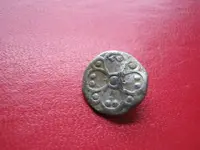
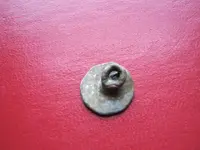
Can anyone date this button?

johnnyblaze

Silver Member
Joined
Dec 20, 2010
Messages
3,214
Reaction score
1,770
Golden Thread
2
Location
Rhode Island
🥇 Banner finds
2
Detector(s) used
T2 SPECIAL EDITION
Primary Interest:
Other
Found this at my favorite site of 2010 dating back to the 1600's.
Could this be from the earlier days brought over from england..
It is silver..
John
 

Attachments

  • silver button 001.webp
    silver button 001.webp
    40.7 KB · Views: 335
  • silver button 002.webp
    silver button 002.webp
    47.7 KB · Views: 343
My first impression is being Celtic because of the design. Isn't that a form of a 4 leaf clover?

Best,
Scott
 
Upvote 0
I´d say early 18th century !
 
Upvote 0
Looks like mid to late 18th century, but probably lead not silver. A real nice one though.
 
Upvote 0
Iron Patch said:
Looks like mid to late 18th century, but probably lead not silver. A real nice one though.
If it was lead it would have a white patina on it..
And if it was pewter the shank would be broken from a bend like that..
John
 
Upvote 0
Iron Patch said:
Looks like mid to late 18th century, but probably lead not silver. A real nice one though.

To me it looks like arsene-bronze !
I can agree on mid 18th century ! :thumbsup:
 
Upvote 0
johnnyblaze said:
Iron Patch said:
Looks like mid to late 18th century, but probably lead not silver. A real nice one though.
If it was lead it would have a white patina on it..
And if it was pewter the shank would be broken from a bend like that..
John


ok. :)
 
Upvote 0
TheDane said:
Iron Patch said:
Looks like mid to late 18th century, but probably lead not silver. A real nice one though.

To me it looks like arsene-bronze !
I can agree on mid 18th century ! :thumbsup:

It could be..It really wont clean up with toothpaste..
Im leaning away from silver..Most of the finds from this site were late 1700's..
John
 
Upvote 0
The button is definitely of the style consistent with 18th century cast buttons. The material appears to be some type of lead alloy. Due to the wear on the design, along with bends in the face and shank, we may note that this item is made of a softer metal material. Pewter is one of the most popular lead alloys of the period. However, pewter tends to become rather brittle with age. Depending on the actual alloy metal with the lead, along with soil conditions, can account for the color and condition of a recovered item. I've personally seen both recovered lead and pewter, range in color from black, to brown, white, gray, and even silver color.

CC Hunter
 
Upvote 0
It could be lead or it could be 'white tombac'.

Read the description..."mass produced in the Late 18th century", "even when one of us dug up one of these Tombac buttons they often have been in the ground for over 200 years or more and the buttons still comes out of the ground with a shiny surface".

A lot of the light shaded (the ones that look like lead) are similar; plus, a lot have floral designs (hunting scenes and floral designs were "in" back then).

http://silversimon.piczo.com/?g=41442428&vsrc=search_google&cr=2
 
Upvote 0
It could be lead or it could be 'white tombac'

Tombac alloy does indeed generally exhibit a characteristic shiny surface, even when recovered centuries later.

However, tombac is a very hard and brittle material, often being found cracked or broken. Of all of the thousands of tombac items I've seen recovered, I cannot recall ever seeing one that was bent. Tombac will most likely fracture into pieces as soon as any stress is encountered. :)

CC Hunter
 
Upvote 0
CC Hunter said:
It could be lead or it could be 'white tombac'

Tombac alloy does indeed generally exhibit a characteristic shiny surface, even when recovered centuries later.

However, tombac is a very hard and brittle material, often being found cracked or broken. Of all of the thousands of tombac items I've seen recovered, I cannot recall ever seeing one that was bent. Tombac will most likely fracture into pieces as soon as any stress is encountered. :)

CC Hunter

THAT is exatly what I mean, when I wrote arsene-bronze (we call it like that!) :icon_thumleft:

Quote form the page:
1. An alloy of copper and zinc (and sometimes arsenic) used to imitate gold in cheap jewelry and for gilding.[Wordnet]
2. An alloy of copper and zinc, resembling brass, and containing about 84 per cent of copper; -- called also German, / Dutch, brass. It is very malleable and ductile, and when beaten into thin leaves is sometimes called Dutch metal. The addition of arsenic makes white tombac
 
Upvote 0
johnnyblaze said:
Iron Patch said:
Looks like mid to late 18th century, but probably lead not silver. A real nice one though.
If it was lead it would have a white patina on it..
And if it was pewter the shank would be broken from a bend like that..
John

Not necessarily...I have a ton of musketballs which have no white patina...it all depends on the soil conditions where the lead was found.
 
Upvote 0
CC Hunter said:
It could be lead or it could be 'white tombac'

Tombac alloy does indeed generally exhibit a characteristic shiny surface, even when recovered centuries later.

However, tombac is a very hard and brittle material, often being found cracked or broken. Of all of the thousands of tombac items I've seen recovered, I cannot recall ever seeing one that was bent. Tombac will most likely fracture into pieces as soon as any stress is encountered. :)

CC Hunter

Granted, none of the ones (in the link I provided) are bent; however, none are any cracked, broken or fractured, either.

These are stated to be Royal Navy buttons, from the mid-1700s, many with flower designs. While they don't state what the buttons are made of, it's just to note that there were also many military buttons with a floral design.

http://www.colchestertreasurehunting.co.uk/navy buttons.htm

Without any maker's mark on your button and the many, many buttons with flower designs, it can only be guessed as to what they were for. You could have it tested to see what it's made of; that'd be your call. Either way, it appears that's it's mid to late 18th century.
 
Upvote 0
CRUSADER said:
johnnyblaze said:
CRUSADER said:
Looks like 20th C aluminium to me

You gotta be joking....Right

No, nothing about the look of that button screams 18th C. Everything to me points to a much later manufacture. The moulding is a clear give away, you will find nothing like it in the 18th C. The scratches also give away the modern look of the metal. It screams 20th C to me. Try & find an 18th C example with the same crispness & definition as that one & you will not be able to, I assure you.

Tombac is totally not possible with this one, you will find none with moulded raised work (like this) with integral loop. The stratches & slight bowing are also not consistant with Tombac damages.

Its modern.

Im not sure but i thought it was more like 17th century or earlier..
This button came out of the earliest site i have found in the area..Actually its the earliest site i have encountered since i started metal detecting.. :dontknow:
 
Upvote 0

Similar threads

  • Question Question
🔎 UNIDENTIFIED From a shipwreck
Replies
2
Views
456
Replies
15
Views
1K
Replies
12
Views
1K

Users who are viewing this thread

Back
Top Bottom