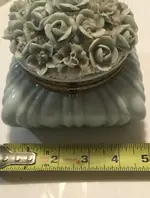
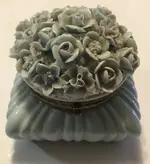
It is indeed a trinket box, sometimes known as a ladies dresser box. It’s a pretty crude mark that looks like it was made on the master for the mould and my guess (only a guess) is that it’s ‘for’ (not ‘by’) the John H Roth Company of America. Roth sold his equity in in the Wheelock Pottery of Indiana and went into business under his own name in 1909 as an importer and wholesaler of pottery commissioned from the actual producers. I believe the company still exists today.
The thing about John Roth’s pottery is that is has no particular style. He shrewdly took whatever he could get from wherever he could get it if the price was right and he thought it would sell. Much of it was fancy decorative ware in European styles, and he sold everything from Staffordshire dinner services to German beer steins, plus everything from high quality porcelain to mass produced Nipponware from Japan. Quality pieces carry one his marks proper under the glaze and are co-marked with the actual manufacturer. I suspect the crude mark is for a factory with multiple customers to identify the customer who commissioned the mould and may have been supplemented on the finished piece with an adhesive foil label that may no longer be present. Most of it also carries a 4 digit style number. I would guess it came out of a Japanese factory as a copy of a French or German porcelain style and may not be particularly old.
The other possibility is that it’s a mould mark for Johansen Roth (again ‘for’ not ‘by’, since they were also American importers not producers). The age and origin would likely be the same. There is a myth that many of their pieces were made by Meissen (and this one has similarities of design to some Meissen-ware) but the Meissen factory historians in Germany are on record as saying that they never produced anything for Johansen Roth (or Jacobsen Roth as sometimes claimed) and had never heard of the names.
It is, as @RW points out, very similar in design to some pieces known to have been produced for Ardent-Lenwile, another American importer who operated in a similar fashion, but the similarities may well be because they were using some of the same source factories in Japan (or elsewhere) as either of the “Roths”.


 BA48001A-B238-4F8C-9FC9-7FFC637901D6.webp149.3 KB · Views: 148
 89C9DEC4-D9F6-4E07-A79D-9644FDF1F435.webp336 KB · Views: 136
 1E391232-F049-495C-B0B1-D91C609DCB77.webp299.7 KB · Views: 112
 B4219857-5FDE-430E-9345-55182D889128.webp99.1 KB · Views: 89
 D9E07EAA-6FBD-4567-A598-E16D488AF664.webp209 KB · Views: 115