What's new

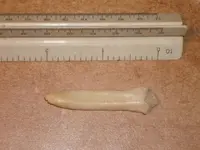
Can someone identify this tooth?

outlawatheart

Hero Member
Joined
Jan 19, 2011
Messages
815
Reaction score
874
Golden Thread
0
Location
Hamilton County IL.
Detector(s) used
White's DFX Spectrum
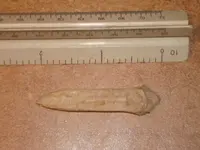
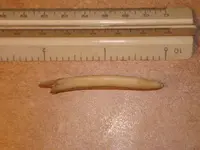
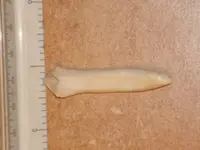
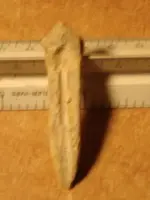
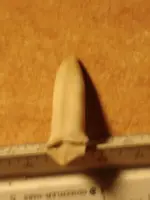
I found this while hiking in New Mexico around the Clovis area. It was found in the side of a wash bank about 10 feet from the surface in loose rock strata.
Would love to know what it is and what animal it is from.
 

Attachments

  • 1-19-11 001.webp
    1-19-11 001.webp
    33.5 KB · Views: 710
  • 1-19-11 002.webp
    1-19-11 002.webp
    32.5 KB · Views: 697
  • 1-19-11 003.webp
    1-19-11 003.webp
    29.3 KB · Views: 704
  • 1-19-11 004.webp
    1-19-11 004.webp
    19.6 KB · Views: 696
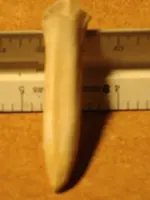
if you look at the second pic it does look like a nerve groove and it does have a hollow socket.

 
Upvote 0
outlawatheart said:
if you look at the second pic it does look like a nerve groove and it does have a hollow socket.
The nerve of a tooth is on the inside. That outside groove is for a tendon I think.
 
Upvote 0
the tooth seems to be split in half long ways the inside has the groove.
THNX for the information by the way
 
Upvote 0
How deep was the " Tooth" found in the hill? and can you get some close ups of the Nerve canal and the ends of it?
 
Upvote 0
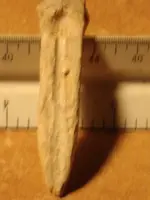
more pic's as requested.
It was found about 10' from the surface + or -
I actually found 2 teeth the other one is a bit larger and in bad shape but is the same type of structure.
 

Attachments

  • 1-19-11 011.webp
    1-19-11 011.webp
    14.7 KB · Views: 698
  • 1-19-11 014.webp
    1-19-11 014.webp
    13.4 KB · Views: 676
  • 1-19-11 015.webp
    1-19-11 015.webp
    11.1 KB · Views: 683
  • 1-19-11 016.webp
    1-19-11 016.webp
    14.9 KB · Views: 679
Upvote 0
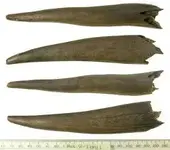
IMO, these are a type of Boar Tusk! The only other thing they resemble is the K9 Teeth of a Saber Tooth Cat.
 

Attachments

  • imagesCAQRI2RY.webp
    imagesCAQRI2RY.webp
    5.1 KB · Views: 681
Upvote 0
Not a tusk IMO. And the cutting surface was not the pointed side: that's the root. So this animal had teeth with very long roots and wedge-shaped cutting surface, probably for cracking bones. Maybe oreodont, hyena or dire wolf. Had to have a significant jaw to anchor that tooth into, so a larger animal, probably 8-10 feet long with very powerful jaws.

Would need to know the age of the rocks in that area to give better idea.
 
Upvote 0
Tuberale said:
Not a tusk IMO. And the cutting surface was not the pointed side: that's the root. So this animal had teeth with very long roots and wedge-shaped cutting surface, probably for cracking bones. Maybe oreodont, hyena or dire wolf. Had to have a significant jaw to anchor that tooth into, so a larger animal, probably 8-10 feet long with very powerful jaws.

Would need to know the age of the rocks in that area to give better idea.

I agree on needing to know the age of the rocks!, if you look at the pic I posted, the "wedge" is the Root. Boars Havalinas, or any type of wild pigs have tremendous strength in their jaws!. The tusks are extremely sharp and can break bones and slick through flesh like a hot knife through warm butter. National Geographic researched the Bite Force of wild Boars, they found it to be equal to a Gray Wolf!! and have been proven to KILL TIGERS that were hunting them!.
 
Upvote 0
The rock in that area of New Mexico is decomposing granite. Very loose but tightly compacted. It was not a suface find. Location was about 20 miles west of Clovis. It was not all that far from the Blackwater Draw site #4
Thnx for all the HELP! :)
 
Upvote 0
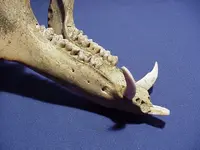
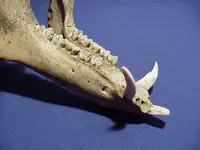
Its not a wild boar/pig tusk. It has no curve to it. The only possibility would be one of the straight thin front bottom incisor teeth. Here is a lower jaw I found but I have also killed many. I wish I could find my shoe box of teeth or this jawbone to pull one out and compare. Ill search for it.
 

Attachments

  • lower_jaw.webp
    lower_jaw.webp
    71 KB · Views: 488
  • lower_jaw.webp
    lower_jaw.webp
    71 KB · Views: 452
Upvote 0

Users who are viewing this thread

Back
Top Bottom