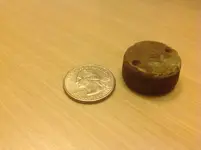
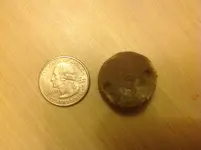
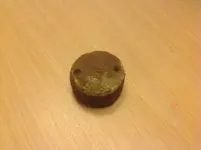
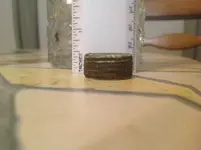
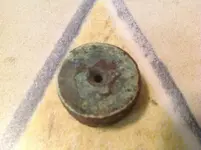
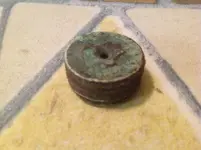
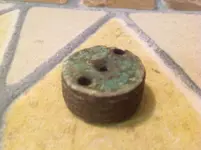
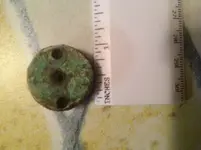
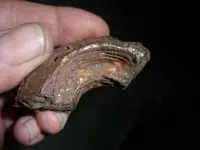
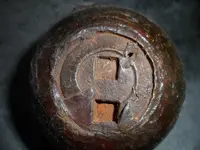
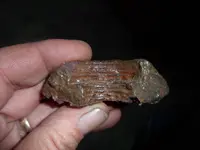
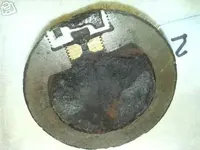
Myrtlebeach, thank you for cleaning the threaded plug and making-&-posting photos after the cleaning, as I requested. They confirm my suspicion that it had a hole going all the way through its center. Now I can give you the (long) part of my previous post that I wrote but withdrew until I had the needed evidence for confirming my ID of the plug.
----------------
Your find is not a cannonball fuze, but it is directly related to one... a Bormann timefuze from the civil war. Specifically, your find is the support plug (also called the underplug) which was screwed into the cannonball's fuzehole underneath the Bormann timefuze. There is a small "flash-hole" in the Bormann support-plug's center, which carried flame from the fuze to the gunpowder in the shell's bursting-charge cavity. The flashhole in your Bormann support-plug is full of dirt-concretion, and thus is very hard to see in your photos -- which is why vhs07 guessed it's a plug from a Sports Shot Put ball. But it's "there"... I spotted it because I knew exactly where to look. It goes all the way through the exact center of the plug. I suggest you use a nutpick or a small nail to dig the crud out of the flash-hole, so your civil war Bormann fuze support-plug will be more easily recognizable for what it actually is.
For anybody here who doesn't already know:
The Bormann timefuze for artillery shells was named for its inventor, Captain Charles G. Bormann of the Belgian Army, in the 1830s. The US Ordnance Department eventually got around to copying it and adopted it for service in the US Artillery in the mid-1850s. The US version remained in active service until the 1880s.
By the way... because your Bormann support-plug is made of brass, the odds are about 98% that it is a Confederate-made one. The yankee-made Bormann support-plug was made of iron.
Here's a photo of a sawed-in-half Confederate-made Bormann-fuzed cannonball. Look underneath the Bormann fuze and you'll see the (sawed-in-half) brass support-plug, with the flash-hole going through its center.