What's new

Cant believe this... my first musket ball! And in the most unlikeliest of places

cti4sw

Bronze Member
Joined
Jul 2, 2012
Messages
1,559
Reaction score
919
Golden Thread
1
Location
Pennsylvania
🥇 Banner finds
1
Detector(s) used
Minelab Equinox 600, Garrett AT Pro, Pro Pointer
Primary Interest:
Relic Hunting
Can't believe this... my first musket ball! And in the most unlikeliest of places

So some time ago I think I mentioned that my wife's grandmother allowed me to hunt their backyard. They live in a heavily residential area that has been residential for over a hundred years, and the township was founded in the early 1890s. It's pretty close to southwest Philadelphia, that may or may not aid in this making sense.

So anyway, I covered the whole backyard (which might be 30' x 12'), found toy cars, clad change, and this. At first I thought it was a bell clapper (because of where I found it more than anything) but someone else posted something identical to it that they claimed was a pistol ball. I shrugged it off until today, when I was bored, and took out my calipers and decided to Google it. It's 0.71" in diameter, or 18mm. It's not magnetic, either, which rules out steel. I am a little stumped as to why it wouldn't have the white oxidation typically seen on lead ammunition.
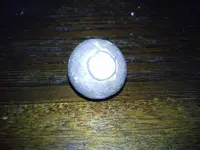
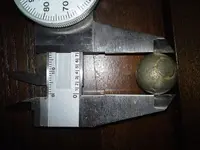
20121212_201531.webp20121212_201719.webp

So anyway, Google says that it's a field-molded Brown Bess musket ball :headbang: I have no idea why I found it where I did, but I'm not gonna complain :) Brown Bess muskets were popular during the American Revolution, but were apparently phased out in the US by the Kentucky rifle in 1838 due to the Kentucky's extended rifled barrel. They were still used by the Mexicans, Maori, Indians, and other rebellious British subjects for their respective revolutions.
 
Upvote 2
Not 100%, no, but it's not magnetic so...
 
It is not corroded enough to be very old. Either it isn't lead and is something else or it is a recent drop by an reenactor.

What looks to be where a sprue was cut off doesn't look right. It is too big for a normal musket ball and there is no marks where it would have been cut. The surface is too flat looking to have been hand cut.

Don't think it is a musket ball.

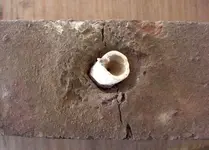
Attached is a photo of a Civil War rifled musket ball in a brick. This bullet was fired at about 6:30AM on a foggy 11th of April, 1865. As you can see the corrosion has turned the bulled a powdery white. A Brown Bess musket ball would be much the same if it had been in the ground for a very much longer time.
 

Attachments

  • Bullet-in-brick.webp
    Bullet-in-brick.webp
    49.2 KB · Views: 209
Last edited:
Well, as a muzzle loader as well as beginning to have a little fun with a metal detector, I can say that it looks like a musket ball. It is very odd that there is no sign of it being in the ground for long.
 
yeah, I had thought the same, but idk the conditions of the ground it was in either. I have an open mind about this possibly NOT being a musket ball, but idk what else it could be other than a crotal bell clapper. (Really hoping it is some sort of crudely made musket ball.)
 
It looks exactly like the round balls I use in my muzzle loader
 
It looks exactly like the round balls I use in my muzzle loader

Could it be modern? I was only thinking it's "old" because when I put the measurements into Google that's what popped up. I completely forgot about modern muzzleloaders, lol.
 
Cast round ball for sure. Use in trade guns,shot guns ,a variety.May not be pure lead,tin or antimony for hardness or cast from wheel weights.
Depth of recovery could help with age,if not a recent drop it should have been lower than any other finds.
Some of them old guns were in use long after "newer"styles became popular.
 
I have recovered bullets that have no patina at all. ANd some that the oxidation washes right off.
However it may have been a modern cast round ball
 
I have recovered bullets that have no patina at all. ANd some that the oxidation washes right off.
However it may have been a modern cast round ball

Chemically speaking, oxidation doesn't always have to happen, nor does it always happen to the same degree. It depends on the conditions. For example, there are railroad tracks near my apartment; one side of the track hasn't been used in decades. The rails are still wholly intact, with minimal rust flaking on the surface, and they are probably the originals (or once removed from the originals). I find iron buried in the dirt in fields abutting the tracks all the time, and the iron is usually almost entirely disintegrated. Iron rails exposed to air and weather fare better than iron protected from the elements 6" deep in the dirt. I'm no dirt expert but I do know one kind of dirt from another when I see it, and the dirt this ball came out of was kinda hardpacked, pretty dry for the cloudy winter day I found it on.

So anyway, the general consensus seems to be that it is in fact a hand-forged musket ball, but from when? And one last question: does any other musket caliber use 0.71" (18mm) balls besides the Brown Bess?

EDIT: It just occurred to me that it could be from someone's family heirloom musket that they were messing with in the backyard. That could account for the lack of patina, if the round spent a lot of time in the chamber. It was deeper than the clad I was finding at 1"-3", it was maybe 4"-5" down.
 
Last edited:
I admire your enthusiasm!

Over the years, I have found thousands of various gauge musket shot.

They sometimes are complimentary to an entire site contents that is from a known date like say a fur trade post from the late 1700's or an early homestead that contains early 19th century finds and is marked on my map.

When searching a new area and one is found, I consider the slim possibility that it may lead to an old site in the general vicinity.

I say slim because most of the shot I have found, came from the hundreds of years of hunting in "Fur trade country."

I would wager that the amount of shot buried throughout my entire province is more than any Rev. War/of 1812 battle site because of the heavy extraction of furs and other game used to fuel the European fur trade.

For North America, lets just say more animals were shot at than humans!

I don't recall if there was much fur trade activity in PA but everyone would have had a flintlock rifle.

I'm not trying to be a buzz kill. Unless you have acres of land to search to try and find an old site, a musket shot in a developed neighborhood would be very difficult to assess.

Also, I have found many shot with the same patina at known period sites and one cannot assume it's age based on that alone.

However, I've never seen one that has the same uniform, polished sprue glob like yours.:icon_scratch:

It was probably shot prior to 1890, before things got developed.

Cheers,
Dave.

Well, that's better than nothing :) you're right, I can see how it would be difficult to assess such a find in a developed area. Still, it's nice to know it is indeed a century-old musket ball. The rest beyond that is just details ;) As I said in the original post, the town was only founded in 1892, and most of the residential development took place in the 1920s. Here is a town atlas from its founding year:

darbyfull.jpg


The street I found it on doesn't exist yet on the map, but can be found roughly on the border of the Andrews/Pusey estates, just north of Parker Ave. Dunno if this helps at all or not. Another thought: the ball may have originally been at a different depth and location; it may have been displaced when the houses' foundations were dug.
 
The ones I get out of flowing water have no white patina on them either. We found some marked base enfields under a early 1800's cabin when we moved it and they had no patina on them either. A battle happened right beside it and 21 C.S were killed and buried there in one grave in the family cemetery .Marked unknown C.S.
 
I dug 3 three ringers this year that were all gray and not white. So I wouldn't go completely on the COLOR of it. Although to me on first look, it appears to be modern and that's not based on color.
 

Users who are viewing this thread

Back
Top Bottom