I've found that catching gold is possible even when a particular setup may go against conventional wisdom, however catching the maximum amount of gold with the minimum amount of gold loss is where it gets complicated. Some folks believe that just because they find tiny specks of gold in their concentrates that they must be catching all the gold down to that size. Perhaps they are but unless they did controlled testing it's just speculation.
You may indeed catch gold running the ur mat in reverse but you may catch more by running it the conventional way. It takes controlled testing to verify.
This may sound silly but I once witnessed a newbie running his sluice with the riffles going the wrong way. The sluice was packed from front to back as he was also feeding it way to much material for the amount of flow. But guess what? Yep, he had some gold in his clean up.

It never hurts to experiment but it's better done in a controlled environment rather than in the field where every speck counts.
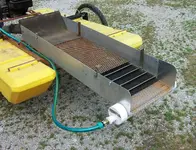
I have been successfully running a fluid bed gold trap at the end of my over under sluice setup on my 4" dredge for a few years now as a safety trap and I am becoming more and more curious about what would happen if I removed everything from the sluice down to bare metal and left only the trap at the end to see how that would work out. Because it would sure make clean up a breeze. like taking a 30 minute job and reducing it to seconds.
If I were to just test it in the field without any control and I found a decent amount of gold in the trap It would be easy to jump to the wrong conclusion because that wouldn't tell me how much gold went down the sluice that I didn't capture. So you see testing under controlled (as close to actual field conditions) is a must where you use a variety of sizes as well as a known quantity of gold to know exactly how to interpret the results.
GG~


?