Welcome to the forum.
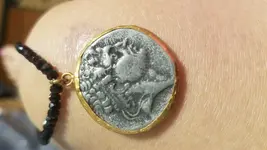
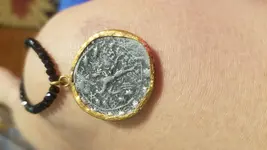
Those star-like things arranged in a double circle, inside and outside the border are I’m sure oak leaves. This is a common reverse design feature for coinage of the Kings of Macedonia in the 2nd Century BC and I think that’s what you have. Likely a tetradrachm, which for that period should weigh around 16-17g, although you’ll have difficulty checking that for a coin which is in a mount.
The portrait doesn’t help much since it’s probably Apollo not the actual King, or perhaps the King personified as Apollo. I’m pretty sure the reverse is the eagle/thunderbolt design pictured below alongside your coin. Not identical, but very similar:
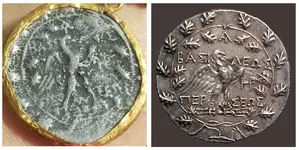
It would take a lot of hunting to attribute it precisely, but the reverse I’m showing above is from the Macedonian King Perseus (179-168 BC) and described as follows;
KINGS of MACEDON. Perseus. 179-168 BC. AR Attic Tetradrachm (30mm; 17.22 gm; 12h). Pella or Amphipolis mint; Ay-, magistrate. Struck circa 173-171 BC. Obv: Diademed head right. Rev: BAΣI-ΛEΩS ΠEΡ-ΣEΩS, eagle standing right, wings spread, on thunderbolt; mintmaster's monogram above, control marks to right (HP monogram) and between legs (AN); all within oak wreath, plow below.
The obverse for that coin also slightly differs from yours, but I wouldn’t be surprised if yours is also under the reign of Perseus, even if that’s not him in the portrait:
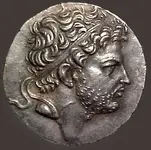
Now you need to sit down and pour yourself a stiff drink. If you go Googling for that specific coin you will find that it last changed hands for $24,500. BUT… it’s a spectacular example and in amazing condition. For yours, I think a couple of hundred dollars maximum would be more realistic. Sorry about that.
It’s also the case that coins of this type are very heavily replicated. Yours may well be authentic because the replicas are most commonly made using a mould from a high quality example, not one which is worn to the extent that the design is difficult to see.