What's new

Constantia Wyn bottle

Scott Peters

Tenderfoot
Joined
Dec 11, 2025
Messages
5
Reaction score
11
Golden Thread
0
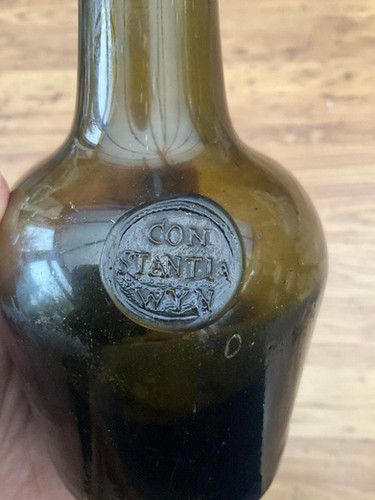
I am trying to find more information about this wine bottle as well as an appraisal of its value. I bought it in 1976 from an antique shop in Amsterdam, Holland. I was told that it was found in a canal in that city. Based on some online research, I have determined that Constantia Wyn is an old winemaker in South Africa. It has been suggested that the bottle was made in Holland, then sent to the then Dutch colony in South Africa, where it would have been filled and the seal applied, and then sent back to Holland for sale and consumption.
I found an article that refers to a bottle fragment found in 2004 that bore the same embossed glass seal as appears on this bottle. It came from a British ship (Severn) that sank off the coast of Delaware in 1774. I saw this same bottle several years ago among the collection at the Corning Glass Museum.
I have attached a few photos of the bottle.
Thank you,
Scott
image0.jpeg
image1.jpeg
image2.jpeg
image3.jpeg
 
Last edited:
I am trying to find more information about this wine bottle as well as an appraisal of its value. I bought it in 1976 from an antique shop in Amsterdam, Holland. I was told that it was found in a canal in that city. Based on some online research, I have determined that Constantia Wyn is an old winemaker in South Africa. It has been suggested that the bottle was made in Holland, then sent to the then Dutch colony in South Africa, where it would have been filled and the seal applied, and then sent back to Holland for sale and consumption.
I found an article that refers to a bottle fragment found in 2004 that bore the same embossed glass seal as appears on this bottle. It came from a British ship (Severn) that sank off the coast of Delaware in 1774. I saw this same bottle several years ago among the collection at the Corning Glass Museum.
I have attached a few photos of the bottle.
Thank you,
Scott Peters Cell# 703-851-4300
View attachment 2237016View attachment 2237018View attachment 2237017View attachment 2237019
You seem to have found the same history I found, but I did find one listed for sale, it appears to be the same style and size but could be a different size, what they are asking for it is one thing but what it sells for is the another, but should give you some idea of approximate value.

 
You seem to have found the same history I found, but I did find one listed for sale, it appears to be the same style and size but could be a different size, what they are asking for it is one thing but what it sells for is the another, but should give you some idea of approximate value.

Thank you so much for this information. The two bottles are very similar, but have some distinct differences as well. Mine is taller. (9 1/2” vs. 8 3/4”) and narrower (3” diameter vs. 3 5/8”). Mine has straight vertical sides while the other has sides that taper outward going up. Also, the neck on my bottle has an odd irregular taper and gets wider as it goes up, while the other one tapers consistently inward as it goes up. Perhaps it’s just a trick of the light, but the other bottle appears to have a flat face on one side just below the seal. I appreciate your taking the time to research this and reply.
I am new to this forum. I have a collection of bottles that I inherited from my father - an avid bottle digger in his day. I’m trying to figure out just what I have.
 
Thank you so much for this information. The two bottles are very similar, but have some distinct differences as well. Mine is taller. (9 1/2” vs. 8 3/4”) and narrower (3” diameter vs. 3 5/8”). Mine has straight vertical sides while the other has sides that taper outward going up. Also, the neck on my bottle has an odd irregular taper and gets wider as it goes up, while the other one tapers consistently inward as it goes up. Perhaps it’s just a trick of the light, but the other bottle appears to have a flat face on one side just below the seal. I appreciate your taking the time to research this and reply.
I am new to this forum. I have a collection of bottles that I inherited from my father - an avid bottle digger in his day. I’m trying to figure out just what I have.
The fact that these are hand blown bottles would account for the differences in shape and size, but both probably held about the same amount of booze, which is what mattered.
 
Very cool bottle! :occasion14:

Scott: Strongly suggest you edit your phone number out of the first post....bad idea
to post it on the open interwebz.
 
Merry Christmas EVERYONE !!!!!
 
Nice bottle. There’s a similar, but not identical, example here:


Historical wine bottle found off the coast in Stockholm
Wednesday, 2 March, 2011 Groot Constantia Estate

A Groot Constantia wine bottle has been bequeathed to The Historical Museum of Wine and Spirits by a man who found the bottle at the bottom of the ocean in the archipelago off Stockholm in the late 1940's while diving in the area.

The bottle housed in the Historical Museum of Wine and Spirits in Stockholm Sweden is engraved with the inscription ‘Constantia Wyn’ as follows:

CON
STANTIA
WYN

It is believed to be an 18th century bottle from Groot Constantia. It is very beautiful and in good condition, made of dark olive green almost brown glass with a long straight neck and a low shoulder and is thought to be from circa 1790.

Jean Naudé is very excited about this discovery and says “this find adds to the clear evidence that Groot Constantia wines were enjoyed all over the world in the earliest of times: Patently the most sought after wine in the world.”

In another exciting and authenticated addition to Groot Constantia’s history, Jean Naude was contacted by a German Glass Museum in October 2010 with another interesting story.
Three different shards of glass certified as coming from South Africa in the 18th Century are in the historical collection of glass in the Annenwalder Glass Factory. There are three different glass emblems containing the insignia ‘Constantia-wyn’.

German research done by the team led them to the fact that the wine in these bottles had been made in South Africa was of high quality and expensive it was named after the daughter of the then Governor of the Cape Simon van der Stel. These pieces of glass had certainly come from wine consumed at the Royal Court in Potsdam, a village in Germany near Berlin.

Of interest is the fact that this old and broken glass was bought from Potsdam by the Annenwalder Glass Factory in order to be recycled. Fortunately it was recognised to be of artistic and historical significance and kept in their museum where it can be seen today.

Even though it is unnecessary in the face of the fascinating and authenticated history of this centuries old farmland, here are three more pieces in the jigsaw puzzle that confirms the rich and integrated history of Groot Constantia.
 
Nice bottle. There’s a similar, but not identical, example here:


Historical wine bottle found off the coast in Stockholm
Wednesday, 2 March, 2011 Groot Constantia Estate

A Groot Constantia wine bottle has been bequeathed to The Historical Museum of Wine and Spirits by a man who found the bottle at the bottom of the ocean in the archipelago off Stockholm in the late 1940's while diving in the area.

The bottle housed in the Historical Museum of Wine and Spirits in Stockholm Sweden is engraved with the inscription ‘Constantia Wyn’ as follows:

CON
STANTIA
WYN

It is believed to be an 18th century bottle from Groot Constantia. It is very beautiful and in good condition, made of dark olive green almost brown glass with a long straight neck and a low shoulder and is thought to be from circa 1790.

Jean Naudé is very excited about this discovery and says “this find adds to the clear evidence that Groot Constantia wines were enjoyed all over the world in the earliest of times: Patently the most sought after wine in the world.”

In another exciting and authenticated addition to Groot Constantia’s history, Jean Naude was contacted by a German Glass Museum in October 2010 with another interesting story.
Three different shards of glass certified as coming from South Africa in the 18th Century are in the historical collection of glass in the Annenwalder Glass Factory. There are three different glass emblems containing the insignia ‘Constantia-wyn’.

German research done by the team led them to the fact that the wine in these bottles had been made in South Africa was of high quality and expensive it was named after the daughter of the then Governor of the Cape Simon van der Stel. These pieces of glass had certainly come from wine consumed at the Royal Court in Potsdam, a village in Germany near Berlin.

Of interest is the fact that this old and broken glass was bought from Potsdam by the Annenwalder Glass Factory in order to be recycled. Fortunately it was recognised to be of artistic and historical significance and kept in their museum where it can be seen today.

Even though it is unnecessary in the face of the fascinating and authenticated history of this centuries old farmland, here are three more pieces in the jigsaw puzzle that confirms the rich and integrated history of Groot Constantia.
Thanks for this. I found the same reference in my researching. I also learned that this wine was a favorite of Napolean and he drank it almost every day during his exile on Elba, requesting it on his dying day. Fun fact!
 

Users who are viewing this thread

Back
Top Bottom