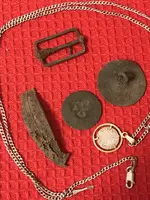
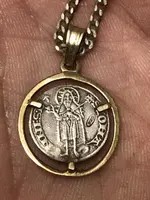
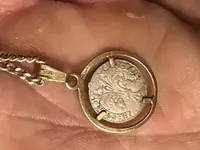
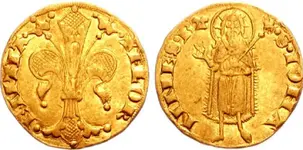
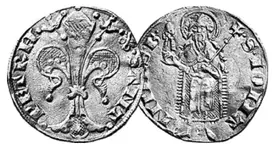
Nice pendant. The coin is copied from a medieval ‘florin’. The city state of Florence, Italy struck these from 1252-1533 in gold, known as the ‘fiorino d’oro’, but there was a less common lower denomination silver issue known as the fiorino d'argento (also called the ‘grosso’).
View attachment 1894402 View attachment 1894403
The above are only typical example designs for these coin (florin and grosso respectively) but there are hundreds of variations… both Florentine and, by the 14th Century, from about 150 city states and authorities. Florence was a major commercial centre and its coinage was widely accepted throughout Europe, leading to other countries (including France. the Netherlands, Germany and Hungary) adopting similar designs and the florin becoming one of the most popular denominations for trading coins.
Yours has the typical ‘John the Baptist’ reverse since he was the patron Saint of the city, and a reverse legend ‘S [Saint] IOANNES [John] B [Baptist]’ with word ‘IOA/NNES’ interrupted by his feet. The symbol to the left of his head is a hammer, which was a mint master mark used in Florence between 1252-1291.
The obverse has the lily as the emblem of the city, but I can’t read the legend from your pictures. Usually it will be ‘FLOR/ENTIA’ (again with the word interrupted by the design).
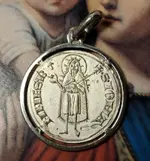
I’ll leave that to you and Google if you want to try and type it more precisely. There will still be dozens or possibilities and, for replicas/copies, these are sometimes generic fantasies for which no exact medieval counterpart actually exists. My guess would be that, since yours represents a ‘worn’ coin, it probably was cast from the real thing… unlike this one, for example:
View attachment 1894404
Frequently the modern pendants were produced in Italy for good luck and, even though the original was a gold coin, the replicas are usually silver. It has long been a Florentine tradition to give a florin on occasions such as the birth of a child, with the wish: “a florin today for a thousand florins tomorrow”.