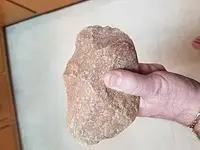
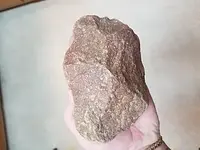
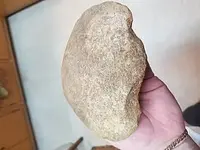
Thank for your insight, and I agree partially but still have some doubt on your assessment. Tell me when you start striking the core, dont you flip it and work pieces off the other side..alternating sides? Do you work all the way around a stone before you flip it? Because this is not bifaced... and I have multiple stone tools that aren't worked like the classic knapable material that you may be used to.. alot of the tool a flaked on one side. The stone tools of the area may not be for the purpose of projectiles.. this media was used for choppers. Scrapers and often much older period than. They didnt need to spald them down and try and work them into razor shaped points.. those were often traded.. This particular stone is well balanced and beveled purposely .. I dont believe it was discarded.. I also have many other scrapers that look like possible
Debitage , and I thought the same but after many house of studying them I have found similar unique styles of the scrapers , made from different stones but end up very similar.. if you just found one you may have thought it was sabotage but when you find many and they end up the same shape.. you find that it is on purpose.. a specific style. Just like you see many types of arrow tips all in the same style like Clovis points... I think if you held this tool in person you could come to see it is a finished tool...not an unfinished throw away.. William Shira has shown such one sided tools in his videos..
The piece you show was worked on one side because he was trying to flatten out that side to create a "spall" that could then be taken to the nearby bifacing site for further work. I have found, very consistently, with that material the starting point for a biface needs to have a width to thickness ratio between 3:1 and 5:1, with 4:1 being ideal for most grades of the material. He failed to clear the thick spot in the middle leaving him with a piece that was going to be more trouble than it was worth. Also, the test flaking lets the knapper get a feel for the material and what otherwise appears to be just fine sometimes gets dumped because "it doesn't feel right", based on hundreds or thousands of hours of experience.
The other confusing thing about the quarry sites is it is where the boys first learned to knap. A huge amount of knapping is repetition and muscle memory, so its practice, practice, practice. So as the men were breaking up cobbles, the boys would take the reject pieces and just knock flakes off them here and there to learn that "feel", in the same way that a boy may practice baseball by throwing the ball up and hitting it on the way down.
You may be able to find the site where the material was being further processed. It is usually on a terrace part way up hill from the creek bed. You will know it by the tremendous amount of chips (waste flakes).
See pages 159-172, "Quartzite Bowlder Quarries, District of Columbia" in this book and compare to what you are finding:
https://babel.hathitrust.org/cgi/pt?...ew=1up;seq=197
If that sparks your interest, I highly recommend:
Stone Implements of the Potmac-Chesapeake Tidewater Province by William H. Holmes 1897