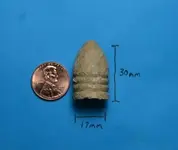
It is definitely a late-1850s-to-1860s US-made "Minie Ball." Note that the spelling is not "mini" as in miniature, but is Minie, because its basic design was invented by a Frenchman whose last name was Minie. The common name for the specific variety of Minie-ball you found (there are dozens of varieties) is a US 3-groove or "3-ringer" Minie. Your size-measurement report (17mm) indicates your Minie-ball was made for use in a .69-caliber or .70-caliber Rifled Musket. Because your Minie-ball shows no rifling-marks on it from firing, nor impact damage, it is an unfired one.
By the way... please pardon me if you already know the following information. I'm including it in case there are some readers here who do not already know it. the white-ish color on your Minie-ball is Lead-Oxide patina, also called Lead-rust, which forms very-very slowly on lead as its surface corrodes during decades of exposure to outdoor weather. That patina on your Minie-ball is proof that it is a genuine "antique" one, not a Reproduction. So, please don't scrub the patina off, nor carry your excavated Minie-ball in your pocket with coins or keys, lest the white patina get rubbed off.