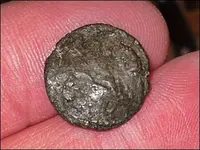
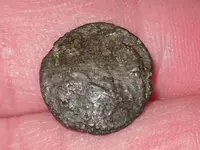
Finding a US Artillery button in Canada is rather unusual, although not unlikely in the least. United States military buttons have been found even further away in remote areas of the world, so a short distance across the border of our neighbor to the north is quite plausible.

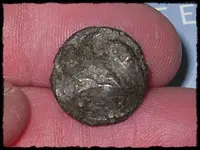
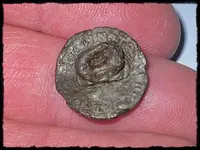
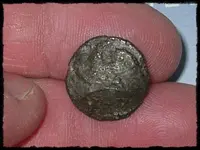
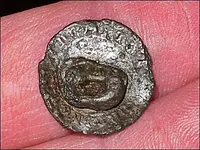
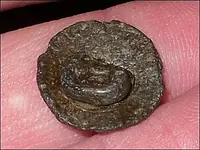
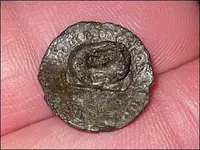
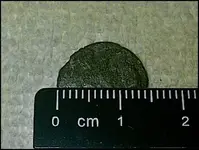
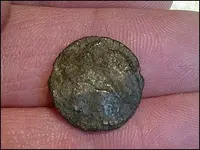
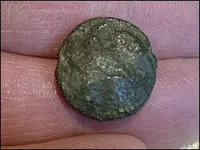
This button though, was in fact described as being found near Watertown New York, per the original post. The finder also describes the button as being pewter material, and from every detail that is evident in the photos, accounting for dull grayish color, edge flaking, waviness on the surface, small cracks, crumble-like degradation on a portion of the shank, overly thick shank that is not consistent with uniform brass wire material, and other features, I will concur 100% with this being a pewter button of the early 19th Century.
I have studied each photo from every angle, squinted with one eye and then the other, and tried to envision a cannon beneath the eagle, all to no avail.

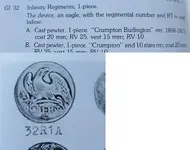
Much like looking at clouds, the prolonged scrutiny of odd shapes can lead the mind to various conclusions. According to a quick perusal of Albert's reference on American Military Buttons, 19th Century artillery buttons are not known to exist in pewter material in any shape, shape, or design. My instinct is that this button is NOT actually an artillery button. The reference I provided earlier of a similar example listed in Albert's, described therein as pewter, example R9 Ap., is actually a subcategory under GI-53.
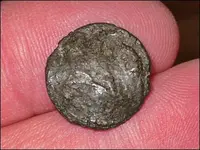
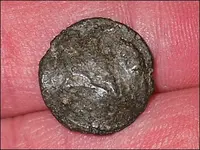
With the additional photos supplied, I am seeing what appears to be
two letters below the eagle on the right side. This may be what was described as "ERY" in the original post, and one clue that led down the path of assigning this as an ARTILLERY button. From my viewpoint, the two letters appears to be a large capital "R" followed by a smaller capital "T", possibly underlined. This may in fact be an abbreviation for REGIMENT, as this style of lettering matches several Infantry Regiment buttons of the period. What is somehow seen as a cannon barrel below the eagle, may in fact be a trick on the eyes due to the pronounced bend at that point in the button. Furthermore, taking into account known button examples where there is an eagle perched atop a cannon (I've even dug a few of these over the years), with lettering below the cannon (I.E; CORPS, REGT., etc.), the lettering would then be much lower on the button than what we see here.
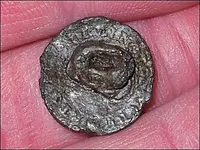
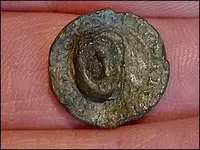
Regarding the backmark detail, the letters "....INGTON" are quite plainly visible to my eyes. The first logical choice would be WASHINGTON, though there are no company backmarks on military buttons with this city or name that I know of (there are only patriotic buttons, typically plain faced brass, with variations of Washington). William Crumpton is noted as a maker of US military pewter buttons of the era, and some carry his name as a mark. However, his business locations are listed as Philadelphia and New Jersey, I believe. Studying the other lettering on the back of this button following "....INGTON", appears to be a fairly good match for CRUMPTON, yet I must maintain this is again much like looking at clouds.
In conclusion I believe we are looking at a one-piece cast pewter button, possibly an unlisted Infantry Regiment variety, dating around the 1810-1830 period.
CC Hunter