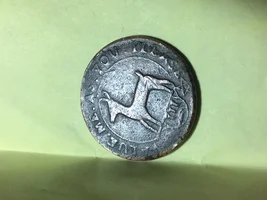
It looks like corroded Zinc to me, and can be tested with a torch as Zinc melts at less than 1,000 degrees fahrenheit. Alternately, you can get some muriatic/hydrochloric acid and drop it on: if it evolves bubbles (hydrogen gas) it is almost certainly zinc, and certainly not Silver whatever else it is, if not primarily Zinc. Many people like using Nitric Acid (I have over a half gallon of concentrated Nitric myself) and I've tested sliver ranging from 22.5% to 99.9% fine silver. Only at below around 50% will there be a noticable reaction with the copper and whatnot, though after a while the puddles on the 50% or-so pure items will become greenish with the colorful and soluble salts of copper.
Anyway, Your friends or local hardware stores likely have at least Hydrochloric acid, so drop some of it on there in a well-ventilated environment. If it starts reacting then it is NOT silver. The readings from your, or anyone else's detector are not going to reflect accurately the elemental nature of a 2 pound piece of metal, lol. It's called common sense people!
Also, the statement that an ounce of silver was equivalent to a day's wages in the late 1800s is far too generalized to be of any solid informational worth. The values ranged between around 40 cents or so an ounce to over 1.11 an ounce from the 1850s to 1920 or so; depending upon supply and global economic conditions (which fluctuated wildly). Most of the time an ounce of silver was worth well less than a dollar, and that ounce represented only a fraction of the value of a hard day's of work by an unskilled laborer, who would earn between 1 and 3 dollars a day prior to 1900, depending upon the job, and their ethnic and gender status. Look it up in the official US statistical charts from 1790 onwards, (I have my 2 volume set, printed in 1975, dunno if it can be accesed on the intarweb though.)
Now, to play the apologist at least in part on the behalf of the OP, I have come across demonstrably silver (coin silver and sterling) items, all silverware, that were tossed in old ash and garbage dumps. They come out black, chalky grey, or otherwise very ugly and look nothing like the silver that would come out of normal soil. I am not certain, but I believe that the extremely high sulphur/sulphide and sulfuric/sulfurous acid content of the coal ash and clinker, blus other caustic chemicals dumped, caused the silver items to react a great deal and made them look about as trashy as this 2 pound piece of whatever. There is some small hope that it may be silver, but i sincerely doubt it.


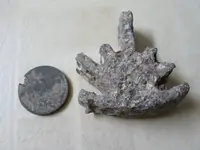

 A single ounce of silver was an entire days pay in the late 1800s yet you claim a smelter would let 2 pounds walk away? Would YOU let someone walk out of your business with a months salary of "splash" in their pocket? Don't confuse "price" with "worth".