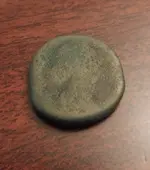
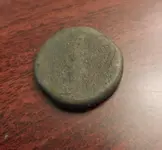
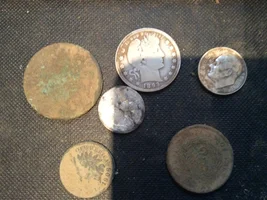
I read recently that as late as the mid 19th century roman coins were found in great numbers in Europe in fields after plowing, so great a number where they found that they were documented to have entered circulation in some parts of France. A worn roman coin, especially one of copper, could easily have entered circulation alongside the many large copper coins of the modern era and ended up in the US. It's a long shot, but I wouldn't be that surprised.
I have heard that aristocrats from the 1600-1700-1800 used to collect Roman coins as a hobby, it wouldn't surprise me if people "mined" for Roman coins to sell to some of these people..
I do have a story that although doesn't directly prove that theory it does lend credence to it..
Back when I lived in Spain we would hunt the countryside for Roman and early Spanish coins, some sites held one type, some held the other, and some held both...
But this particular day we were hunting just a Roman site, pieces of lead and junk metal and a few Roman coins.. nothing else in the plowed field, until out of nowhere I dig a 1753 2 Silver Spanish Real, and a few feet further I got another similar Spanish Silver coin..
I knew this was just a Roman site because early Spanish sites produced Buttons, and Buckles and bells, and thimbles and other stuff from that time period, but here we found nothing at all of any early Spanish settlement.... Why ? Why would you find these 2 silver Spanish coins and nothing else ?
Because they didn't actually live there...
So why the two early Spanish Reals, why Silver ? when most early Spanish sites produce copper Maravedis.. ?
It's only a theory of course but my guise is that in the 1600s and 1700s and maybe early 1800s this place still had remnants of Roman Ruins, and the Spanish Aristocrats visited this site to see the ruins, and maybe collect artifacts that they could find..
It's the only logical explanation I have ever been able to come up with for those two lone silver coins...
Anyway it makes for a very good story..