What's new

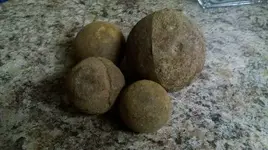
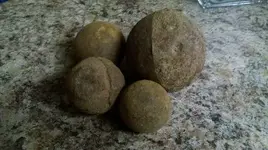
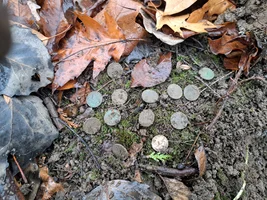
Found these at an estate auction - Got them for $10

goquickly

Greenie
Joined
Apr 6, 2011
Messages
13
Reaction score
0
Golden Thread
0
Location
Gilbert, Az
Any idea of time frame/origin?

2011-04-16_16-30-06_926 copy.webp

2011-04-16_16-30-06_926 copy.webp
 

Attachments

  • 2011-04-16_16-30-34_228 copy.webp
    2011-04-16_16-30-34_228 copy.webp
    27.2 KB · Views: 613
  • 2011-04-16_16-30-06_926 copy.webp
    2011-04-16_16-30-06_926 copy.webp
    39.2 KB · Views: 607
  • 2011-04-16_16-30-34_228 copy.webp
    2011-04-16_16-30-34_228 copy.webp
    27.2 KB · Views: 616
The larger two of your solid (not hollow) metal balls are out-of-round, therefore they are definitely not cannon balls. The reason: ALL actual cannon balls absolutely HAD to be very carefully manufactured to be perfectly round -- lest their out-of-roundness cause them to jam in the cannon's barrel during firing, which could cause the cannon itself to burst violently, killing the artillerymen. Therefore, a big part of an Ordnance Inspector's job to was to make sure that EVERY cannon ball supplied to the artillerymen was perfectly-round.

Your two smaller solid metal balls are perfectly-round. So, there is at least a possibility that those two are artillery "antipersonnel" balls (which were called Canister-balls). To find out for certain, you will need to do SUPER-PRECISE measuring of them, using Digital Calipers. Then check their precisely-measured diameter to see if it matches up with any ball in the charts here: www.civilwarartillery.com/shottables.htm

For detailed instructions, plus a lot more information on how to determine if a metal ball is really-&-truly a cannon ball, go here: http://www.pochefamily.org/books/SolidShotEssentialsMod.html

As I said in a previous post at TreasureNet:
The problem about correctly identifying a metal ball is that there are literally millions-&-millions of civilian-manufactured (not military) metal balls which were NOT manufactured to be a bullet or a cannon projectile. Some examples of the "non-firearms" types of metal balls are:
ball bearings
ore/rock/gravel-crusher balls (from the Mining & Stonemilling industry, thus they're also called "mill balls")
"ornamental" balls (such as a gatepost-top)
Sports Shot Put balls
"tumbler" balls (used for polishing or cleaning - for example, iron balls are used to clean dried cement out of the inside of a cement-delivery truck's tank)
Often, the balls listed above will look a lot like a cannon ball, a Grapeshot-ball, or a Canister-ball ...but in actuality they are almost always one of the Civilian-use types of balls. (More than half of the Solid-Shot (solid metal, not hollow, no fuze) "cannon balls" shown for sale on Ebay are a Civilian type of ball, mis-identified as being a cannon ball.
IMPORTANT NOTE: If a solid (not hollow) metal ball is out-of-round (not a perfectly-round sphere), is it absolutely not a cannon ball!
 
Upvote 0
Here are some more details on the balls, largest is about 3 1/2"

Two are about 2"

Other is about 1 1/2"

All are magnetic.

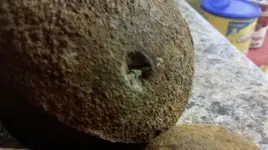
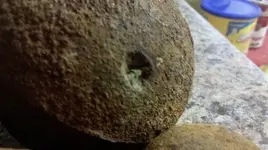
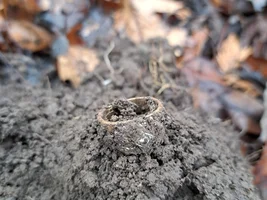
The largest of the three have visual plugs in them. Would this make them some sort of fused grenade?
 
Upvote 0
Note the "extreme" casting-mold seam showing on the larger, out-of-round "balls." The only grenade I've seen with such an extreme seam is a Revolutionary War grenade, a very crudely cast one maufactured by the Continentals.

I don't see any of the "plugs" you mentioned in the photos. All I see is a round-ish depression, which appears to be a casting-flaw. If the depression is not what you're talking about, please post photos showing the "plugs."

Grenades are hollow, of course ...and therefore are significanty lighter in weight that a solid metal object of the same size. So, please provide a precisely-measured weight for whichever of the "balls" you think might be a grenade. When you do, I'll be able to tell you whether they're hollow or solid.

I said "precisely measured" weight because typical household bathroom weighing-scales are notoriously inaccurate. You'll need to weigh them on a Postal shipping-scale or a grocery's vegetable-weighing scale to get an accurate weight measurement.
 
Upvote 0
This is for CannonBallGuy because I have interest in the topic as well. Could a shot cannonball be deformed by striking something? In the instance of a solid iron ball, I would doubt it. But I have little knowledge on the topic. Lead seems much more likely to deform. I do some live firing of cannon, but we use a large lead pellet, not a solid projectile. Those deform easily.
 
Upvote 0
DirtDigler wrote:
> Could a shot cannonball be deformed by striking something?

The answer to your question is No. Cannonballs (and Grapeshot and Canister balls) were made of cast-iron. In Metallurgy, cast-iron is classified as one of the "brittle" metals. Brittle meaning, the metal won't flex or bend without breaking, shattering, or chipping.

That why, unlike lead balls or bullets, you never see cannonballs/Grapeshot-balls/Canister-balls with a flat "smushed" area or a dent. Instead, cast-iron projectiles will crack or shatter or chip. For example, at civil war elic shows, you will occasionally see a Parrott Bolt (meaning, a solid-shot) whose nose was shattered by impact ...but never one which is "smushed." You'll also see Read shells whose base shows big chips broken off of their base.

Also, on a few rare occasions you'll see a Solid-Shot cannonball which was "broken" by high-speed impact with a large boulder or a granite cliff. (A few have come from the slopes around Kennesaw Mountain battlefield, in Georgia.) But never a "smushed" one.

There is a famous civil war photo which shows a yankee Ironclad ship with a "smushed" fired Confederate Mullane Bolt sitting on the deck near the Ironclad's turret. But that is because that particular fired Mullane Bolt was made of wrought-iron, not cast-iron.
 
Upvote 0

Similar threads

  • Question Question
🔎 UNIDENTIFIED Spur ID
Replies
8
Views
764
Replies
8
Views
916

Users who are viewing this thread

Back
Top Bottom