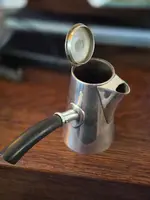
Looks substantial, with a strong hinge. I have never seen a handle like that. I can envision a waiter standing between people sitting at a restaurant table, reaching out and topping their coffee or tea from the side. Just an idea.
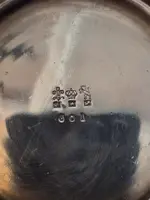
Yes, it would be for preparing coffee (also chocolate), but those are not hallmarks, I’m afraid. They’re silverplate marks as pseudo-hallmarks, and as used by E.G. Webster & Son of New York between 1886-1928
Those are the marks used by John Leonard Smith of Syracuse, NY, active between 1851-1880. He did produce in silver, but those particular marks were used on silver plate. Mostly he's known for reproduction of earlier pieces in Sheffield plate rather than electroplate.
Very good, thank you, I bought this stuff in a lot, so among the plate was some good stuff as well like a sterling Tiffany stamp box. So all in all I did ok.
Based on your description, this set of marks is highly characteristic of British silver plate (specifically, antique or vintage Sheffield plate) rather than solid sterling silver.
The combination of marks you are describing—a crest with crossed keys, a crown, and a profile facing right—points to the following identification:
Key Identification:
The Crown: This is likely the Sheffield Assay Office mark, used to indicate silver plated in Sheffield, England.
The Crossed Keys: This is a maker's mark, most commonly associated with Henry Wilkinson & Co. of Sheffield (active 19th century). Other Sheffield makers, such as John Parsons & Co. and J. Green & Co., also used crossed keys.
The Profile Facing Right: This is a "duty mark" or "pseudo-hallmark" meant to imitate the British Duty Mark (a profile of the reigning monarch used from 1784 to 1890
Based on your description, this set of marks is highly characteristic of British silver plate (specifically, antique or vintage Sheffield plate) rather than solid sterling silver.
The combination of marks you are describing—a crest with crossed keys, a crown, and a profile facing right—points to the following identification:
Key Identification:
The Crown: This is likely the Sheffield Assay Office mark, used to indicate silver plated in Sheffield, England.
The Crossed Keys: This is a maker's mark, most commonly associated with Henry Wilkinson & Co. of Sheffield (active 19th century). Other Sheffield makers, such as John Parsons & Co. and J. Green & Co., also used crossed keys.
The Profile Facing Right: This is a "duty mark" or "pseudo-hallmark" meant to imitate the British Duty Mark (a profile of the reigning monarch used from 1784 to 1890
This looks like an AI-generated answer, but it's not correct. The assertion that "The Crown: This is likely the Sheffield Assay Office mark, used to indicate silver plated in Sheffield, England" is completely wrong. British Assay Offices had no responsibility for marking plated items, but makers of Sheffield plate were required to register their own maker mark with an Assay Office up until about 1830.
A number of British makers have used the crossed keys as self-applied marks, but those are American marks for the Lawrence B. Smith Company, as I said. Smith sometimes accompanied the marks with the word "Sheffield" or "Sheffield Plate" to indicate the use of the Sheffield process (not manufactured in Sheffield) where a thicker layer of silver was heat and pressure bonded onto copper rather than electroplated as less durable thinner layer.
marks and hallmarks of American silver plate manufacturers and American and Canadian sterling silver, coin silver, solid silver and silverplate makers: the illustrated directory of marks, location, history of American metalware makers of EPNS, EPBM, EPWM - Electroplate on White Metal, E.H.H...
This looks like an AI-generated answer, but it's not correct. The assertion that "The Crown: This is likely the Sheffield Assay Office mark, used to indicate silver plated in Sheffield, England" is completely wrong. British Assay Offices had no responsibility for marking plated items, but makers of Sheffield plate were required to register their own maker mark with an Assay Office up until about 1830.
A number of British makers have used the crossed keys as self-applied marks, but those are American marks for the Lawrence B. Smith Company, as I said. Smith sometimes accompanied the marks with the word "Sheffield" or "Sheffield Plate" to indicate the use of the Sheffield process (not manufactured in Sheffield) where a thicker layer of silver was heat and pressure bonded onto copper rather than electroplated as less durable thinner layer.
marks and hallmarks of American silver plate manufacturers and American and Canadian sterling silver, coin silver, solid silver and silverplate makers: the illustrated directory of marks, location, history of American metalware makers of EPNS, EPBM, EPWM - Electroplate on White Metal, E.H.H...
Thanks for the clarification 👍
I have found one very large Company stating E.P. on Copper
While the base metal was actually brass. Nice savings on Wm Rogers books.
Looks substantial, with a strong hinge. I have never seen a handle like that. I can envision a waiter standing between people sitting at a restaurant table, reaching out and topping their coffee or tea from the side. Just an idea.