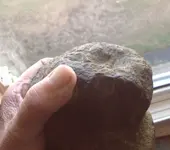
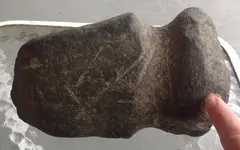
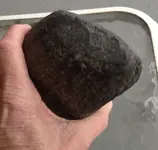
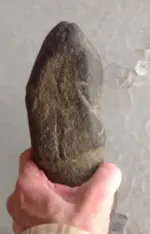
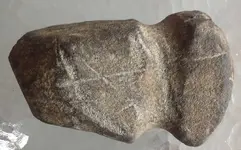
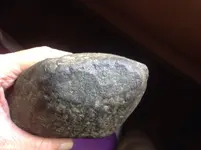
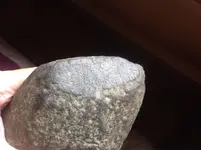
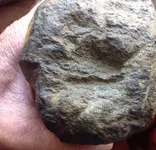
There's no question it was used as a heavy duty hammer, like a sledgehammer. Something this heavy could pound large sections of bark off felled trees. Looks like they were making an axe to start. But, with all the pecking down near the bit, it was suggested that the maker changed his mind on axe, having realized he needed a hammer, and maybe never got around to grinding a sharpened bit before using it as a maul. Or, after seeing use as an axe, it ended its' usage life as the sledgehammer we see today. One has only to examine that darkened smoothed flat facet to know this was used to pound the hell out of something, not to cut like an axe at all. And, the fact that it is not chipped like the bit on a hammerstone used on rocks, proves that it was hammering something that was softer material then the hammer surface itself. Otherwise, it would be chipped up like most hammerstones, and not have a large unbroken smooth surface facet. As noted, this would be ideal for whacking large sections of bark off felled trees.
These are often referred to as camp axes as well, since they were so heavy they were stashed at seasonal camps rather then transported from seasonal camp to seasonal camp.
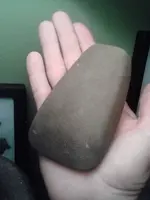
These photos show how the wear is on the side of the bit, not the worn edge of the bit. And that large side facet was pounded smooth on something softer then the rock itself. Although the poll end does show usage, and I agree that is common, it is the bit end that shows the usage in order to create that flat facet in granite. That's a heck of a lot of pounding on granite showing right there, to get it that flat and smooth. That is definite pounding wear, not chopping wear, and a hell of a lot of pounding wear, with the momentum of 8 pounds. I said sledgehammer simply because 8 pounds is a standard size for a small sledge, and not because the tool type actually goes by that name; it doesn't, but the comparison is spot on! Not going to cut much with a broad flat face like that; this was clearly used as a heavy duty hammer regardless of it's' likely start as a camp axe.
Therefore, at the end of its' usage life, it was definitely more of a sledgehammer then an axe. At least if we define axe as something used to chop or cut. Definitely. The usage wear makes that much a no brainer conclusion, IMO. A person can still call it a full groove camp axe, but its' usage at the end of its' life was as a maul on material softer then the tool itself. And I have absolutely no problem at all comparing it to a sledgehammer. I will stick by that comparison 8 days of the week, because it's absolutely accurate as a comparison, given 8 pounds of weight and very obvious pounding wear. And it would take some SERIOUS pounding on a softer material to wear the granitic surface down to that extent.
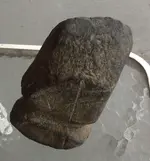
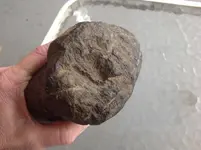
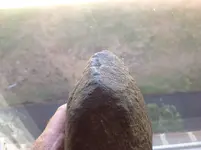
Another shot of the poll as well. There is a sharp ridge of rock running across the center of that battered hole at the top of the poll. No doubting the poll end saw use in some fashion as gator and NC field hunter suggest.