What's new

✅ SOLVED Harmonica ID/History

Underwonder

Bronze Member
🥇 Charter Member
Joined
Jul 31, 2017
Messages
1,731
Reaction score
3,307
Golden Thread
0
Location
RI
Detector(s) used
White's XLT Spectrum, TRX Pin-pointer, Garrett AT Pro Pin-pointer, Eagle II SL with Bigfoot, Equinox 600, Equinox 800, Manticore
Primary Interest:
Relic Hunting
Hello,
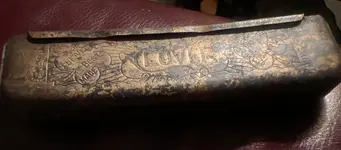
I have found harmonica reeds in the past but was so happy to clean up this dirty, odd object to find it is a harmonica. It has engravings on it and patent dates. It indicates Germany. I couldn't find the maker nor are any visual matches coming up for me. It appears to be key of D or E.

I am always glad to get some help.

Thanks!
Kim
IMG_8046.webp
IMG_8050.webp
IMG_8051.webp
 

Attachments

  • IMG_8047.webp
    IMG_8047.webp
    840.2 KB · Views: 64
Neat find. This was sold as the ‘Clover’ harmonophone (note the clover trademark) with a metal megaphone resonator, like this:

Clover.webp


It was made by C. A. Seydel Söhne (‘Söhne’ means ‘son’ in German) and the company still exists today in Klingenthal, Germany):


The U.S. Patents references are:

#642642, dated February 6, 1900, by Ferdinand Strauss, for a harmonica with a resonating chamber.

#423642, dated March 18, 1890, by John F. Stratton, for a new and improved mouth harmonica.

#483160, dated September 27, 1892, by Ottomar Meinel, for improvements to mouth harmonicas.

#605083, dated June 7, 1898, by Charles L. Curtis, for an improved harmonica.

Here's the February 6, 1900 patent for the attachment:

Clover2.webp

To all whom it may concern: Be it known that I, FERDINAND STRAUSS, a citizen of the United States, and a resident of East Orange, Essex county, New Jersey, have invented new and useful Improvements in harmonicas, of which the following is a specification.
This invention relates to a mouth-harmonica, provided with a resonating-chamber, through which the air is ejected from the cell block to increase the volume and timbre of the tone. The resonating-chamber is of peculiar construction and is removably attached to the body of the harmonica proper, so that it is optional with the player to use the latter with or without the former.
 
Last edited:
Upvote 0
Neat find. This was sold as the ‘Clover’ harmonophone (note the clover trademark) with a metal megaphone resonator, like this:

View attachment 2225933


It was made by C. A. Seydel Söhne (‘Söhne’ means ‘son’ in German) and the company still exists today in Klingenthal, Germany):


The U.S. Patents references are:

#642642, dated February 6, 1900, by Ferdinand Strauss, for a harmonica with a resonating chamber.

#423642, dated March 18, 1890, by John F. Stratton, for a new and improved mouth harmonica.

#483160, dated September 27, 1892, by Ottomar Meinel, for improvements to mouth harmonicas.

#605083, dated June 7, 1898, by Charles L. Curtis, for an improved harmonica.

Here's the February 6, 1900 patent for the attachment:

View attachment 2225937
To all whom it may concern: Be it known that I, FERDINAND STRAUSS, a citizen of the United States, and a resident of East Orange, Essex county, New Jersey, have invented new and useful Improvements in harmonicas, of which the following is a specification.
This invention relates to a mouth-harmonica, provided with a resonating-chamber, through which the air is ejected from the cell block to increase the volume and timbre of the tone. The resonating-chamber is of peculiar construction and is removably attached to the body of the harmonica proper, so that it is optional with the player to use the latter with or without the former.
Thank you! That's great info.! I have to laugh because even after several brushings and seeing the clover, I just kept seeing the word as "LOVER" LOL.

Very interesting. I appreciate your time and effort. I never knew some harmonicas had a megaphone!
 
Upvote 0

Users who are viewing this thread

Latest Discussions

Back
Top Bottom