nnieto505,
Your 5000D is a dickens of a good machine but it will not work well for prospecting. A prospecting machine must be able to handle the high mineralization that is found in areas where gold is. The area your are panning, is it known to have gold in it? If not then I'd stick with the panning to search for gold AS metal detecting for gold is not easy, it takes time and effort to really learn any detector and that especially includes a Gold detector.
I own a White's Coinmaster 6000D and together we have found copper, silver, gold, lead, brass, iron, aluminum as well as other metal objects. Of course all of these finds came in the city and were coins, jewelry, sprinkler heads, pull tabs, gum foil, nails, a .45 ACP fired slug, pocket knife and on and on. I tried prospecting with it One time and found square nails down in "my canyon", had a miserable time attempting but never getting a good ground balance due to the mineralization (mineral type iron in the soil, lots of it in gold country) and then of course there were the hot rocks (high mineralization as well as the cold rocks (a different type of sensitivity than the hot rocks) and both of those will drive a "coin machine" nuts.
For the 5000D you own make sure there are no batteries in it as if they leak they will ruin at least the battery holder and maybe part of the detector itself. The 5000D series 2 and the 6000D are similar and therefore the 5000D can be super tuned just like the 6000D. Once this tuning has been done you will know what metal type is under the coil before you dig, this is of course for city situations where ground mineralization is low and you have no overhead electric wires emitting signals that the detector will pick up. Even with the super tuning the 5000D will not work very well for prospecting as compared to modern day gold prospecting machines. If you want to know more about the super tuning let me know in a PM.
I have owned a Whites GMT since 2007 and it took till 2010 before I found gold with it. This time lapse was due to three main reasons: 1) lack of understanding on how to use the machine 2) very little time out in the field 3) putting the coil over gold with the right settings on the machine. Without having knowledge/improvements in these three items it is likely it would have been much longer before I found gold with my GMT, my fault not the machines.
Purchasing a Gold Detector. On the Tnet home page scroll way down and very close to the bottom of the page you will find a list of sponsors. When you've decided on which machine you want to purchase contact all the sponsors that carry the machine you want and check prices as well as what, if any, extras they add to the machine. A lesche digging tool with holder is useful. Now I've jumped way forward with this sponsor info but I wanted to make certain I did not forget to let you know about it. So lets back up.
If you are in gold country and you've used You Tube to learn about How to Pan and have watched a ton of videos for the major gold detectors and IF you've found gold while panning and you are still interested in getting a detector then you need to choose a detector. Good Luck doing this! It is frustrating Work to determine which one of the several Good machines (there are lesser machines that can find gold) to choose from that you want.
Why? Anyone who's never owned a gold machine has no clue as to how to determine which one is THE right one for them. Start by attending club meetings in your area and asking the members what they use. Each person that owns a different brand/model will tell you that theirs is the best! I am no different! Why? I've only used one machine!! Some folks own Several gold machines and find special uses for all of them. On Tnet is a Gentleman by the name of Steve Herschbach look for a thread under metal detecting, Which would you bring...AT Pro or CZ-3D, and you will find his name off to the right, the fourth one down, click on the thread, go to his post and at the bottom of his post will be a hot link for the detectors he owns with comments on all of them. If you can make a copy of his comments and read them over and over. AFTER you've read and pondered and looked at the manufacturers web site and down loaded their detectors manuals and read them and have asked the folks at the club near you and have reached the point of insanity in trying to decide what to buy And Why (as in is it the right detector for Your area), you can actually send a PM to Steve and I would think he will respond. Be sure you've done your part and have learned as much as you can about these machines so you have some knowledge to speak with him about otherwise you will waste his time and yours. That may sound harsh but you do not want to waste your money on a machine that will not work well in your area (if you have a heavy iron Cap in your area the VLF machines will be useless, you will learn this at a club meeting) so do your homework so you can make the best educated estimate, that's a guess, at what machine to purchase!
Me, I've owned White's machines and one Fisher the original Gold Bug (like the GB 1). I never found a single piece of gold with the Gold Bug "1" and still owned it when I purchased my GMT and it still took me three years of summers only to find gold.
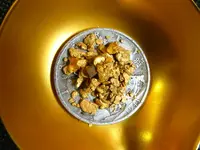
This is a picture of "All" the gold I found in 2010 during four different trips into my river canyon. Its about 1/4 oz of some of the prettiest flat 'nuggets' I've ever found! Of course up till this time I'd only found flake gold while panning, no nuggets. Oh and even with a detector you will not get away from panning!!
Another thing you will need to learn is how to read a river when it is wet or dry. This you can find out on the internet, You Tube has some or just enter Reading a River for Gold (or something like that) and click on search. Inside bends, the tightest bed in a river, on the down river side of Obstructions to the water (big boulders on the shoulder where you can get at them or out in the river where you can't get at them), cliffs jutting out into the river, downed trees and other obstructions. Oh, just in case you were wondering this will be hard work! What else is on the down river side of and obstruction to the flow of the river, lots of smaller boulders, rocks, pebbles, gravel, dirt/sand and the like. The gold, if there is any, especially the larger stuff is usually under all the other stuff.
Okay, this should get you started. Check out Steve's comments on detectors he owns/uses. Learn about your area so you've a better idea what will work there, go to the club meetings. And when you have narrowed it down to 2 or 3 machines you might write each detector note on its own sticky note, post all of them on a dart board and with your eyes closed throw a dart at the board and see if you hit a name and get that one. It is about that bad trying to decide what to get. Steve has been at this game for a very long time so he own's many detectors of both the VLF type as well as the PI type. All of these range in price from (suggested manufacturers price, all are discounted) $800 to $6500 and up, gag! And then there are accessory coils and tools and earphones and 'stuff'.
I use and have for many years a Gerber Gorge folding & collapsible shovel and I think it is great. A classifier for sorting the large racks from the dirt and gravel - my first was a Tuna Fish can I'd cut both ends out of and pop riveted in some 1/4" mesh hardware cloth into one end, it works great!
Oh, the gold I found in 2010 was on the backside of a large boulder (about 1.5 times the size of a VW Beetle). Also on the backside of that boulder was a good number of other smaller boulders of various sizes. I had the 4 x 6 elliptical coil on the GMT and even then I could not 'swing' it in all those boulders. I would move boulders with a Pry Bar (another tool), I have two: 18" Eastwing Gad Pry Bar or Geologists pry bar and a 5' long pry bar: then I would gather some sample material in a 5 gallon bucket with a handle. I had detected the "river bank" (a bunch of smaller rocks) and found a section that did not give the detector fits and would pour the bucket of sample on that spot, detect it and if the detector did not go zip zip(for the GMT) I did noting further with that sample. When the detector did signal that there was metal in the pile I panned and later sluice boxed (another tool) the classified sample and pulled the gold out of it. This all takes a lot of time and a lot of work. Part of it for me is the adventure, part of it is being in the outdoors as I love it and of course when gold is found there is the thrill of having succeeded in having some gold in my sample bottle. Ami I tired of it, NO! Am I willing to spend more of my summers searching, YES!
That is a great picture of your children and the time you spend with them is important bonding time as both of you get to know each other better and the memories all of them will have of being with you will last them forever, same with you of them. I have three, 2 girls and a boy. The girls came first and as each turned four years of age I took them backpacking with me, they were spellbound with the place and it was an instant change from being in the city and there were different rules and things to do than in the city. My son was 4 years and 1 day old on his first trip in with Dad and he stuck with me the longest in going backpacking with me. He now takes his own trips and his oldest sister is a "fisherwoman" to this day while the youngest daughter is getting back into shape to go on her own trips with her friends.
You've a lot of work to do young man and I hope this short book is of help to you. Get back in touch with me any time you have a question
I wish you Success on your Quest for the yellow metal...................................63bkpkr
















