Welcome to Tnet.
Yes, Crusader is quite right (as always) and I was just putting together a response on similar lines.
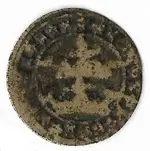
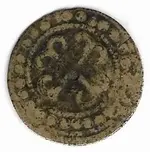
It's a mediaeval ‘cross & crown’ jeton and I would think probably English, although those used in England were often imported from France or Germany.
Jetons were not tokens as such, in the sense that they didn’t circulate as currency. They were used as ‘counters’ on a chequered board, moved around singly and in stacks to make financial calculations. Similar in principle to the way an abacus is used for calculation. Varying the numbers of rows and columns on the board could accommodate accounting calculations in any currency, whether divided into sub-units of 10, 12, 20 or whatever. The chequered board gave rise to the term ‘exchequer’, as in ‘Chancellor of the Exchequer’.
With apologies for the quality of this example which has been holed (they’re often found as such), yours appears to be similar. Cross ‘moline’ with ‘pellets’ in the angles on the reverse and two crowns (one above the other) on the obverse.
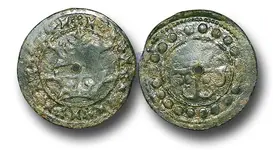
I couldn’t readily find a better picture of the double crown obverse, but here’s the Cross moline reverse from another example (although it has a different obverse to yours, as a crowned Monarch’s head).
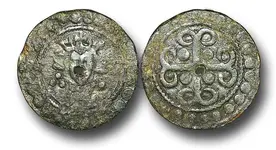
Both examples I’ve shown are the fairly typical 20-21mm in diameter (a little smaller than a quarter), in copper alloy (but all kinds of base metals were used), and the double crown example dates to c1280-1343 (but is of a design that probably continued to be used in later mediaeval times).