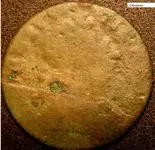
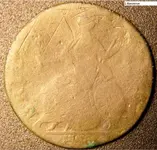
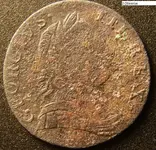
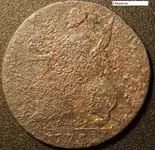
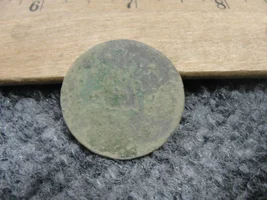
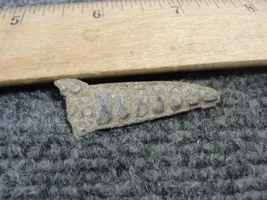
So why does the first coin appear to have been struck with a broken die? Was that common?
Like Sag said, they are most likely counterfeits (or evasion) halfpennies.
You have to remember that Mercantilism was the dominant economic policy and mercantilism's basic viewpoint was that trade was a zero sum game, those who imported lost because their gold/silver/copper left their country and went to another country and those who exported gained because they got gold/silver/copper. Because of this, Europe and Britain in particular did not want to ship their gold/silver/copper over to the colonies where it might not be counted as "their" money.
Because of this, the colonists were perpetually left with a shortage of good British coinage. Most of the silver coins would come from the Spanish colonies which had discovered vast silver deposits in Mexico and South America, most of the coinage that Britain did send over was of inferior quality, while a British half-penny was struck with 46 to the pound, the coinage sent to America was struck at a standard of 120 halfpence to the pound. And a lot of it was coinage that was rejected by other parts of the empire (mainly Ireland, which is why you see so many Irish half-pennies being dug up in the US).
It didn't help that official British coins were few in number, even in Britain, the government was often unwilling to issue copper coins, so counterfeiting became an epidemic with more coins being fake than genuine! Although the penalty for forgery was severe, the law was widely ignored because an underweight halfpenny or farthing that circulated was more useful to make change than no copper coins at all. In the colonies, things were even more desperate with the majority of people simply ignoring the fact they had even a blatant counterfeit simply because there was no other option.
During this time period "evasion" halfpennies also began to be issued. While it was illegal to issue counterfeit coinage that had the same legend as official coinage, it was perfectly legal to issue "tokens" that just happened to look nearly identical to the official issues that were just slightly underweight (the forger had to make a profit!) that had slightly modified legends. These evasion halfpennies were often poorly struck and many times the dies were deliberately altered to give the coin an appearance of circulation. In an era where many were often illiterate, these coins could circulate widely.
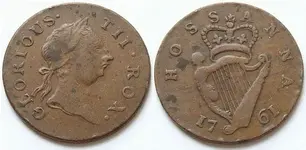
Above is an evasion Irish halfpenny. Notice that at first glance it looks to be a normal Irish halfpenny until you read the legend.
In addition to evasion halfpennies, penny, halfpenny and farthing tokens (called Conder Tokens) were also produced. These commonly featured a town or business on them and served both as a way to make small change and as advertising. These generally did not circulate in the colonies but circulated widely in Britain.
The counterfeiting craze ended in 1797 when Matthew Boulton gained a license to produce official copper coinage. Rather than creating fiat money where a halfpence contained less than a halfpence worth of copper, Boulton produced copper coins of full value where a copper penny would contain a penny's worth of copper (minus the cost of minting) these coins were huge with a copper penny weighing an ounce and a copper twopence weighing double that! Because of the much heavier size of these coins, they could no longer be counterfeited economically and Boulton's efficient steam-powered minting machines churned out 400 pennies a minute! Very impressive in the late 18th century.