I have found 31 gold rings in the last 21 months, and over 300 rings total. I just updated my current totals for the year... I'm at 214 rings.
To answer your question, YES... you can generally get a good idea of what a target is going to be good based on the sound it makes. But not always. I found a 2.4 gram 14K gold earring earlier this year in about 4.5 inches of soil. It ran up 42 and sort of broken sounding. I would have sworn an oath it was aluminum trash. I pulled it because I didn't want to find it again in the future. I was totally surprised! The signal was because it wasn't a full "ring/circle" Just a big almost circle. The shape has a lot to do with the sounds. Breaks in the circle on a ring will also degrade the signal (like a broken/split band, will create "cracking" in the signal).
For the most part though, it's easy to learn unbroken ring signals. Just grab a handful of them from someone's jewelry box and toss them on the ground. Raise or lower your coil for different "depth" readings. If you can get a few gold rings in the mix, you'll quickly discover that gold rings ring pretty darn solid all the way through the depth, until right at the edge of the signal. Unless there's a break in them, or if they're earrings, you'll get a decent signal on them. Rings are typically nice and clear, even if they're junk. The shape does it, I think. It's probably one of the reasons the old style pull-tabs sound so good. A nice bit round ring in them. The only thing you have to watch for is those surface rings that do the bid-deep-deep signal as you run past them. If you're unfamiliar with this sound, you can accidentally assume its a bunch of trash together. It only happens if you wave your whole full coil over it though, if you're using the wiggle method, once you isolate, you'll just get one signal back and forth (because you're only using the middle of the coil).
You can replicate this with pretty much any large ring, you can put it on top of the ground and over-swing it with each pass, with a fast swing. Close proximity just sets off the detector three times as it passes each coil wire.
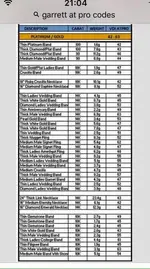
For me, I almost always have a good idea its a ring when I go to dig it. But that doesn't mean the sound is ALWAYS a ring. It just means that it's not some piece of trash that I know is trash. LOTS of trash, though, sounds just like rings do... ESPECIALLY the dreaded pull-tab... though after over 500 hours on the AT Pro, I'm getting to the point I think I can pick them out. I'm learning that they do have a slightly different sound to them... I'm getting closer, and I've not been surprised, yet, when I think it's a pull tab. I can't always tell, but I'm getting close. Basically, for the induction signal between 52 and 55, the strength of the signal should be a bit "more" for a ring, than is showing up in a pull tab. A 55 signal that is a gold ring on the surface will bid-deep-deep, for example, but a pulltab often won't... but it'll show 2" or less. It's all tricky, and I definitely am still learning the nuances. In this case, it would sound the exact same for someone just listening for a signal. It's the strength of the signal that gives it away.
That being said, I dig most everything I come across above 35. I have a limited number of parks and schools I hit, and I'd rather have them "clean" so I don't worry about the same pull tab everytime I go through an area. For me, it works. If I go to another city, though, I don't dig it all...and I only search for the signals that have a high probability.
I chose 35, btw, because I have a tendency to pull out small chains from tot-lots at that low signal. None of them have ever been gold, but a 35 is low enough to catch the larger bracelets. I'm considering, though, that I should go Pro-Zero mode in tot-lots, just because I can pull out nails and stuff, too... Who knows, maybe I'll get surprised with a stud earring that rings up at 12.
Cheers!
Skippy
Cheers,
Skippy