maverick4440
Jr. Member
- Joined
- Mar 20, 2003
- Messages
- 62
- Reaction score
- 0
- Golden Thread
- 0
- Location
- NW Montana
- Primary Interest:
- All Treasure Hunting
I went out detecting today.
One of my neigbors was digging a hole for a new septic tank.
I just happened to be passing by and this caught my eye.
I live in a heavily timbered area in Northwest Montana.
We are in dense forest with 50 to 100 foot tall trees as far as the eye can see.
If it weren't for the massive charred stumps you stumble on in the woods you would never know that a catasrophic fire wiped this whole valley out in 1910.
It has completely reverted back to heavy timber in the last 97 years.
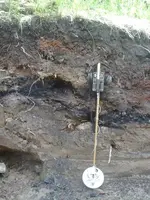
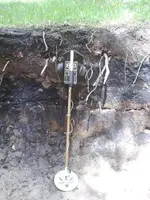
What I found interesting about the septic hole was the line of heavy charcoal showing how much soil has accumulated and built up on top of the original 1910 charred timber line.
I detected the charcoal line and found bits of man made metal items so I am posotive this was above ground in 1910.
What is amazing is that the soil has covered the charcoal at depths of up to almost three feet in some areas!
Some only has 18 inches of soil accumulation.
It makes me wonder how deep those really old coins could be.
If you look at the pics I put my detector in for scale comparison.
The hole is 4-1/2 to 5 foot deep.
You can see the line where the 1910 fire hit and also see how much soil has accumulated since.
Those old coins may be deeper than I thought in some places.
I really wouldn't have believed there could be that much soil accumulation since 1910.
One of my neigbors was digging a hole for a new septic tank.
I just happened to be passing by and this caught my eye.
I live in a heavily timbered area in Northwest Montana.
We are in dense forest with 50 to 100 foot tall trees as far as the eye can see.
If it weren't for the massive charred stumps you stumble on in the woods you would never know that a catasrophic fire wiped this whole valley out in 1910.
It has completely reverted back to heavy timber in the last 97 years.
What I found interesting about the septic hole was the line of heavy charcoal showing how much soil has accumulated and built up on top of the original 1910 charred timber line.
I detected the charcoal line and found bits of man made metal items so I am posotive this was above ground in 1910.
What is amazing is that the soil has covered the charcoal at depths of up to almost three feet in some areas!
Some only has 18 inches of soil accumulation.
It makes me wonder how deep those really old coins could be.
If you look at the pics I put my detector in for scale comparison.
The hole is 4-1/2 to 5 foot deep.
You can see the line where the 1910 fire hit and also see how much soil has accumulated since.
Those old coins may be deeper than I thought in some places.
I really wouldn't have believed there could be that much soil accumulation since 1910.
Attachments
Upvote
0