This Bimetallic collector's site has 2 listed with just the words "Post Exchange", but no pictures, for Fort Hamilton and Madison Barracks (Scroll down to New York)
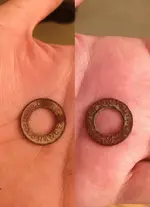
when i found it it did seem as a whole piece but then i let my cousin take it out of my site to run water owver it and he brought it back to me like this and said the middle was just dirt
Schenkman's BiMetallic Trade Tokens book lists possibilities. Fort Sheridan, IL (which piece is pictured in his book and on TokenCatalog.com as TC-203933), Fort Adams, RI (which is not pictured in his book, but it is TC-298948 on tokencatalog.com), and Madison Barracks, RI (which is not pictured either place). You might be able to tell if yours matches the ones shown on tokencatalog.com by pulling up the large-size photos and comparing with yours. The ornaments at the sides need to match.
BiMetallic trade tokens were made to reduce the chances of counterfeiting - the outer ring is brass and the inner part is aluminum. Since aluminum does not fare nearly as well in the ground, dug pieces are often missing the critical inner part. They were made under an 1899 patent and were mostly struck by the S. D. Childs Co. and the Meyer & Wenthe Co. of Chicago into the 1930s.
Post Exchange tokens were used on military bases where a soldier could get an advance on his pay (in the form of tokens) and then purchase sundries at the commissary.
Susan--the obverse says POST / (this is where the missing info would be) / EXCHANGE
and the reverse says GOOD FOR / (this would be the denomination) / IN MERCHANDISE