What's new

Is THIS an alligator?

rwsnc

Hero Member
Joined
Jun 30, 2007
Messages
990
Reaction score
12
Golden Thread
0
Location
Raleigh, NC
Detector(s) used
Minelab Xterra 705, Minelab Xterra 70, Compass Relic Magnum 7a, Compass Coin Magnum, Garrett AT Pro (Sold)
Primary Interest:
Metal Detecting
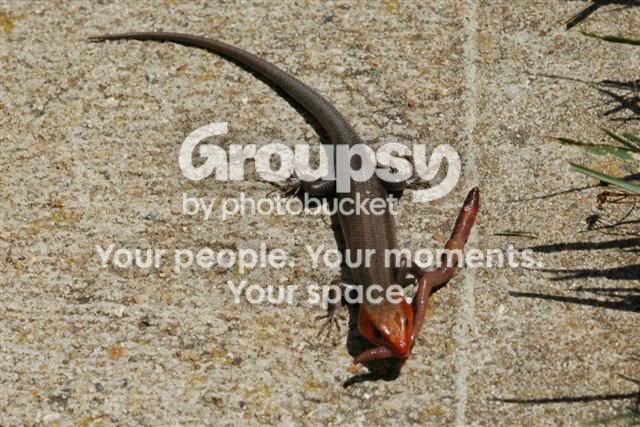
... No.. guess not. It's just a salamander that I caught stealing worms, but I can't figure out what kind it is. It has an orange head, is about 7 or 8" long and lived in my garage in North Carolina up until about 5 minutes before this picture was taken. Now he lives somewhere outdoors.

I don't think it's a lizard. Anybody know what it is?

DSC_0373_edited-1Small.jpg


DSC_0372_edited-1Small.jpg
 
A variety of skink.

Skink
Scientific classification
Kingdom: Animalia

Phylum: Chordata

Class: Reptilia

Order: Squamata

Suborder: Sauria

Family: Scincidae
Gray, 1825


Genera
many—see text


Skinks are the most diverse group of lizards. They make up the family Scincidae which shares the superfamily or infraorder Scincomorpha with several other lizard families, including Lacertidae (the "true" or wall lizards). Scincidae is the largest of the lizard families with about 1200 species.

Skinks look roughly like true lizards, but most species have no pronounced neck and relatively small legs. Several genera (e.g., Typhlosaurus) have no limbs at all, others, such as Neoseps, have only reduced limbs. Often, their way of moving resembles that of snakes more than that of other lizards. Skinks usually have long, tapering tails that can be shed and regenerated.

Many species are good burrowers. There are more terrestrial or fossorial (burying) species than arboreal (tree-climbing) or aquatic species. Some are "sand swimmers", especially the desert species, but for instance also the Mole skink in Florida.

Most skinks are medium sized with a maximum length from the snout to the vent of some 12 cm, although there are a few that grow to larger sizes, such as the Corucia, which can reach 35 cm from snout to vent.

Skinks are generally carnivorous; many feed on smaller invertebrates.

About 55% of the skinks are oviparous, that is, they lay eggs in small clutches. The other 45% give birth to living offspring: they are ovoviviparous.

Skinks occur worldwide. Some species are endangered.


Scott
 
I'm glad to help. I never thought my herpetological skills would EVER be utilized after studying it 35 years ago! Any questions about entomology?
Scott
 
;D ... Glad all that time and money that you spent on your education paid off for you.
 
The kids kept one of those for a winter in a terrarium. Maybe 7 inches nose to tip of tail. It bit me on the knuckle and I had to tear out a plug of skin to get it off me. Beautiful animal but that broad head is to hold all those jaw muscles.
 
AU24K said:
I'm glad to help. I never thought my herpetological skills would EVER be utilized after studying it 35 years ago! Any questions about entomology?
Scott

As a fly fisherman, I know a little bit about entomology (not as much as I should or some of my cohorts know). I do, however have a really great book entitled Aquatic Entomology written by W. Patrick McCafferty. Great info.
 
mcgearhead said:
That's a neat pic ! I've never seen one with a worm in their mouth like that ! Heck, I never even seen one with anything in their mouth before. I was out behind my garage moving some lumber, found a bunch of scorpions, lizards, and all kinds of bugs ! Needless to say, even if I wanted to get some pics of the scorpions, all you would be able to see would be a little greasy spot on some old 2x4 !

Thanks, my camera just happened to be handy. As for the "greasy spot".... Can't blame you there. :D
 
GL said:
The kids kept one of those for a winter in a terrarium. Maybe 7 inches nose to tip of tail. It bit me on the knuckle and I had to tear out a plug of skin to get it off me. Beautiful animal but that broad head is to hold all those jaw muscles.

Interesting. It sure had a death grip on that worm.
 

Users who are viewing this thread

Back
Top Bottom