What's new

Julia Thomas had the best chance

What was a day's wages back then?
Call the Dept. of Labor. Explain why you want to know.
Phoenix got electrified around 1884 and refrigeration was not a big thing until later. How did she operate an ice cream parlor? NOTE: I fully admit to only a quickie search for that information.
Do more than a quickie. She also sold oysters. But only in season. How in the world did she do it all? She must've had a fake ice cream parlor!
 
Phoenix got electrified around 1884 and refrigeration was not a big thing until later. How did she operate an ice cream parlor? NOTE: I fully admit to only a quickie search for that information.

Hello Conceptual, you and I both are learning something, as it was a very good question you asked.


Ice cream parlors existed long before electricity. In the 18th and 19th centuries, shops called "ice cream saloons" or parlors operated by relying on massive underground "ice houses". Merchants insulated and stored winter ice—often shipped from cold climates—to hand-churn and freeze desserts during the warmer months.

Ice Harvesting: Natural ice was cut from frozen lakes and rivers in the winter, then packed tightly into sawdust-insulated ice houses or subterranean pits that kept it frozen well into the summer.

Hand-Cranked Freezers: Ice cream was made by packing a metal churn pot inside a larger wooden bucket, layering the outside with ice and rock salt (which lowers the freezing point of water). The mix was hand-cranked until frozen. Storage and Serving: Operators used non-mechanical "iceboxes"—insulated chests cooled by replenishing daily blocks of ice—to keep the prepared ice cream firm enough to scoop for patrons.

Screenshot 2026-07-18 112425.webp


1840s: American Nancy Johnson patented the first hand-cranked ice cream freezer. This significantly sped up churning times and helped democratize the treat, allowing more confectioners to open dedicated public ice cream saloons. Late-19th to 20th Century: Commercial ice-making machines, followed by mechanical electric refrigeration, eventually eliminated the need to harvest and store natural winter ice, paving the way for the modern ice cream parlors we know today.

So there ya have it Old Crow learned something today.

Crow
 
Jim,
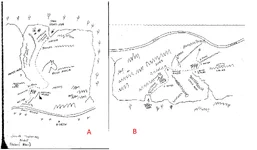
I never looked at this map, in the light you’re talking about.

Julia found out about the hogs right off. 🥴
But the “start here” spot looks to be where she meant to go on that first trip. I think it represents the location she had in her mind for where the monumented trail head was.

The next opening to the right, might be over by Barks, and the two could converge over by the 3 pines.

The trip with Herman, coming in from the West, or left and above the “hogs”, crossing a ridge shown north of Weaver’s Needle, could represent Bull Pass.

The 3 pines and water, could be near Bluff Springs Mnt, and White Rock Springs.

There are caves in real life at the base of the bluffs at the East wall of Marsh Valley. 😳

That puts the mine off to the area west and north in her mind. 🥸🤷🏼‍♂️
Somewhere in the maze of canyons in that vicinity. 😁

My imagination probably has large amounts of influence in the results. 🤓
I'm pretty much thinking the same thing. Just north of the needle, but within sight of the caves to the east....

If you pass 3 red hills, you've gone too far ;)

Edit: That being said, it could be farther east...interested in what others think the map shows...and...does it line up with the directions she gave Bick? How does it line up with what Herman said about their search?
 
Last edited:
<snip> Merchants insulated and stored winter ice—often shipped from cold climates—to hand-churn and freeze desserts during the warmer months.

Ice Harvesting: Natural ice was cut from frozen lakes and rivers in the winter, then packed tightly into sawdust-insulated ice houses or subterranean pits that kept it frozen well into the summer. <snip>

Crow, Phoenix had locally produced ice even before Emil and Julia Thomas came to Phoenix. Power was provided by steam boilers:

Jun 18, 1879
Phoenix_Weekly_Herald_1879_06_18_Page_3.webp
 
Last edited:
Call the Dept. of Labor. Explain why you want to know.

Do more than a quickie. She also sold oysters. But only in season. How in the world did she do it all? She must've had a fake ice cream parlor!

The reason I asked about wages was it seemed like a big debt amount. '$320 in back wages owed to him.'

I found what appears to be reliable estimates of about 15 cents per hour, varies by type of work, what did he do for her? Help at an ice cream parlor might be on the low end. The debt would be about more than a full time year assuming she never paid him anything all that time. Plausible?
 
Hello Conceptual, you and I both are learning something, as it was a very good question you asked.


Ice cream parlors existed long before electricity. In the 18th and 19th centuries, shops called "ice cream saloons" or parlors operated by relying on massive underground "ice houses". Merchants insulated and stored winter ice—often shipped from cold climates—to hand-churn and freeze desserts during the warmer months.

Ice Harvesting: Natural ice was cut from frozen lakes and rivers in the winter, then packed tightly into sawdust-insulated ice houses or subterranean pits that kept it frozen well into the summer.

Hand-Cranked Freezers: Ice cream was made by packing a metal churn pot inside a larger wooden bucket, layering the outside with ice and rock salt (which lowers the freezing point of water). The mix was hand-cranked until frozen. Storage and Serving: Operators used non-mechanical "iceboxes"—insulated chests cooled by replenishing daily blocks of ice—to keep the prepared ice cream firm enough to scoop for patrons.

View attachment 2260026

1840s: American Nancy Johnson patented the first hand-cranked ice cream freezer. This significantly sped up churning times and helped democratize the treat, allowing more confectioners to open dedicated public ice cream saloons. Late-19th to 20th Century: Commercial ice-making machines, followed by mechanical electric refrigeration, eventually eliminated the need to harvest and store natural winter ice, paving the way for the modern ice cream parlors we know today.

So there ya have it Old Crow learned something today.

Crow

Nice! I see that over here https://thesquarephx.org/blog/cold-storage/ they explain there were 2 outfits operating there then making ice with the ammonia process and mechanical power for compression was probably non electric then. I have an ice cream maker, last used it decades ago with my kids back when they were young. Cream comes from a local cheese factory. local fruits.

So her ice was local made and she used it to convert cream to the yummy stuff :)

I wonder if that was a high end business.
 
The reason I asked about wages was it seemed like a big debt amount. '$320 in back wages owed to him.'

I found what appears to be reliable estimates of about 15 cents per hour, varies by type of work, what did he do for her? Help at an ice cream parlor might be on the low end. The debt would be about more than a full time year assuming she never paid him anything all that time. Plausible?
Yes, quite a bit of money...I'm not sure what Rinehart did to earn that much money, but I believe Emil owed it to Riney for work in the years 1885-1888. Riney then left AZ to go mining in the NW, even bought a house in Tacoma, but then Julia must've asked him to come back to AZ once things were getting bad with Emil. Just guessing, but that's what it looked like to me.

Anyway, Rhinehart held some of the debt that Emil skipped out on and Julia was paying all those debts the best she could. Perhaps Julia offered Riney some kind of profit sharing in the restaurant until she could pay everyone off? I don't know...but he did loan her $140 on top of taking the furnishings etc. in lieu of wages. Whatever handshake deal they had we'll never know...but Riney accepting the contents of the restaurant for the $320 in back wages, and the $140 loan from Riney to Julia was documented.

To this day I've never seen anything to indicate what happened. Did Julia pay Riney the $320 and repay the $140 loan? I don't know. Perhaps he just stayed on as some sort of part owner until she sold the business. Not sure how it was resolved.
 
I went back and looked at the Julia/Riney loan record just to make sure I wasn't getting it wrong...stranger things have happened :laughing7:

I remembered it right, it really was $320 for wages due and $140 cash...

Rinehart loan to Julia.webp


It does say that Riney would own the stuff until $460 was paid to him, so Julia either paid him back later as she could, or she would've paid him back when she sold the business...not sure which happened.

Fun fact: Samuel D. Lount, who witnessed the above loan document, was the same guy who built/owned the Ice Manufacturing Plant in Phoenix that was described in the newspaper article in post #24 above...it was a small town I guess :tongue3: but Emil probably owed Lount a bunch of money too, if Emil hadn't paid his daily ice bill for a long time!
 
Last edited:
I seem to be following the 2nd law of TD...lots of entropy going on the older I get...:laughing7:

Here are a couple of possible routes that Julia could've been trying to put on her map. IMO, of course...

The dotted red lines are maybe, depends on how accurate she was. Bold red line is most likely, IMO. Blue and dotted blue lines are maybe, but don't make as much sense for them to follow such a route. Stars are most likely representations of where the trail ended, with dotted lines and question marks less likely but possible.

I will admit to being influenced by Herman saying they searched Needle Canyon in the area of the west side of Bluff Springs Mtn ;)

Julia Map Possibilities.webp
 
And there you have it...Julia seems to think you enter the mountains to the west of WN, from the south. But if you do that, it's a really crappy way to go overland to actually wind up at the needle. Why would Waltz send her that way? I don't think he would.

So maybe she just couldn't remember the trail perfectly? Her directions to Bick "generally" line up with the map. But I don't think she ever intended on giving anyone the last few steps. When Bick asked her if the tributary canyon comes in from the east or west, she said she couldn't remember.

Apparently, she also didn't make a copy of "Jake's parchment map" and "how to get to it"? She took the original into the mts, without leaving a backup tracing in town?

Now, if it were me, I'd leave the original hidden in town somewhere, and I'd be taking a map into the mountains that was changed up a bit, in ways only I knew about.

This all leads to my opinion that the info we have today, and also possibly the info the Petrasches had, was off just enough to throw seekers off the trail. John Reed admitted to doing the same thing to Bark/Ely and then later, with Clay. Reed just wanted someone more experienced to take him into the mountains so he could look around, coming back later if he found the mine.

He later tells Erwin Ruth that he actually knows where the mine is, after going in with Clay, and he intends to open it. Then he's never heard from again.

Perhaps Julia was doing the same sort of thing.
 
And there you have it...Julia seems to think you enter the mountains to the west of WN, from the south. But if you do that, it's a really crappy way to go overland to actually wind up at the needle. Why would Waltz send her that way? I don't think he would.

So maybe she just couldn't remember the trail perfectly? Her directions to Bick "generally" line up with the map. But I don't think she ever intended on giving anyone the last few steps. When Bick asked her if the tributary canyon comes in from the east or west, she said she couldn't remember.

Apparently, she also didn't make a copy of "Jake's parchment map" and "how to get to it"? She took the original into the mts, without leaving a backup tracing in town?

Now, if it were me, I'd leave the original hidden in town somewhere, and I'd be taking a map into the mountains that was changed up a bit, in ways only I knew about.

This all leads to my opinion that the info we have today, and also possibly the info the Petrasches had, was off just enough to throw seekers off the trail. John Reed admitted to doing the same thing to Bark/Ely and then later, with Clay. Reed just wanted someone more experienced to take him into the mountains so he could look around, coming back later if he found the mine.

He later tells Erwin Ruth that he actually knows where the mine is, after going in with Clay, and he intends to open it. Then he's never heard from again.

Perhaps Julia was doing the same sort of thing.
Good morning Jim,
My wife has a hard time with N S E W and being able to project in her mind. I think some folk just have a hard time.

I look at the maps attributed to Julia and they are not consistent within themselves. My understanding is that these maps were made AFTER the trips Julia made, so she had hiked through some of the areas, and other areas she did not hike, as far as we know.

The south entrance had enough resemblance, but everything begins to be skewed after the START.

I think Julia has drawn in things on the map according to how she mentally sees them….. for the most part. 😉

She has Hogs shown in the Garden Valley vicinity 🤷🏼‍♂️😩

I can’t say that my wife would do any better. 👍🤓

I personally think that if she had actually went over the spine of the mountain, that she could have made better maps. 😎

The directions of “how to find it” I do think we’re referring to the “monumented trail”directions, that Julia had given to Bicknell for the article…. I think waltz had Julia memorize the “monumented trail”.

I agree with you that going over the spine of the mountain to get to the vicinity of weaver’s needle is not the best choice ….. FOR US. 😊

Maybe in the days when things were more wild and dangerous, it was safer?
Maybe easier to conceal yourself … 🤷🏼‍♂️

When I look at the maps, it looks like Julia had interpreted the “monumented trail” pathway, to drop down in front of / before instead of dropping down past the needle.

If she was wanting to throw folk in the wrong direction, maybe she drew it that way to be sneaky. I personally don’t think that, but it could be a possibility, I guess.

I think it is how she interpreted the trail directions. I do not think she ever hiked the trail.

If the dotted line for the trail went around the backside of weaver’s needle, it would be dropping into a North /South Canyon.

It would have dropped right down into the canyon between Palomino mountain, and Blacktop Mesa. It is known as East Boulder Canyon, and is the only large canyon heading north …. (Just West of the needle).

Everything changes just one canyon over.
I think it never occurred to Julia that she was looking in the wrong N/S canyon. 😳

However, it is pretty solid that the area NORTH of the Needle ( needle canyon & marsh valley ), is where Julia liked. 😎

coming in from the West they most likely went over Bull Pass, since it was already a trail for going over blacktop Mesa. The parchment map was gone already.

They might have searched all around the core area around marsh valley. They might even have looked right at the site, and not recognized it. 🤷🏼‍♂️

After coming into that area, from the west, it would make sense they would look for the tributary to be coming into the area from the East.

Maybe that’s how come Julia noticed the caves, because they were on the east of that vicinity. 🤷🏼‍♂️
 
Last edited:
All good points, Russ. I tend to believe Julia and Rhiney came over Freemont Saddle on their second trip. I get this impression from the Bark notes. Not that it specifies Freemont, but that it seems to be their second (or later?) trip that Rhiney is describing, when they make it over the mtn.

Anyway, going up there, you start out going north for about a half mile, but soon you're heading NW. When she first sees the Needle from up top, if she thinks she's heading N (but is really heading NW), then the Needle would be off to her right...so she might think the Needle is east of where they're coming in.

I agree that the "how to get to it" is the monumented trail directions she gave Bick. I just don't think she told him everything on how to find the mine from the monumented trail...nor do I think she lays it out on her map. The scale of the map is too large anyway...for the kind of detail one would need to find the mine.

These are just my best guesses ;) but I'm not certain/convinced of anything :laughing7:
 
Jim,
I didn’t remember that they (Julia and Rhiney) ever came over the mountain. Now I don’t have any excuses for Julia not having sorted out compass points. 😬😵‍💫

Maybe it was raining and all cloudy while they were coming over the top.

Supposedly Waltz and his partner had gone and knocked over the monuments from the mine, back passed the needle, and a little ways up the mountain …. Leaving the rest of the monuments from part way up, to the rest of the way up to the top and across and back down. 🤷🏼‍♂️

Maybe some monuments up top were knocked over, or some other reason that prevented them from going further up top, before dropping down. If they had bad weather or not is probably unknown. 🤷🏼‍♂️

You brought up a good point … it seems most folk would not take the originals of the parchment map, and how to get to it…. Even Waltz’ citizenship papers were with her. 🥸

I don’t have an answer for why she would pack them around in her bag. Sounds like she didn’t feel safe leaving them anywhere, except on her person. 🤷🏼‍♂️

I also agree that there were things Julia did not tell Bick or Bark. Things that Waltz had told her … sometimes Rhiney was paying attention too. 🤓

So she could have maybe seen Needle canyon from from the mountain, and saw the Needle, and thought…. time to go back down. 🤷🏼‍♂️

That was an interesting exercise with her maps. 👍
 
What is the earliest written account of Julia Thomas's encounter with Jacob Waltz?

Crow
 
What is the earliest written account of Julia Thomas's encounter with Jacob Waltz?

Crow
Definitely Jim Bark. He saw Julia and Rhiney on their first trip in, and interviewed Rhiney in probably August of 1892. Bark mentions seeing Waltz sometime prior to that in Julia's store, so it seems Bark had first-hand knowledge of Waltz/Julia knowing each other.

But the Bark notes were never "published". So the first published account would be Bick, who wrote a couple articles in 1894-1895. His source is considered to be Julia.

Then there was James McCarthy and Charles M. Clark, both who said they knew Julia and got their stories directly from her.

Ely was published later, but he makes reference to interviewing Julia years prior to that. Julia passed away in 1917, so that would be the latest possible direct interview of her in regards to Waltz.
 

Users who are viewing this thread

Back
Top Bottom