What's new

Ks700 Gpr Value Meaning

moc

Tenderfoot
Joined
Jan 8, 2025
Messages
2
Reaction score
2
Golden Thread
0
Hello, I bought KS 700 grp but it gives a lot of numerical values. and I don't know what these numbers mean. I'm trying to do some processing in voxler and see something but I can't get any clear information other than the comparison. I would be very happy if you could help.
 
Upvote 1
Hello, I bought KS 700 grp but it gives a lot of numerical values. and I don't know what these numbers mean...
tn_md.gif
I noticed this was your very first post - so, Welcome Aboard! You didn't list your state (or country) in your profile. So, you might consider jumping over to Sub-Forum: Select Your Area.... for information (i.e., clubs, hunts, finds, legends, maps, etc.) directly related to your state (or country).
tn_moved_over.gif
I moved ya from HELP! over to METAL DETECTING for more exposure.
tn_notice.gif
NOTE: Forum HELP! contains guides tutorials on how to use the new TreasureNet.com software.
 
Hello, I bought KS 700 grp...
tn_link.gif
Until a member(s) pipes in - I searched
tn_02.gif
and got a bunch of threads. You might enjoy reading them while waiting. Just hit this: KS 700 TN Search.
 
I can't help you with your questions but welcome to the forum from Oregon!
 
KS700-voxler hakkında tam olarak neyi merak ediyorsunuz? KS700'ü 10 yıldır kullanıyorum.
 
I have never heard of this brand (KS Analysis), or model KS700, so they are not considered a know manufacturer of ground penetrating radar (GPR). That doesn't mean that they can't make a GPR, just that they don't sell GPR to professional users of GPR.

The documentation says that this is a frequency modulated continuous wave (FMCW) GPR instrument, which is may be. The documentation also says that it can image down to 40 m, which I don't believe in any world. The wording about FMCW on all of the marketing materials means that the manufacturer either doesn't understand the physics of GPR or that they are lying to you.

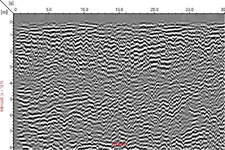
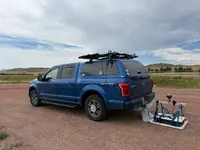
I have attached two images to this email, the first is my ImpulseRadar CrossOver CO1760 GPR mounted to the back of my truck for a bedrock mapping survey on a road. The CO1760 is an impulse GPR instrument and has two pairs of antennas, one pair with a center frequency of 170 MHz and the other with a center frequency of 600 MHz. I have also attached a sample GPR profile of 170 MHz data over very electrically resistive soil with great penetration showing around 8 m of penetration. For GPR to penetrate to 40 m, you would require a very low center frequency for the system and very resistive material such as ice in Antarctica. The dimensions of this KS700 mean that the antenna elements can not be large enough to operate at the low frequencies required for 40 m depth of investigation.

I found some marketing material about the instrument on this website. This isn't what GPR data looks like.

GPR instruments never report numerical values. The data is almost always graphically displayed showing amplitude vs time for each a-scan and interpolating the amplitudes vs time for b-scans (what I showed in my attached image). All of the b-scan data can be processed into c-scans in analysis software after completing your surveys. These will be 3D volumes of data.

Golden Software Voxler doesn't do any processing, just visualization of 3D volume of data.

Sorry, I can't really help you.
 

Attachments

  • ImpulseRadar-CO1760-Sample-170MHz-Data.webp
    ImpulseRadar-CO1760-Sample-170MHz-Data.webp
    287.9 KB · Views: 55
  • IMG_1976.webp
    IMG_1976.webp
    461.5 KB · Views: 55
I have never heard of this brand (KS Analysis), or model KS700, so they are not considered a know manufacturer of ground penetrating radar (GPR). That doesn't mean that they can't make a GPR, just that they don't sell GPR to professional users of GPR.

The documentation says that this is a frequency modulated continuous wave (FMCW) GPR instrument, which is may be. The documentation also says that it can image down to 40 m, which I don't believe in any world. The wording about FMCW on all of the marketing materials means that the manufacturer either doesn't understand the physics of GPR or that they are lying to you.

I have attached two images to this email, the first is my ImpulseRadar CrossOver CO1760 GPR mounted to the back of my truck for a bedrock mapping survey on a road. The CO1760 is an impulse GPR instrument and has two pairs of antennas, one pair with a center frequency of 170 MHz and the other with a center frequency of 600 MHz. I have also attached a sample GPR profile of 170 MHz data over very electrically resistive soil with great penetration showing around 8 m of penetration. For GPR to penetrate to 40 m, you would require a very low center frequency for the system and very resistive material such as ice in Antarctica. The dimensions of this KS700 mean that the antenna elements can not be large enough to operate at the low frequencies required for 40 m depth of investigation.

I found some marketing material about the instrument on this website. This isn't what GPR data looks like.

GPR instruments never report numerical values. The data is almost always graphically displayed showing amplitude vs time for each a-scan and interpolating the amplitudes vs time for b-scans (what I showed in my attached image). All of the b-scan data can be processed into c-scans in analysis software after completing your surveys. These will be 3D volumes of data.

Golden Software Voxler doesn't do any processing, just visualization of 3D volume of data.

Sorry, I can't really help you.
Sir, I have the utmost respect for you; however, it saddens me that you have not heard of the KS-700, a GPR-based system considered one of the best-preserved and high-performing devices.

I live in Turkey and have been using the KS-700 machine for the past 10 years. In addition, I have experience with many detectors, area scanning, and underground imaging devices. As a user and analyst, I can confidently say that the KS-700 ranks 2nd among the best devives.
According to my analyses, the device can detect:
Water up to approximately 100 meters, (and more)
Metal, underground cavities, and other subsurface structures up to appoximately 60 meters.

The KS-700 detects changes in the ground through the signals it sends; when it identifies disturbances in soil structure, it displays the data digitally as a graph. Based on my field tests and imaging in various culturally rich regions of Turkey, I can conclude that the best underground imaging devices are the Turkish-made Proton and the German-made KS-700.
Ranking:

1. Proton (Assuva Defense Industry, Turkey-made)
– Highest performance and precision.
2. KS-700 (Germany-made) – High depth capacity and reliable data analysis.
3. ...... etc.
Kind regards
 
Its a German made GPR with price of $19,000 USD, very few are sold on this side of the Atlantic.
 
Sir, I have the utmost respect for you; however, it saddens me that you have not heard of the KS-700, a GPR-based system considered one of the best-preserved and high-performing devices.

I live in Turkey and have been using the KS-700 machine for the past 10 years. In addition, I have experience with many detectors, area scanning, and underground imaging devices. As a user and analyst, I can confidently say that the KS-700 ranks 2nd among the best devives.
According to my analyses, the device can detect:
Water up to approximately 100 meters, (and more)
Metal, underground cavities, and other subsurface structures up to appoximately 60 meters.

The KS-700 detects changes in the ground through the signals it sends; when it identifies disturbances in soil structure, it displays the data digitally as a graph. Based on my field tests and imaging in various culturally rich regions of Turkey, I can conclude that the best underground imaging devices are the Turkish-made Proton and the German-made KS-700.
Ranking:

1. Proton (Assuva Defense Industry, Turkey-made)
– Highest performance and precision.
2. KS-700 (Germany-made) – High depth capacity and reliable data analysis.
3. ...... etc.
Kind regards
I will have to disagree with your assessments.

The physics of GPR don't allow what you have described. You can do a back of the envelope calculation on the maximum depth of investigation of a GPR instrument when you know the dynamic range in decibels (dB) and the approximate electrical conductivity of the soil/rock.

If either of the GPR(?) instruments you mentioned were actually good, then the professionals would be using them. There are lots of GPR manufacturers who make ridiculous claims that no competent professional would use.

Here is a list of the GPR equipment manufacturers who sell worldwide and are recognized as being quality instruments.

Geophysical Survey Systems, Inc. (GSSI)
ImpulseRadar
Sensors & Software (now part of SPX)
IDS Georadar (Owned by Hexagon Geospatial)
Earth Science Systems (ESS)
Proceq Screening Eagle
Groundradar (Jan Francke, doesn't sell instruments only leases them)
Kontur (previously 3D-RADAR)
Coded Radar
GuidelineGeo Mala

I hope I didn't miss any of the reputable ones.
 
Sir, I have the utmost respect for you; however, it saddens me that you have not heard of the KS-700, a GPR-based system considered one of the best-preserved and high-performing devices.

I live in Turkey and have been using the KS-700 machine for the past 10 years. In addition, I have experience with many detectors, area scanning, and underground imaging devices. As a user and analyst, I can confidently say that the KS-700 ranks 2nd among the best devives.
According to my analyses, the device can detect:
Water up to approximately 100 meters, (and more)
Metal, underground cavities, and other subsurface structures up to appoximately 60 meters.

The KS-700 detects changes in the ground through the signals it sends; when it identifies disturbances in soil structure, it displays the data digitally as a graph. Based on my field tests and imaging in various culturally rich regions of Turkey, I can conclude that the best underground imaging devices are the Turkish-made Proton and the German-made KS-700.
Ranking:

1. Proton (Assuva Defense Industry, Turkey-made)
– Highest performance and precision.
2. KS-700 (Germany-made) – High depth capacity and reliable data analysis.
3. ...... etc.
Kind regards
Can you provide some scan images for the depths that you've quoted?
It would be helpful to see the quality of the data.
 
What, in your opinion, defines professionalism?


Is ten years of experience enough for someone to be considered a professional? :D
Please don’t say it’s not enough—otherwise, doctors, engineers, and many others would have spent all those years trying to become professionals in vain. :D


With ten years of experience—and as an IT professional who has worked with many different machines, examined motherboard circuits, and conducted numerous tests—I feel confident in saying whether a product is high-quality and suitable for professional use.


Here’s what I want to tell my friends: Don’t approach anything in this world—whether living or non-living—with prejudice. Your experience gives you the expertise and professionalism you need to do your job. Since I have professional experience with this machine, I can say it’s reliable. But no one who hasn’t used it can make that judgment. :)


By the way, we experimented and excavated with countless excavators. I’ve mastered working everywhere—from east to west, south to north of Türkiye—and I am recognized as an expert everywhere. Most of the people involved are foreigners, mostly Armenians and Jews, and many especially in the east come to us for certified sites. So I have experience in every way, both in the field and technically, with both foreign and local teams.


This machine is German-made; I didn’t make it, and I’m not selling it. :D But as someone who has used it, I can say the KS700 is a very professional GPR machine. Please don’t be influenced by the biased opinions of those who haven’t experienced it.


As we say in Türkiye: “Kill the brave, but give them their due.”


Sorry for the long post.
 
Can you provide some scan images for the depths that you've quoted?
It would be helpful to see the quality of the data.
Of course, I can share a few clear pieces of data. Since I have my own private scans, I can share two of them: one is a pinpoint scan in terms of depth, and the other is around 12 meters, where you can even notice the rooms in the images. I’ll do my best to help when I get to my office during the week.
 

Users who are viewing this thread

Back
Top Bottom