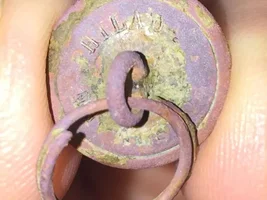
Your button's backmark gives no indication of a manufacturer's name, so I can't help you about that, except to say that the backmark's British spelling of the word color as colour means your button was made in Britain. On a brass 1-piece flatbutton, indented lettering in the backmark dates it to being from sometime between about 1810 and the mid-1830s. However, British ones dug in America are most likely from the 1820s into the 1830s, because the War Of 1812 (US-versus-Britain) interrupted trade between the two countries, and many Americans boycotted British-made products for nearly 10 years after the war's end (1815).
The reason so many British-made pewter, white-tombac, and brass buttons are found in America:
The very young American button-making industry was not capable of mass-producing metal buttons until the late-1820s. So, to supply the demand for metal buttons from the clothing industry, hundreds-of-thousands had to be imported from Britain.
I should mention, the British government protected Brit button-makers from American competition by restricting exports to the US of raw copper and brass needed for button making and various other "skilled" metal crafts such as making candlesticks, bowls, goblets, eating utensils, etc.
Historical info-sources:
"American Military Button Makers And Dealers; Their Backmarks & Dates" by William F. McGuinn and Bruce S. Bazelon
"Record Of American Uniform And Historical Buttons" by Alphaeus H. Albert (which most button collectors simply call "the Albert button-book").