What's new

Mudlarking Trip Yields Coins and Gold!

UnderMiner

Silver Member
Joined
Jul 27, 2014
Messages
4,476
Reaction score
12,334
Golden Thread
2
Location
New York City
🥇 Banner finds
2
Detector(s) used
Minelab Excalibur II, Equinox 800
Primary Interest:
All Treasure Hunting
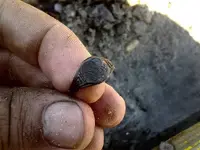
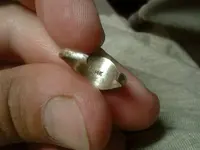
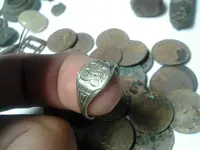
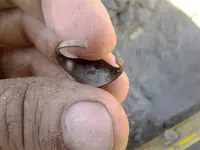
Yesterday had some free time so hit the beach for a low tide hunt. This may sound a bit strange but I didn't bring a detector, just a gardening hoe and my trusty fire boots. Scraped the tidal line for a few hours to see what I could dig up. Must have calculated my theory just right because no sooner did I start tilling the ground before I was pulling Indian Head Cents, Wheat Cents, and old relics dating from the late 1800's to the early 1930's. Just lots of old pennies mostly - 26 of them by the end of the hunt! I was expecting some silver coins eventually but to my surprise I instead scraped up a 14k gold signet ring! Best part is when I saw the ring I took out my camera and recorded everything.


Fresh from the ground:
10202016 7.webp10202016 6.webp

Cleaned up:

10202016 5.webp10202016 4.webp

It is only 1.9 grams but heck I wasn't even expecting to find gold so it was a nice surprise!
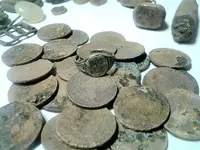
10202016 3.webp10202016 2.webp

This is my first gold found with just a gardening hoe for a hunting tool. I later found a second ring but that one was just brass. Some other finds included a .50 caliber bullet, brass shell casings, a pair of old cuff links, a locket, and a whole manner of other old relics. All the finds are pictured here:
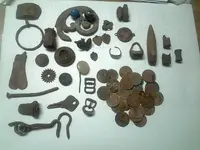
10202016 8.webp
 
Upvote 50
outstanding.gif
Nice finds - never thought of approaching the edge with just a gardening hoe! I think I will try it (w/o a MD) just using my sand scoop and see what happens when we get down to FL shortly. Thanks for sharing...
 
Cool finds. You are the second person only I have heard of doing this.

First guy was a Horse Back Shrimper in Northern France. He uses his horse to walk through the water and drag his nets. He gets about 200 kilograms a day in as little as 2 hours and is happy with that. So one day I saw him using something that appeared to be much like the box he uses in front of his nets but instead behind it was a 6 foot long 3 foots wire mesh cage.

I watched him, then went over to him after he stopped. He said that he does this about once a month right at the tide line and a few other low spots. His box is set to go down only about 20 cm but that clearly was not an issue at all because this man had enough in that trap. He said that he only does the tide line that is on his commercial fishing lease. He said that his father and grandfather had practised this method because a clean beach brings more shrimp. Then he told me he thinks that is a bunch BS, that a clean beach keeps the Fishery happy, authorities happy and brings in more visitors to the beach to loose stuff.

He counted all his coins and it was just over 1200 Euro on a two kilometer stretch with six passes, about 22 grams in gold and 81 grams of silver, lots of lead weights, small pieces of copper wire and a few odd items. He said that since it was Fall pickens are slim but it is enough to feed and care for his Belgium with only the best grains.

Good luck on your next hunt and keep sharing.
 
Jesus, your first day scratching the ground looks better than most days i'm swing my detector! Congrats!!!
 
Had this area been productive for you in the past or some research led you to it or just a piece of luck?
 
Cool finds. You are the second person only I have heard of doing this.

First guy was a Horse Back Shrimper in Northern France. He uses his horse to walk through the water and drag his nets. He gets about 200 kilograms a day in as little as 2 hours and is happy with that. So one day I saw him using something that appeared to be much like the box he uses in front of his nets but instead behind it was a 6 foot long 3 foots wire mesh cage.

I watched him, then went over to him after he stopped. He said that he does this about once a month right at the tide line and a few other low spots. His box is set to go down only about 20 cm but that clearly was not an issue at all because this man had enough in that trap. He said that he only does the tide line that is on his commercial fishing lease. He said that his father and grandfather had practised this method because a clean beach brings more shrimp. Then he told me he thinks that is a bunch BS, that a clean beach keeps the Fishery happy, authorities happy and brings in more visitors to the beach to loose stuff.

He counted all his coins and it was just over 1200 Euro on a two kilometer stretch with six passes, about 22 grams in gold and 81 grams of silver, lots of lead weights, small pieces of copper wire and a few odd items. He said that since it was Fall pickens are slim but it is enough to feed and care for his Belgium with only the best grains.

Good luck on your next hunt and keep sharing.

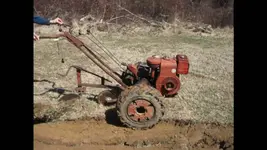
I've been testing a theory that most valuables such as gold, silver, and copper because of their density vs. the density of different types of sands will inevitably fall between a certain sand depth directly at the tidal line. I tested the theory and it is most definitely true at least to a certain extent. Your story confirms everything I thought and shows that treasure does indeed seek out the tidal line, and this is excellent news for us treasure hunters. If someone were to dredge a 2 foot wide stretch of the tidal line to a minimum depth of 6 inches for miles on end there is not doubt in my mind that a massive hoard of valuables would be accumulated. The question now is designing a simple compact machine that can do this, preferably electric and self propelled. Good news is there is one machine out there that already exists that can be modified in such a way to serve as a prototype:
maxresdefault.webp
If a machine like the one above can be modified to sift and sort sand it may very well make the beach detector obsolete as one could simply drive this machine for miles, never once having to stop to dig a single hole, and it will accumulate every single target it passes over.
 
Had this area been productive for you in the past or some research led you to it or just a piece of luck?

Starting in the late 1880's there was a shipping port at this location that closed down shortly after WWII ended. I would always find pennies from this location that dated from the 1930's and older, that's the one thing I would always find in the area. Found silver coins as well, but these are less common. I went out with my gardening hoe expecting just to find pennies and maybe a silver mercury dime or standing liberty quarter at most, the gold ring was an eyeopener. Now I know this place has gold and isn't just a penny bank! The .50 caliber bullet is a relic from the final years of the port's operation during WWII, no doubt there is still untold treasures hidden under the sand there.
 
I've been testing a theory that most valuables such as gold, silver, and copper because of their density vs. the density of different types of sands will inevitably fall between a certain sand depth directly at the tidal line. I tested the theory and it is most definitely true at least to a certain extent. Your story confirms everything I thought and shows that treasure does indeed seek out the tidal line, and this is excellent news for us treasure hunters. If someone were to dredge a 2 foot wide stretch of the tidal line to a minimum depth of 6 inches for miles on end there is not doubt in my mind that a massive hoard of valuables would be accumulated. The question now is designing a simple compact machine that can do this, preferably electric and self propelled. Good news is there is one machine out there that already exists that can be modified in such a way to serve as a prototype:
View attachment 1372812
If a machine like the one above can be modified to sift and sort sand it may very well make the beach detector obsolete as one could simply drive this machine for miles, never once having to stop to dig a single hole, and it will accumulate every single target it passes over.

View attachment 1372816

Yes an einachstraktor (single axle tractor) would serve this very well. Considering how cheap these things are too you would make your money back pretty fast. I had a Hako single axle tractor with a 300 kilogram trailer some years back. I got it in 2003 and paid like 100 bucks for it. I used it only for going in the forest and harvesting firewood. I had mine for about 5 years and then I got another tractor that was better suited for a great deal more weight.

But what I am saying with this is that I know first hand how much power these little light weight things have. They also fold up pretty small too.

The one in the picture is just an example of the chair trailer, you can pick them up on ebay for about 300 bucks new. But they also makes ones that the power shaft coming out of the rear of the machine hooks up to giving you an all wheel drive version. These are often used for heavier loads on mountain sides in loose terrain.

Then you have to consider that it could dig it self down some, but that is fixed fast with the extra wheels that bolt right onto the existing wheels converting it into a dually or a triplet. Get a set of cheap used ones for about 20 bucks.

The one I had was from 1962, I got it cheap and never once serviced it. After the first time I used it I thought I would just check the oil and maybe change it. Never found out where the oil went. Never once serviced it and could move about 25KMH with a full load.

Take that chair trailer and create a small drag box that angles down just right with a chicken wire basket like that shrimper had.
 
View attachment 1372816

Yes an einachstraktor (single axle tractor) would serve this very well. Considering how cheap these things are too you would make your money back pretty fast. I had a Hako single axle tractor with a 300 kilogram trailer some years back. I got it in 2003 and paid like 100 bucks for it. I used it only for going in the forest and harvesting firewood. I had mine for about 5 years and then I got another tractor that was better suited for a great deal more weight.

But what I am saying with this is that I know first hand how much power these little light weight things have. They also fold up pretty small too.

The one in the picture is just an example of the chair trailer, you can pick them up on ebay for about 300 bucks new. But they also makes ones that the power shaft coming out of the rear of the machine hooks up to giving you an all wheel drive version. These are often used for heavier loads on mountain sides in loose terrain.

Then you have to consider that it could dig it self down some, but that is fixed fast with the extra wheels that bolt right onto the existing wheels converting it into a dually or a triplet. Get a set of cheap used ones for about 20 bucks.

The one I had was from 1962, I got it cheap and never once serviced it. After the first time I used it I thought I would just check the oil and maybe change it. Never found out where the oil went. Never once serviced it and could move about 25KMH with a full load.

Take that chair trailer and create a small drag box that angles down just right with a chicken wire basket like that shrimper had.

Excellent! No doubt there will need to be some fine tuning made to the wire drag net so it doesn't pull itself all the way under the sand, but once that is set right one could drive for miles with this machine, relax, and at the end of the beach empty the wire mesh and count the profits. :treasurechest::icon_thumright:
 
Some great brainstorming going on here.
Congratulations on some great finds!

 
Man you went old school on that hunt. Seems to have paid off for you UM, congrats. :occasion14:
 
Nice work underminer, mudlarking has intrigued me since I got into the "Mud Men" TV series a few years ago. It's amazing what can be found when only using eyeballs and scraping tools.
 
Excellent! No doubt there will need to be some fine tuning made to the wire drag net so it doesn't pull itself all the way under the sand, but once that is set right one could drive for miles with this machine, relax, and at the end of the beach empty the wire mesh and count the profits. :treasurechest::icon_thumright:

This shrimper I saw his cage did not ever go under the sand; he had something that looked much like a Mud Horse Sled but right under the sled it self was just an opening, small slit cut out about 2 inches tall and nearly as wide as the sled.

The opening was enough to dig under really well, sand would go on top and the as the new material would come in it would push it out the back into the cage like thing he had made of chicken wire, but that small stuff that is only like 1X1 cm holes.

You going to end up getting me to drive up north about 12 hours just to go take a picture man. LOL
 
I don't know how you can scrape the sand and see a coin before it is buried again. You have way better eyes than I do. Wouldn't it be easier to make a wood sifter and just put shovel fulls of sand in it and after it runs out see what is left? I can't imagine using a hoe and seeing coins and rings before they get covered.
 
I don't know how you can scrape the sand and see a coin before it is buried again. You have way better eyes than I do. Wouldn't it be easier to make a wood sifter and just put shovel fulls of sand in it and after it runs out see what is left? I can't imagine using a hoe and seeing coins and rings before they get covered.

An excellent point, I tried the wood sifter idea at this same site and I recovered a handful of old pennies. Only problem is the sifter is not practical, it's much more labor intensive. By the time you have sifted a one square foot area with the sifter you could have covered 4 times as much area just by scraping. The sand under the first layer of white sand is denser and a darker color so coins get trapped on that layer and are easy to see. In the video you can see the grey sand underneath and the white sand on top, the grey sand is where all the treasure gets trapped and the contrast between artifacts and the grey sand makes it easy to spot valuable finds. :icon_thumright:
 
I too went to the Beach once with a Hoe and...wait that's the wrong story.:BangHead: Great idea and great finds!:notworthy:
 
My eyes wouldn't let me see them but that is an amazing story and a blast of an idea.
 
This shrimper I saw his cage did not ever go under the sand; he had something that looked much like a Mud Horse Sled but right under the sled it self was just an opening, small slit cut out about 2 inches tall and nearly as wide as the sled.

The opening was enough to dig under really well, sand would go on top and the as the new material would come in it would push it out the back into the cage like thing he had made of chicken wire, but that small stuff that is only like 1X1 cm holes.

You going to end up getting me to drive up north about 12 hours just to go take a picture man. LOL

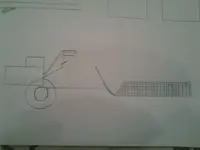
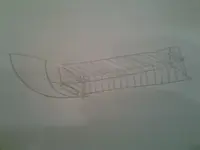
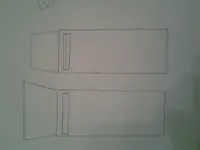
Made some quick preliminary sketches.
20161023_001600.webp20161023_001916.webp
Sketch shoes the 1cmX1cm wire mesh cage on a mud sled, with a 2 inch wide slot on the bottom going into the cage. Pulling the sled across the sand is a nice old gas powered walk behind garden tractor. Forgive the crudity of the drawings.
20161023_001610.webp
 

Users who are viewing this thread

Back
Top Bottom