What's new

Need help Identifying my Grandfather's find

TravisMag

Greenie
Joined
Sep 4, 2022
Messages
13
Reaction score
36
Golden Thread
0
Location
South East North Carolina
Hey all. You have a great forum here - not only the NA Indian Artifacts section but I have been reading posts on a few of the others as well - interesting and informative information!

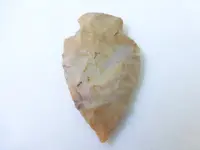
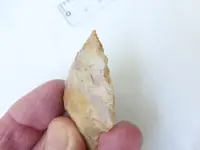
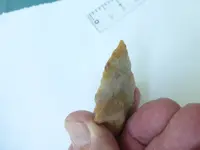
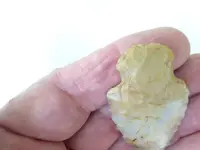
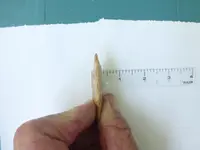
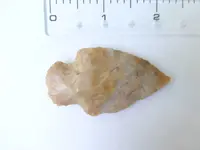
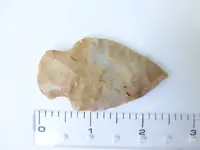
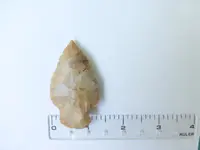
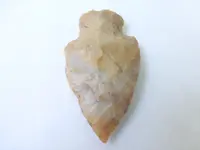
I have a point that my grandfather found when working in his upper central New York State vegetable garden back in the late 40's to early 50's. I am looking for your opinions on classification and what material it seems to be made from and the approximate age. And also what sort of weapon it would have been used on? The stone is very smooth - almost a greasy feel to it - is it flint? Again it was found about half way between Rochester and Syracuse, NY about 8 miles south of Lake Ontario.

I have had it now for many years and always figured it was some sort of Iroquois arrowhead, but after doing some research on my own, I am guessing that it may be a Brewerton side notched point from the Archaic period that was used on the end of a javelin? Any help you all can give is much appreciated. point 1.JPG
 

Attachments

  • point 2.webp
    point 2.webp
    172.3 KB · Views: 97
  • point 3.webp
    point 3.webp
    200.2 KB · Views: 84
  • point 4.webp
    point 4.webp
    194.7 KB · Views: 85
  • point 5.webp
    point 5.webp
    298.2 KB · Views: 89
  • point 6.webp
    point 6.webp
    275.8 KB · Views: 88
  • point 7.webp
    point 7.webp
    199.7 KB · Views: 89
  • point 8.webp
    point 8.webp
    227.9 KB · Views: 80
  • point 10.webp
    point 10.webp
    244 KB · Views: 87
  • point 9.webp
    point 9.webp
    186 KB · Views: 94
Upvote 16
A very nice piece. I believe it would be classified as an expanding stemmed point with a convex base. Looks like it sustained a little damage on one corner as well as the same area of the stem. I'd say that happened long ago due to the patina being the same in the break(s). Not sure whether it is a knife or a projectile but if it's determined to be a projectile and more than ~ 2000 years old (arguably), it would predate the bow & arrow. It does look like Flint Ridge Chalcedony.
 
Last edited:
Don't get stumped by " Brewerton side notched point" sort of idents... what Tdog said is much more on the money.., "expanding stemmed point with a convex base". On the left coast that would most likely be an atlatl point, like he said, pre-date bow and arrow.
 
I thought Flintridge as soon as I saw it. I'm not familiar with NY types of flint but Flintridge was traded far & wide. Nice find by your Grandfather. Atlatl dart or knife I would guess.
 
Last edited:
I want to thank everyone who has responded and answered my post. I had not even considered that the point may have been a knife and I didn't really understand that it would have naturally have had a handle- I just figured the owners would hold the bare point in their hand and use it. Then after poking around the net last night I happened across this.
09a2d7_b422d360050947d696834439d584d251~mv2.webp


It is even made of the type of flint several of you have suggested! And I am assuming the color variation is most likely due to the patina of age ?

So of course I have more questions - some maybe with no definitive answer but ......

Is there a way to tell for sure which my point was used for? as a knife or projectile point ?

What would be a good guess as to the age of the point or what time period it was likely made?

I will be passing it on to younger family when the time comes, but what would be the approximate monetary value of a point like this ?

Again thank you to everyone - its exciting to have some knowledge about something my grand dad discovered a lifetime ago.
 
Last edited by a moderator:
I thought Flintridge as soon as I saw it. I'm not familiar with NY trees of flint but Flintridge was traded far & wide. Nice find by your Grandfather. Atlatl dart or knife I would guess.
Thanks newnan man. One of my questions was how that type of Flint may have wound up in north central New York State.
 
Travismag, sorry, I had to delete your link, it leads to a website selling modern pieces which violates our rules, I copied the picture so it is still seen for the example.
 
Travismag, sorry, I had to delete your link, it leads to a website selling modern pieces which violates our rules, I copied the picture so it is still seen for the example.

Not a problem - sorry for posting a link to something prohibited I was not aware of- I wanted to post a picture of it for context and make others aware it was a modern reproduction knife of the same material.
 
Travismag, sorry, I had to delete your link, it leads to a website selling modern pieces which violates our rules, I copied the picture so it is still seen for the example.

Not a problem - sorry for posting a link to something prohibited I was not aware of- I wanted to post a picture of it for context and make others aware it was a modern reproduction knife of the same material.

Not a problem, you are a new member.... :icon_thumleft:
 
Your point looks to have been resharpened several times & was probably much larger when 1st made. I would guess knife. As far as value not too much. Much more valuable as a family keep sake.
 
The lower 1/4 - 1/3 is the typical hafting area on knives and projectiles. If a hafting area is prepared with a stem, notches, grinding (in some cases) et al, it was meant to be hafted to a handle or shaft of some sort. One can get an idea of how large this respective handle or shaft was by the size of the waist at the stem, between the notches or absence of either. Hope this helps.
 
I can’t decide if I’m seeing the start of a needle tip, might be a hint that it was hafted as a knife… if it was a dart and if it is a needle tip you would risk breaking your tip on every throw
Also again not convinced but seems like the base may have a tiny notch in the middle not much of a functional difference but would open up new type possibilities
 
The lower 1/4 - 1/3 is the typical hafting area on knives and projectiles. If a hafting area is prepared with a stem, notches, grinding (in some cases) et al, it was meant to be hafted to a handle or shaft of some sort. One can get an idea of how large this respective handle or shaft was by the size of the waist at the stem, between the notches or absence of either. Hope this helps.

I am guessing the reasoning by Newnan and yourself is the waist on this point is too large for an atlatl and that is why it was more probably either a knife or spear point ?

Also wondering how to tell that it has been resharpened ? Rough outer edge perhaps?
 
I can’t decide if I’m seeing the start of a needle tip, might be a hint that it was hafted as a knife… if it was a dart and if it is a needle tip you would risk breaking your tip on every throw
Also again not convinced but seems like the base may have a tiny notch in the middle not much of a functional difference but would open up new type possibilities

It does indeed have a tiny notch in the middle of the base which made me question whether the base was convex or concave as I was trying to decipher it myself. It appears to be flaked off but was this by accident or deliberately done?

If it is a deliberate notch what other possibilities would it open up ?
 
I am guessing the reasoning by Newnan and yourself is the waist on this point is too large for an atlatl and that is why it was more probably either a knife or spear point ?

Also wondering how to tell that it has been resharpened ? Rough outer edge perhaps?
First of all, the terms Spear and Dart mean the same thing. An atlatl is nothing more than a "throwing stick". It serves as an extension of the arm which provides more velocity for the spear/dart that is being thrown. Spears and knives tend to have larger diameter shafts and handles than arrow shafts which is more pencil sized. Spears can also be hafted to a foreshaft that can double as a knife. Knives are mostly medium to large in size. Think of modern day knives and how large the handle vs blade diameter is. Many times they are asymmetrical due to wear and subsequent resharpenings on the most used edge but not always. They also exhibit a change or lack of patina on the resharpened edge(s) and may exhibit a noticeably different flaking pattern. The notch looks unintentional to me. Look at pics 2/10 and 6/10. There is a big chunk of material missing and looks very thin there compared to the rest of the flaking at the base. Also, it has more noticeable damage in that area although slight.
 
Last edited:
Hey TravisMag:
If I had to describe my home turf, it would be just what you said about the location of your grandfather's find: half way between Syracuse and Rochester, 8 miles south of Lake Ontario! I'm on my way to check MY vegetable garden for artifacts right now! :)
 

Users who are viewing this thread

Back
Top Bottom