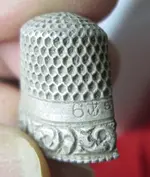
In this case I'm not sure it does mean Birmingham, because if it has an assayer mark, it would have the purity mark as well. ie. its been assayed. Plus the anchor is not stamped.
The '6' is the size, the Anchor I'm guessing is just a quality mark.
What's after the 'S'? Standard?
Worthing looking into. I don't know much about thimble makers, but I do know lots of companies used the anchor symbol because of it meaning. ie. its a quality piece because anchor means 'to hold fast', 'security & stability' etc..
I think the S is the first letter in the word Sterling, we just can't see the rest of it. I may be wrong though. Here is what I found regarding Stern Bros.-
In 1868, the firm of Stern Brothers was established in Philadelphia. Within a few years, the company expanded and relocated to New York City and entered the diamond and jewellery manufacturing business. From 1890, Stern Brothers used a "fouled anchor" (an anchor entwined with a rope) as their thimble trademark. From the period 1908-1912, the company sometimes used an "S" as its trademark with a "B" in the upper curve and a "C" in the lower curve of the "S". From 1913, the company used a squared "G" with an "S" and a "C" inside after August Goldsmith became a partner. The company shut down and ceased operations in 1933 following the stock market crash of 1929.
In this case I'm not sure it does mean Birmingham, because if it has an assayer mark, it would have the purity mark as well. ie. its been assayed. Plus the anchor is not stamped.
The '6' is the size, the Anchor I'm guessing is just a quality mark.
What's after the 'S'? Standard?
In this case I'm not sure it does mean Birmingham, because if it has an assayer mark, it would have the purity mark as well. ie. its been assayed. Plus the anchor is not stamped.
The '6' is the size, the Anchor I'm guessing is just a quality mark.
What's after the 'S'? Standard?
I think the S is the first letter in the word Sterling, we just can't see the rest of it. I may be wrong though. Here is what I found regarding Stern Bros.-
In 1868, the firm of Stern Brothers was established in Philadelphia. Within a few years, the company expanded and relocated to New York City and entered the diamond and jewellery manufacturing business. From 1890, Stern Brothers used a "fouled anchor" (an anchor entwined with a rope) as their thimble trademark. From the period 1908-1912, the company sometimes used an "S" as its trademark with a "B" in the upper curve and a "C" in the lower curve of the "S". From 1913, the company used a squared "G" with an "S" and a "C" inside after August Goldsmith became a partner. The company shut down and ceased operations in 1933 following the stock market crash of 1929.