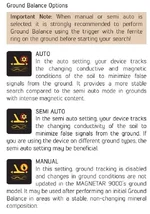
So far, I prefer to use the Magnetar 9000 with semi auto ground balance. I like to have a level of control over ground balance especially at sites with extreme magnetite mineralization.
I have not used the Magnetar 9000 in an area with iron sulfides that are detectable so I cannot comment on that scenario.
I have only used the Magnetar 9000 in areas with lots of iron oxide magnetite and hematite that are scattered throughout the dirt from microscopic to golf ball sized and also embedded in host igneous and metamorphic rock from near the earth's mantle.
I have attached a link to a very short write-up and video showing a hot rock detection comparison between the Minelab Goldmonster 2000 and the Magnetar 9000 at a high altitude site with ground conditions like I described above. The hot rocks detected by both detectors contain magnetite and hematite and the ground itself that is detected in the video is peppered with magnetite particles and pebbles.
I made this video before the latest Magnetar software update which improved ground handling and sensitivity.
Unfortunately, I have been too busy with other stuff along with the weather not cooperating here in my area of Colorado and also in Arizona, so I have not used the Magnetar 9000 with the new software update in the field yet.
The GM 2000 detected a very small non ferrous target during the video that was not a hot rock and I point that out in the video. The Magnetar was also able to faintly detect that target. I did not try to alter the settings on the Magnetar in order to hit that target better during the video. It has the classic Minelab GPZ 7000 faint warble indicating a smaller of difficult to hit target.
The target turned out to be a 0.08 gram (1.2 grain) fragment of lead at 2" depth.