What's new

Old Iron Spike Lever Thing

Bramblefind

Silver Member
Joined
Nov 26, 2009
Messages
2,966
Reaction score
4,024
Golden Thread
0
Location
New York
Detector(s) used
T2/F75 SE
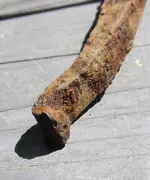
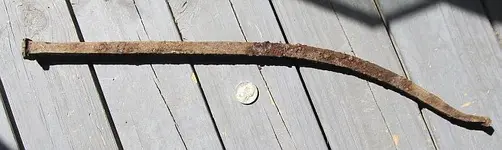
Is that the right ID for this? :D I found it this morning at a beautiful cellar hole deep in the woods - unfortunately I think it has been hunted over quite a bit so I am left with the iron. But this is pretty cool. About 17 inches long. That is a nickel coin in the pic.
 

Attachments

  • IMG_3133.webp
    IMG_3133.webp
    30.2 KB · Views: 841
  • IMG_3134.webp
    IMG_3134.webp
    22.7 KB · Views: 1,262
  • IMG_3135.webp
    IMG_3135.webp
    56.5 KB · Views: 456
Bramble, do you think it was bent like this originally or do you think it was straight? I have no idea, but it looks like it was hand wrought. Interesting, Breezie
 
Upvote 0
Thanks Breezie ;D I originally thought it was bent but now I'm leaning toward made that way. I really don't know though.
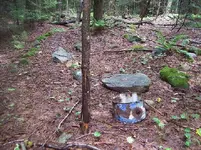

Such a pretty place I found it at!
 

Attachments

  • 102_0143.webp
    102_0143.webp
    150.9 KB · Views: 513
  • 102_0145.webp
    102_0145.webp
    120.8 KB · Views: 459
Upvote 0
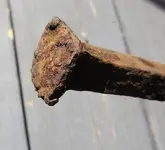
The square head reminds me of a book telling the evolution of nails. "A Reverence For Wood" By Eric Sloane

The first nails didn't have heads until they were hammered for the first time. The first pounding gave them a little flattened ridge. The second generation of nails I believe had the square head.

This spike being long, could have been used to hold a tent down. It could also have been bent trying to pry or lift rocks by standing and jumping on. Seeing the tip has it's own bends I would think it was wedged into a box to pry it open and as more of it got into the box the leverage spot moved. That part is all wishful speculation as I've been reading about treasure chests all morning.
 
Upvote 0
:hello:

Looks like it's been hit with a hammer, so I doubt it was made that way, I wonder if it was some type of log splitter :dontknow:

SS
 
Upvote 0
M_M said:
The square head reminds me of a book telling the evolution of nails. "A Reverence For Wood" By Eric Sloane

The first nails didn't have heads until they were hammered for the first time. The first pounding gave them a little flattened ridge. The second generation of nails I believe had the square head.

This spike being long, could have been used to hold a tent down. It could also have been bent trying to pry or lift rocks by standing and jumping on. Seeing the tip has it's own bends I would think it was wedged into a box to pry it open and as more of it got into the box the leverage spot moved. That part is all wishful speculation as I've been reading about treasure chests all morning.

Thank you! :D I like the reference - I actually skimmed the Slone "Musuem of Early American Tools" book before I posted!

stefen said:
Could be a lightning rod :coffee2:

Very interesting idea! :)

Silver Searcher said:
:hello:

Looks like it's been hit with a hammer, so I doubt it was made that way, I wonder if it was some type of log splitter :dontknow:

SS

I think I've been out in the woods too long today b/c it took me a while to process what you are saying but I think you might be right .. or on the right track :icon_thumleft:

Lots of logging was done in this area.

The head of the spike is about 1/2" on each side so it is not the heftiest thing though... probably not a surprise it buckled.
 
Upvote 0
If some of the logger relic hunters don't chime in, you can repost to the relic forum - there's guys that drag huge logging chains out of the woods that post there.

I especially like your attitude - "I found it this morning at a beautiful cellar hole deep in the woods - unfortunately I think it has been hunted over quite a bit so I am left with the iron. But this is pretty cool."
 
Upvote 0
It looks like a 16th century beam spike. We stopped at an old church in England where they were taking the roof off down to the top of the walls. After talking with the workers, and being invited up on the scaffolding, he reaches over, pulls a spike out of the beam (yes, the oak was that rotten) and gave it to me. Still treasure it. The last roof and beams had been put on in 1560.
 
Upvote 0
It may be a cribbing spike used to join timber to timber. Most of the ones i find are 12" to 14". The longest I found were 22" and these were along an old logging rr grade that had to cross a wet area on a hillside, probably tied together thicker timber. Quite a few are bent as are rr spikes that are removed when rails are taken out.
 
Upvote 0
Thank you! And thanks to everyone who replied. It is a neat thing that I will clean up and add to my good iron collection. :wink:

The old map shows that a saw mill was right across the road :icon_thumleft: That is my next adventure.
 
Upvote 0

Users who are viewing this thread

Back
Top Bottom