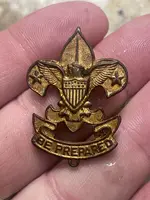
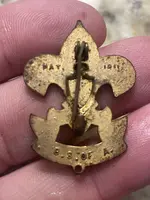
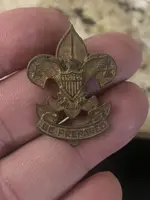
Congratulations on some interesting finds. The Boy Scout item is a mother’s pin for the First Class rank in scouting. They were given to the moms when a boy earned his rank and he got the cloth patch for his uniform. A lot of units stopped given them out years ago and some boys buy them and use them as hat pins or put them on their merit badge sash (they are not supposed to go on the sash, but they do it anyway).Visiting Destin Florida and pulled this nice Boy Scout piece from an empty field, also a buffalo 🦬 Nickel, a Mercury Dime and 5 wheats.
Any information about that Boy Scouts badge would be greatly appreciated.
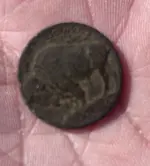
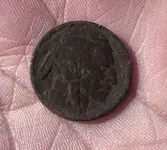
Nice finds ! Your buffalo nickel is interesting. I can't see the date on the front but on the back it looks like there is a mint mark. Also, it looks like it may be the buffalo (bison) is standing on a "raised ground" which would make it a 1913. Closer examination would help with the ID on the date. If it is a "raised ground" it can ONLY be a 1913.Visiting Destin Florida and pulled this nice Boy Scout piece from an empty field, also a buffalo 🦬 Nickel, a Mercury Dime and 5 wheats.
Any information about that Boy Scouts badge would be greatly appreciated.
Buffalo is too far gone to read the date 🤷🏼♂️ sorry 😞Nice finds ! Your buffalo nickel is interesting. I can't see the date on the front but on the back it looks like there is a mint mark. Also, it looks like it may be the buffalo (bison) is standing on a "raised ground" which would make it a 1913. Closer examination would help with the ID on the date. If it is a "raised ground" it can ONLY be a 1913.
Yes the 1913 V nickel is one of the rarest of U.S. coins. Only 5 are known to exist. The 1913 Buffalo nickel was a transitional coin that had mintages in the millions, but there were 2 types. The raised mound type was changed to a flat ground type mid-issue because of wearing issues, thus, the only Buffalo nickel with the raised mound was the 1913. That's why I said that if you can identify the raised mound on the reverse side (which yours kind of looks like) you could prove that it is a 1913 even if the front of the coin's date is unreadable. The following link from PCGS explains the mound change.Buffalo is too far gone to read the date 🤷🏼♂️ sorry 😞

Also I don’t know anything about a “hilly” buffalo 🦬… never heard that before… I thought the 1913 didn’t exist… but now that I think about it… that’s the 1913 V Nickel… am I right?
Any information about that Boy Scouts badge would be greatly appreciated.
The Boy Scout item is a mother’s pin for the First Class rank in scouting. They were given to the moms when a boy earned his rank and he got the cloth patch for his uniform. A lot of units stopped given them out years ago and some boys buy them and use them as hat pins or put them on their merit badge sash (they are not supposed to go on the sash, but they do it anyway).
Thank you 😊Boy Scouts of America was founded on 8 February 1910, and your badge is from their early history.
According to the Virtual Scout Museum, upon induction, scouts would be given a metal ‘Tenderfoot’ badge to be worn on the breast pocket and, from 1911 onwards, ‘Second Class’ and then ‘First Class’ metal badges were awarded to mark achievement. Your is ‘First Class’ and intended to be worn on the left sleeve between the wrist and elbow.
To progress to second and first classes, a scout needed to pass a number of tests, and was not allowed to earn ‘merit’ badges until he achieved ‘First Class’ status.
These pins were manufactured by T.H. Foley of 1 Madison Avenue, NY until around 1915 and by an unknown manufacturer thereafter. Although the 1911 patent was valid for 14 years, and the badges still in production until the early 1920s, around 1913 they began to be replaced by sew-on fabric patches worn in the same position. Photographic evidence suggests that many Boy Scouts actually wore the metal pins as hat badges and continued to do so after cloth patches were issued.
As always great information. Your information goes back further than mine and the pin in the post may well be one of the older ones. When I was a scout and in my early leadership in scouting we did give them as mother’s pins. I do find the different rank pins regularly in a camp that did not open until 1981. I do believe they may still be available for sale in some scout supply stores.Boy Scouts of America was founded on 8 February 1910, and your badge is from their early history.
According to the Virtual Scout Museum, upon induction, scouts would be given a metal ‘Tenderfoot’ badge to be worn on the breast pocket and, from 1911 onwards, ‘Second Class’ and then ‘First Class’ metal badges were awarded to mark achievement. Your is ‘First Class’ and intended to be worn on the left sleeve between the wrist and elbow.
To progress to second and first classes, a scout needed to pass a number of tests, and was not allowed to earn ‘merit’ badges until he achieved ‘First Class’ status.
These pins were manufactured by T.H. Foley of 1 Madison Avenue, NY until around 1915 and by an unknown manufacturer thereafter. Although the 1911 patent was valid for 14 years, and the badges still in production until the early 1920s, around 1913 they began to be replaced by sew-on fabric patches worn in the same position. Photographic evidence suggests that many Boy Scouts actually wore the metal pins as hat badges and continued to do so after cloth patches were issued.