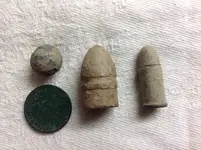
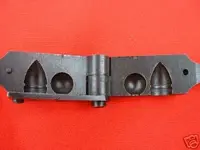
VaNana, thank you for providing the bullet measurements in 1/100ths-inch... which prove the bullet identifications I gave you are correct. I can now tell you with certainty that the ball is an unfired one from a civil war era Colt .44 Revolver bulletmold. That type of bulletmold made a "conical" bullet and a roundball. See the photo below.
Civil war era bullets for revolvers were slightly larger than the gun's caliber (in this case, .44-inch), because a revolver bullet entered the back end of the gunbarrel, instead of its front end (which is called "muzzle-loading). If the lead ball (or bullet) was for a muzzleloading gun, it would be slightly smaller than the gun's caliber.
Your unfired Confederate "Richmond Laboratory" bullet was made for use in a Sharps Rifle/Carbine. Bullets for that gun were loaded into the back end of the gunbarrel, so unfired ones are slightly larger than its .52"-diameter bore.
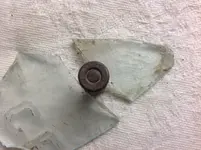
Your bullet-cartridge's .949-inch length and diameter of .342-inch proves it is for a .32-caliber pistol. Because its powder-casing has the "primer" in the center of the base (called a centerfire primer), it is definitely from sometime after the end of the civil war. If you can clean the cartridge's flat bottom enough to tell us exactly what the lettering on it says, we'll be able to give you a specific time-period for it.