[America’s introduction to the lucrative Pacific Northwest Coast fur trade occurred on August 10, 1788, when the sloop
Lady Washington, under Captain
Robert Gray, traded with local people for sea otter skins just north of Yaquina Bay. Four days later, Gray and his eleven-man crew entered
Tillamook Bay flying the American flag, the first recorded American landing on the coast. The
Columbia Rediviva under Captain John Kendrick carried the furs to Macao and Canton as part of the China trade.
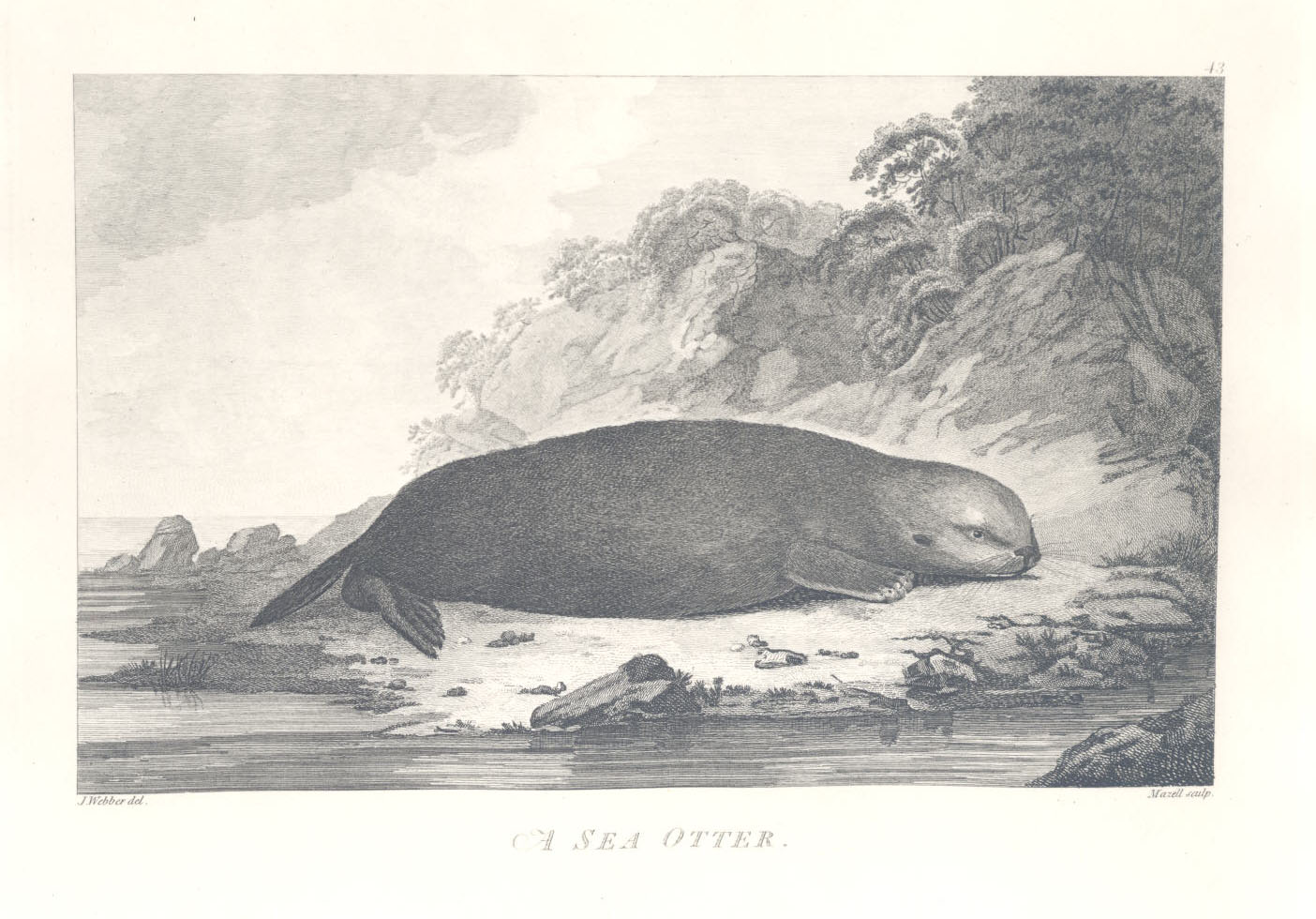
Sea otters (
Enhydra lutris), the largest of the otter species, are adapted to forage, play, sleep, and give birth in a marine setting without being on land. Where other marine mammals have insulating layers of blubber, the sea otter’s insulation and buoyancy depend on water-resistant, ultra fine, lustrous, dark underfur with long white-tipped guard hairs that give it a frosted appearance. The animals rub and pat their fur meticulously to cleanse it, blowing into and aerating it with a churning paw motion. Trapped air bubbles help provide vital insulation. They originally ranged around the North Pacific coast, from the Kuril Islands north of Japan to the west coast of Baja.
With a lifespan of from fifteen to twenty years, sea otters forage inshore waters that are dominated by the giant kelp that clings tenaciously to the sea floor. Kelp strands reach as far as 200 feet upward to the sea surface to provide a forest-like cover for sea otters and their prey. Sea otters daily consume a quarter of their body weight. Their diet includes crabs, clams, abalone, mussels, sea urchins, octopuses, and bottom fish such as lingcod. The single sea otter cub can be born at any time of the year, and almost all births take place at sea. The mother embraces and grooms her cub attentively for the year it is dependent on her.
The smallest of marine mammals—males average sixty-eight pounds and females forty-eight pounds—sea otters at one time had the world’s most valuable pelt. Eighteenth-century Russian traders, who called otter pelts “soft gold,” worked from outposts in Alaska. They pressed Aleut men who owned lath-frame and sealskin-covered kayaks into service beginning in the 1760s, creating a highly lucrative and exclusive trade with China. In time, Russian ships with Aleut hunters ranged the length of the West Coast. British, French, Portuguese, and American ships joined the trade when Captain James Cook's third expedition made it known that there was money to be made in trade with Natives for sea otter pelts, their sale to China, and a return home with silk, tea, fine chinaware, porcelain, and exotic woods.
Sea otter furs, worn as robes or blankets, served as a medium of exchange and status for Native people. At the time when Captain Gray sailed over the
Columbia River bar to trade with the Chinook people, for example, one pelt was worth five iron chisels, and four pelts were traded for one sheet of copper or for a quantity of beads, preferably blue.
By 1790, an estimated 250,000 sea otter pelts worth $50 million had been taken from coastal waters; and by 1867, when Russia sold Alaska to the United States, otters were near extinction. By 1911, both sea otters and northern fur seals were given protection under an international treaty signed by Great Britain (for Canada), Russia, Japan, and the United States. The Aleutian Islands were declared a National Wildlife refuge in 1913, and the Marine Mammal Protection Act of 1972 reinforced their protection in U.S. waters.]
America’s introduction to the lucrative Pacific Northwest Coast fur trade occurred on August 10, 1788, when the sloop Lady Washington, under Captain Robert Gra…

www.oregonencyclopedia.org