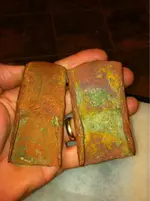
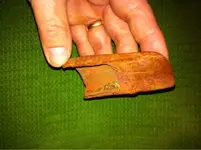
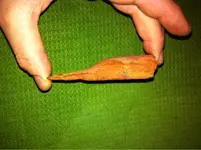
Thought I'd share this. Found these together several years ago. They are coper with a brown patina I believe because they spent much time in water. One still has a nice cutting edge. The other seems to maybe have been for rough work. They weigh 138 and 176 grams and are both about 3.5 inches long.
A few people say Archaic. Some believe they could be Woodland. They really are in remarkable condition. At the end of the week I plan on traveling to a friend's home down south near the Wisconsin border. He is an authority on such items and I will get a detailed description along with his professional opinion. So over the weekend I will be happy to add some detailed info on the spuds.
Bob was once the curator at the Oshkosh museum. He examined the spuds and said without doubt they are Old Copper Culture tools. Age....10000 to 2000 years old. He loved the spuds.
Copper,
Great finds. As per identification of the relics, did the expert call them "spuds"? I would call them call "socketed adzes", but I am not extremely well versed in Old Copper Culture.
You had me baffled for a moment as I did not recall him correcting me. Nor do I recall him referring to them as anything other than "socketed spud". So when I read your post I sat there scratching my head and wondering. With that I dug around and found my fiends phone number and got him on the phone. Back in the day according to him the accepted terminology used by collectors and etc was "spuds". That's not to say that the terminology may differ now and it may differ depending on location. You have to realize though he began work as an archaeologist back in the 1950s. He's sharp as a tack but getting up there in age. In other news "socketed adze" is also an accepted term for these relics.
Copper,
Thanks for looking into this. That explains it. I found one years ago in Ohio, and I ended up donating it to a small historical society near the site I found it on. They gave me a copy of the notes from the Arch at the Cincinnati Museum Center who looked at it for them. On those notes, they called it a socketed adze, and that term stuck with me since.