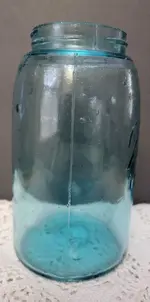
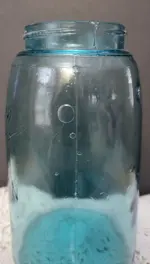
Hello SandogInteresting. Are those air bubbles in the glass?
Hello SandogGreat. Don't air bubbles like that in glass indicate that it is relatively old?
Hello SandogHello Sandog
Robot, another member, summed it up well, too, in regards to the seeds.
Before getting back to you, I went on the hunt and found some more information to add to Robots comment.
Seed bubbles are formed because of incomplete glass ingredient melting. The alkali used to desolve the silica in the melting process forms small gas bubbles. These bubbles slowly rise to the surface and pop and usually become suspended in the molten glass if they aren't removed. They can be removed from the molten glass by reducing the temperature in the furnace and then raising it again. This causes the bubbles to condense and form larger bubbles that rise to the surface and burst faster.
Which goes back to your question about if jars with air bubbles indicate it being older, I say read yes. You won’t see those in newer jars/bottles.
Wow! this is what makes doing this so interesting and how we get more knowledgeable about what we find and / or collect. Very cool!
Thank you for that question.
Jim
Hello Robot
That happens to be a good guess and kinda makes sense.My best guesses on the original question: 1. jar was somehow twisted in the mold at the neck. 2. the top with threads and the main body were made separately and then joined somehow.
Obviously I know nothing about glass jar manufacturing, so I can make up anything I want, LOL.
Hello FreeBirdTimThis webpage explains why mold seams don't always line up:
https://sha.org/bottle/machinemadedating.htm
Here's the paragraph that deals with that issue:
1. Vertical side mold seams which usually (see the Note box below point #3 for an exception) run up to the highest point of the finish and often onto the extreme top finish surface (i.e., onto the rim or lip). On many early (very early 1900s into the 1920s) and occasional later (1930s and later) machine-made bottles the vertical body/neck and finish mold seams are discontinuous and offset from each other; click offset seams for a picture of this attribute. These vertical seams - finish mold seams vis-à-vis the upper neck mold seams - may range from just slightly offset to 90 degrees offset (like shown at the linked image above). The offset is a function of the orientation of the parison relative to the two molds (parison and blow molds) used on the particular machine, or occasionally, to the hot parison "sticking" to the neck ring of the parison/blank mold when transferring to the blow mold (Ceramic Industry 1949:14-15). There are also no horizontal tooling marks present on the finish and/or upper neck as would be observable on the finish of mouth-blown bottles.