Don, we might as well attack this thing, because it's sure not going away. I'll post some things about it that I see, and maybe others can debate those points or agree, so at least we can have some new starting place to begin figurig it out.
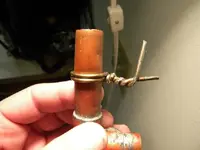
1) These objects were found in one fairly local area. (indicating possibly one maker, or local custom, and perhaps also suggesting this was a unique invention)
2) These objects are homemade. (again suggesting a possibly unique local invention)
3) The patina and age of site suggest late 1700's -early 1800's but date is unknown.
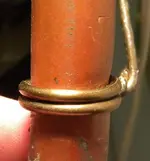
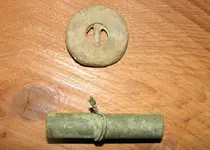
4) The brass wire wrappings seem to have a fairly long straight twist (possibly indicating that as well as securing the wire, they may have gone through wood with ends crimped over to secure)
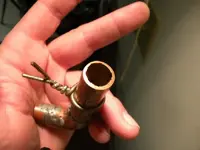
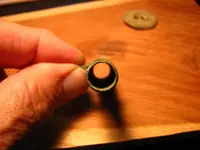
5) The tubes are double wrapped with at least one scored (probably to prevent tube from riding out of the loop)
6) Tubes act as a sleeve to guide the weight.
7) The tubes were attached at their center point. (this is curious, as it might require these to be attached within a corner or a groove (in wood?) to prevent pivoting.)
8) lead weight is secured by steel wire (making it seem unlikely that these were designed to be used under water for any length of time)
**9) Possibly a direct weight to something above, or a counterweight attached directly to a lever above. (steel wire wouldn't allow for any bends or pulleys as the weight is too light)
**10) What ever this was, its use seems to have been short lived. (possibly indicating it was follwed soon by a better design)
Does that all sound about right?
Don , we talked privately about the "perfect mousetrap" of which there were many kinds made during colonial times, and with many live traps made of wood. Unfortunately we can't resurrect Rube Goldberg, as he could tell us exactly what this was used for.


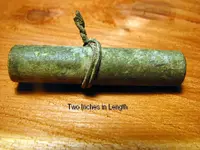


 Since I am not 100% sure where all were found but 100% certain one was found in association with a homestead that housed the owner of a well known Iron forge from approx 1815-1830. But, the site was occupied prior to that, since it was a Saw mill site from the 1700s. After the iron forge closed down, I think the area slowly went from a tiny community (a few worker houses, Tavern, plus the mansion the owner lived in) to a total ghost town mid 1800s.