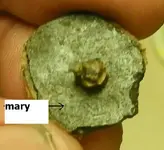
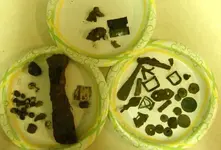
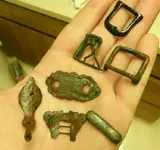
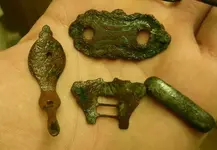
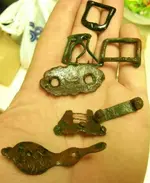
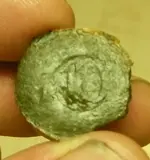
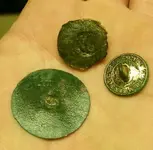
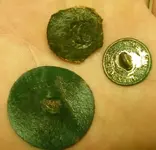
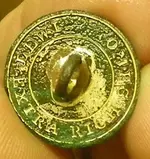
If it is from the 10th that button has quite a story to tell. Looks like that bunch were plucked right out of the movie "Stripes"

~ "The Continental Army" by Robert K. Wright, Jr., published by the Center of Military History, United States Army, Washington DC, 1983. (The book is part of the Army Lineage Series).
SHEPPARD'S ADDITIONAL CONTINENTAL REGIIMENT (10th North Carolina Regiment) p. 303: Authorized 17 April 1777 in the North Carolina State Troops as Sheppard's Regiment.
Organized 19 April- I July 1777 at KINSTON to consist of eight companies from the northeastern part of the state. Adopted 17 June 1777 into the Continental Army as Sheppard's Additional Continental Regiment and assigned to the Main Army. Disbanded I June 1778 at Valley Forge, Pennsylvania.
Engagements: Philadelphia-Monmouth.
This is the story. Abraham Sheppard commanded a battalion in South Carolina. There was just one problem: he hated South Carolina. He hated the climate, he hated the mosquitos, he hated the people. There was not one good thing he could say about the state. So he started pleading with the North Carolina Legislature to please, please, please get him out of that state. He wanted to create another North Carolina regiment. At first, the Legislature said no. North Carolina already had 9 regiments; the state didn't need any more. Sheppard continued pleading, and then his pleading turned to promising. If North Carolina would let him create a tenth Regiment, he would recruit 300 men, march them North and help Washington pound the British. If the legislature would let him do that, the war would be over much sooner. That sounded like an excellent proposition to the North Carolina Legislature. Could he really recruit 300 men? Yes, he could, he told them; just please get him out of SC and give him a chance! So they did. The 10th North Carolina Regiment was authorized 17 April 1777 and organized 19 April-1 July 1777. Sheppard put out handbills all over the northeastern part of the state, promising a great bonus to any man who would enlist.The majority of respondents were sick, tattered, backcountry men. Sheppard should have known that to march these men anywhere would be asking them to commit suicide. However, he was free of South Carolina. He was back in civilization. So he reported that he had his men. Good, said Washington. Go to Richmond, Virginia and await further orders. In June 1777, Sheppard marched his men into Virginia, but stopped only a few miles from Halifax, where he parked his men. Then he returned to his home in Dobbs County, North Carolina--and the IOth did not advance. Washington became quite irritated when he did not see those 300 men of the 10th anywhere in sight. When Sheppard was discovered enjoying homelife in Dobbs County, he was ordered to immediately rejoin his men and march them on to Maryland--no ifs, ands, or buts. This was a war--not a Sunday picnic. Reluctantly, Sheppard joined his men, and they began the long march forward. Several problems immediately arose, however:
1. His men didn't have any shoes.
2. HIS men didn't have any breeches.
3. His men didn't have any food.
4. And the bonuses promised the men for joining the Army were put on hold. They weren't going to get the money until after they had fulfilled their mission of combat. All of these problems, plus the rotten weather, made the men of the IOth rather grumpy. The lack of clothing and food made them rather ill. Many of them came down with various ailments and many of them died while enroute. One reason for the slowness of the march was because the IOth had to stop every few miles to bury someone. Desertions were out of sight. By the time they reached Maryland, the desertion rate was one man for every mile. Washington really became angry when he discovered that those promised 300 men had not yet reached Valley Forge. Where were they, any way? Winter was setting in; he was planning a huge campaign in a few months. He needed those men! They were so slow in arriving at Valley Forge that he finally sent out an officer to hurry them on in. Sheppard's Additional Continental Regiment (the 10th North Carolina) did not arrive at Valley Forge until February! When they finally scraggled in, only a few of them remained. They were so late in arriving, they missed the smallpox innoculation. And so few of them remained, that Washington disbanded the 10th altogether. The survivors were disbursed among the other existing units, primarily the Ist North Carolina and the 2d North Carolina.
Rankin said the main problem with the 10th North Carolina Regiment was its inept leader, Abraham Sheppard. "While he was enthusiastic, he was a BIG PROCRASTINATOR. His records were so dishelved that no one could really tell who was assigned to his unit. His brother, Benjamin Sheppard, handled the money for the unit, and a lot of graph was going on at the top--something many of the enlistees paid for dearly with their lives. It wasn't that the IOth did not receive shoes or breeches or food. The 10th received more than the other 9. The graft at the top quickly consumed what the unit was actually given.


 000_0009.webp30.2 KB · Views: 1,803
 000_0010.webp41 KB · Views: 1,796
 000_0011.webp33.4 KB · Views: 1,801
 000_0012.webp46.7 KB · Views: 1,787
 000_0018.webp28.3 KB · Views: 1,769
 000_0017.webp57.6 KB · Views: 1,772
 000_0016.webp41.7 KB · Views: 1,773
 000_0015.webp44.3 KB · Views: 1,792
 000_0019.webp49.8 KB · Views: 1,763

 Unbelievable, Pete, unbelievable!!
 Makes it even more enjoyable!




 Roughly!