What's new

Some type of hammer? How old is it?

Lowryevans

Jr. Member
Joined
Jan 17, 2013
Messages
88
Reaction score
94
Golden Thread
0
Primary Interest:
All Treasure Hunting
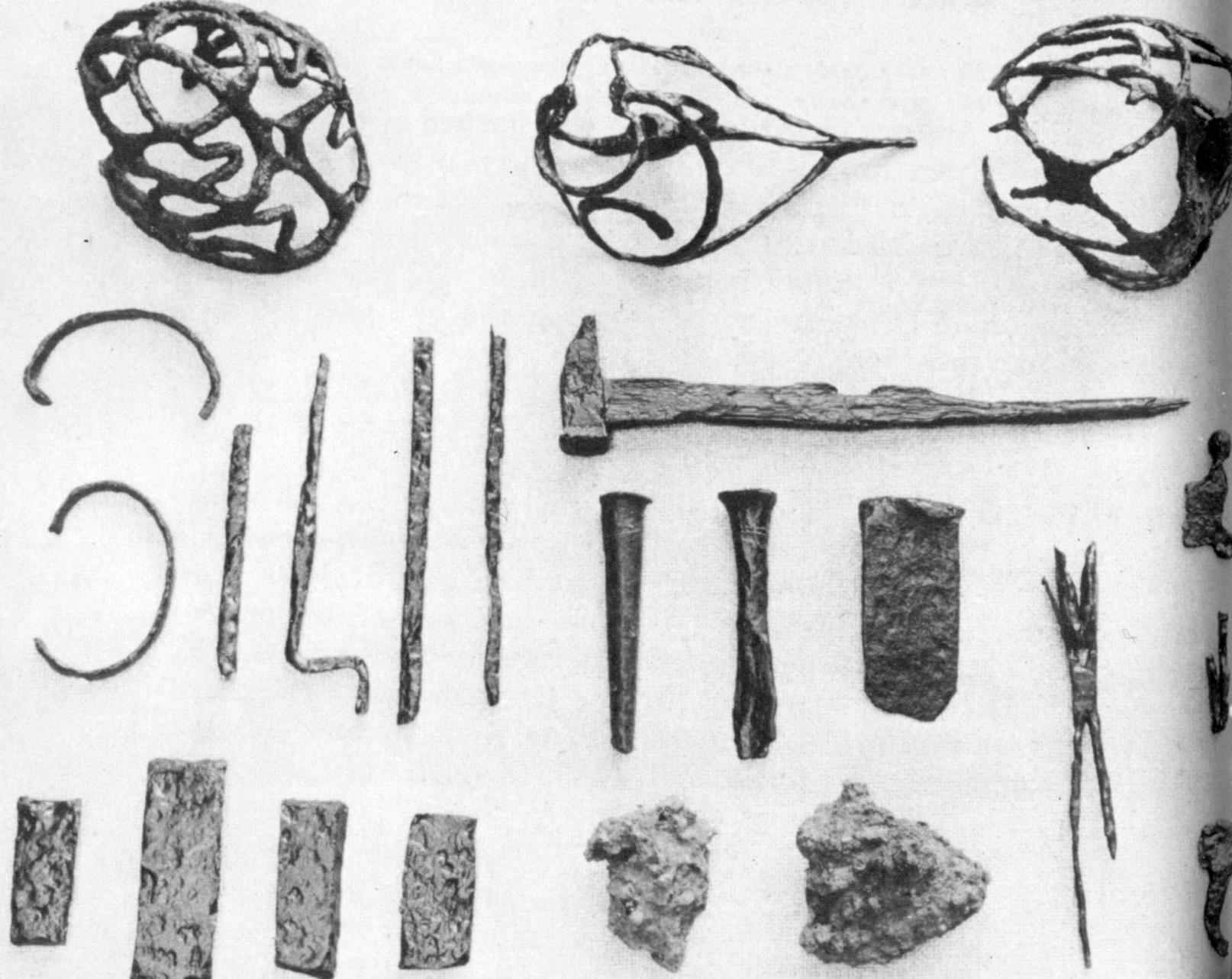
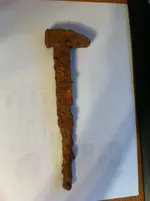
I found this iron relic, that looks like a small hammer with what appears to be a notch cut out of the handle part of it. I found it in an area that dates back to the Colonial Era. I've searched the Internet, and the only one I've found that looks like it is one that was dug from Jamestown VA., site of the 1st Engish Settlement in America. I guess my question is:
What type of tool is it, and how old is it?
If anyone can give me any help, I would appreciate it.
 

Attachments

  • image-2861407830.webp
    image-2861407830.webp
    19.4 KB · Views: 157
well...Edward Abby picked me up hitchhiking back in 1976...going from tempe to Tucson... intelligent person...we had a great talk...about the desert, industrialized tourism...ect..

thanks for the flashback...
 
Upvote 0
Thank you surf- some day I'll figure out how to post things. lol FeS2 according to the link that surf put up for me, the 'coach wrench' was patnd. 1841 and sold in the U.S. as a monkey wrench.

HH yelnif
That means that the pic of the Jamestown finds was either--

1. not in fact a pic of colonial era relics found at Jamestown, or

2. part of a monkey wrench from 200 years later contaminated the site, or

3. that was in fact a hammer and not part of a monkey wrench.

Regardless of size of the tool, looking at the pic, the shaft sure looks squared off as though it was part of a monkey wrench. No need to square off the shaft of a hammer. AND, why waste metal to forge a hammerhead and shaft all together? Weren't all hammers hafted in wood?

I have my grandpa's monkey wrench btw. Probably dates from the late 1800s (he was born about 1885). Have used it sometimes because the jaws open wider than a crescent's.
 
Upvote 0
Good Call Ivan!! But just remember everyone is born right handed!! Fortunately at about 6 months of age some of us grow out of the affiliction and are normal the rest of our lives!! He He!! GOOD HUNTING!! VERDE!!
 
Upvote 0
Upvote 0
Neat Post Surf!! Very interesting!! WOW!! GOOD HUNTING!! VERDE!!
 
Upvote 0
That means that the pic of the Jamestown finds was either--

1. not in fact a pic of colonial era relics found at Jamestown, or

2. part of a monkey wrench from 200 years later contaminated the site, or

3. that was in fact a hammer and not part of a monkey wrench.

Regardless of size of the tool, looking at the pic, the shaft sure looks squared off as though it was part of a monkey wrench. No need to square off the shaft of a hammer. AND, why waste metal to forge a hammerhead and shaft all together? Weren't all hammers hafted in wood?

I have my grandpa's monkey wrench btw. Probably dates from the late 1800s (he was born about 1885). Have used it sometimes because the jaws open wider than a crescent's.

I vote for no - 2. part of a monkey wrench from 200 years later contaminated the site - This type of wrench made it's debut in 1840 and was patented in 1841 .. The Jamestown excavation wasn't even done until 1957 .. so there is a window of opportunity spanning 116 years for the contamination to have occurred, which no doubt it did.
 
Upvote 0
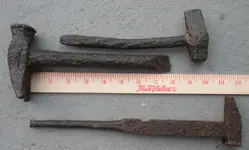
A couple of iron hammers and... The two hammers at the top of the picture are from a French & Indian War military outpost site in PA. The other "hammer" is from a Civil War site near The Plains,hammer001.webp VA. Numerous bullets, buttons, axe heads, pocket knives and other CW related items were found in the immediate vicinity.
 
Upvote 0
According to Wikipedia; "The monkey wrench (US) or gas grips (UK) is an adjustable wrench, a later American development of eighteenth-century English coach wrenches...Adjustable coach wrenches for the odd-sized nuts of wagon wheels were manufactured in England and exported to North America in the late eighteenth and early nineteenth centuries", Therefore It was in use in the 1700's and " They were set either by sliding a wedge, or later by twisting the handle, which turned a screw, narrowing or widening the jaws." "In 1840, Worcester, Massachusetts knife manufacturer Loring Coes invented a screw-based coach wrench design in which the jaw width was set with a spinning ring fixed under the sliding lower jaw, above the handle. This was patented in 1841 and the tools were advertised and sold in the United States as monkey wrenches, a term which was already in use for the English handle-set coach wrenches."
Since the example 'monkey wrenchs' depicted have the notch in the frame for the screw-based design, then it is improbable that they are period to the 1600's but were left/ discarded roughly 200 yrs. later.

HH yelnif
 
Upvote 0
A couple of iron hammers and... The two hammers at the top of the picture are from a French & Indian War military outpost site in PA. The other "hammer" is from a Civil War site near The Plains,View attachment 841160 VA. Numerous bullets, buttons, axe heads, pocket knives and other CW related items were found in the immediate vicinity.
Hate to tell ya but your hammer on the bottom is not either a hammer...its part of a wrench as well....guaranteed
 
Upvote 0
I think it 1840 to civil war eraish "coach wrench / adjustable wrench" that broke and might have been "repurposed" as a backsmith shoeing hammer (farriers tool) but that's just my thoughts on the matter --the indent along the side of the handle makes it clear to me that at one time it was an adjustable wrench of some sorts - so it basically can not pre date 1840 * when they were Invented.
 
Upvote 0
Hey yelnif,

Copy the link that you wanna post & paste it in the spot you want, highlight the pasted url & hit that blue globe looking icon in the tool bar, paste the url in the little box that appears, hit the OK button, and you should be good. I hope. Happy linking...

Monkeywrench Creek - Oklahoma - Map and Area Photos


Thanks surf for the 'linking 101'. I just replied to this thread using your advice and it worked- cool. Just in case you haven't figured it out yet I'm new to the computer era and come here with over 60 yrs. experience- life. My better half often tells me that I was born 150 yrs. to late as when I went to grade school we used a slate and piece of chalk- who would have thought it would have come to this now. lmao
again thanks. HH yelnif
 
Upvote 0
Kuger, thanks for relaying that to me. As you can see in my quote, I stated 2 hammers and .... and put "hammer" in quotes for the 3rd, as I was indicating that what folks thought to be a hammer was not. I need to eliminate the confusion! lol

A couple of iron hammers and.... The two hammers at the top of the picture are from a French & Indian War military outpost site in PA. The other "hammer"
 
Upvote 0
:thumbsup:...its funny how something looks completly different when looking at it again...your statement,I read it wrong and now see plainly what was meant...Thanks!!
 
Upvote 0
Hate to tell ya but your hammer on the bottom is not either a hammer...its part of a wrench as well....guaranteed

So there WERE hammers with iron shafts. I'd hate to pound an anvil with one. Did they wrap the grip with leather? Is there evidence of knurling to keep the leather grip from slipping off?

These hammers btw are of the type called "cross peen," commonly used in metal work. The wedge shape can dent and cut through a white hot length of iron.
 
Upvote 0
FeS2, I can not see any sign left on them that would indicate a leather wrap knurl, but it's unlikely that these marks would remain after 258 years. As you can see, the bottom of the handles are tapered for pry-bar use, so if they were wrapped, it wouldn't have covered the entire handle shaft.
 
Upvote 0
I'm wrong about the hammers in TomPA's pic. One hammer looks like it is notched, for pulling spikes maybe? And they are short and small, as though they were cobbler's or farrier's tools.
 
Upvote 0
great id, i never saw that but i have had a few in years past. Only thing is, they were also worn in such a way as to indicate use as a hammer. Probably out of frustration. Thanks for the id, dave
 
Upvote 0

Users who are viewing this thread

Back
Top Bottom