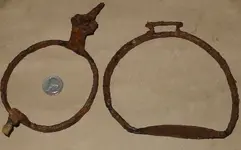
Ooop's I should have realised you boys and girls over there might not have heard about them..A foot patten comprises the iron ring, a wooden platform (to which the ring is attached), and a fabric or leather toe-piece and sides. The pattens were fitted to the underside of the wearer’s shoes and held in position by laces. They were worn to protect the shoes from mud and surface water.
Wikipedia...A later pattern of patten which seems to date from the 17th century, and then became the most common, had a flat metal ring which made contact with the ground, attached to a metal plate nailed into the wooden sole via connecting metal, often creating a platform of by several inches (more than 7 centimetres).[SUP]
[5][/SUP] By this time men's shoes had thicker soles and the wealthier males (the
gentry or
gentlemen) commonly wore high
riding boots, thus pattens seem only to have been worn by women and
working-class men in outdoor occupations. Since dress
hems extended down to the feet for most of this period, it was necessary to raise the hem above the ground to keep the dress clean even in well-swept and paved streets. The
motto of the London
Worshipful Company of Pattenmakers, the former representative
guild for this trade, was and remains:
Recipiunt Fœminæ Sustentacula Nobis, Latin for
Women Receive Support From Us. The 19th century invention of cheap rubber
galoshes gradually displaced the patten, as did the widespread use of
urban paving, especially elevated, paved pathways only for
pedestrians- the now
ubiquitous pavements or
hard road surfaces.
SS