What's new

Strategy for hunting nugs in mountains, WA/OR?

Bandiman

Tenderfoot
Joined
May 9, 2026
Messages
5
Reaction score
8
Golden Thread
0
It's been a struggle out there with the Axiom and GM1000 in the hills of WA and OR. Let's talk strategy.

Aside from some hot rocks that need some crushing, detecting for nugs has been a bust for me. I have access to some claims and open areas where I have hit old hydromines, Under hardrock prospects on hillsides, benches near old placer mines, hillsides under a bunch of quartz veins. I have detected ridges, washes, and kind of all over the place. I have spent a little time looking for specimens in creeks. I seem to hit so much Iron and being somewhat limited in digging potential post shoulder surgery 6 mo ago I move on.

The overburden is brutal in some areas here. How do you work these hills or hills like you'd find in WA and OR? Where do you work? Do you have better luck on top of lidar workings or around them? Creeks or hillsides? Makes me jealous of you AZ folks! Thanks!
 
Upvote 0
It's been a struggle out there with the Axiom and GM1000 in the hills of WA and OR. Let's talk strategy.

Aside from some hot rocks that need some crushing, detecting for nugs has been a bust for me. I have access to some claims and open areas where I have hit old hydromines, Under hardrock prospects on hillsides, benches near old placer mines, hillsides under a bunch of quartz veins. I have detected ridges, washes, and kind of all over the place. I have spent a little time looking for specimens in creeks. I seem to hit so much Iron and being somewhat limited in digging potential post shoulder surgery 6 mo ago I move on.

The overburden is brutal in some areas here. How do you work these hills or hills like you'd find in WA and OR? Where do you work? Do you have better luck on top of lidar workings or around them? Creeks or hillsides? Makes me jealous of you AZ folks! Thanks!
One strategy is to perhaps dig where others are not in general. With that being said using your eyes first rather than the metal detector could be a place to start.
This strategy can be easy to do where others have not been willing to dig due to the harder efforts compared to flatter lands with less overburden and brush etc.

The iron can be a friend if and only if other minerals have tagged along with it.
This is just a strategy others will have a different approch.
 
You have to be in an area when there was generally detectable gold being found. Pocket gold. Many vein deposits required intensive processing methods to recover gold. Others prospered on flour gold with rare larger pieces. Check out the old state mineralogist reports.
 
You have to be in an area when there was generally detectable gold being found. Pocket gold. Many vein deposits required intensive processing methods to recover gold. Others prospered on flour gold with rare larger pieces. Check out the old state mineralogist reports.
Some will say that 'detectable' is possible however very slow with a pinpointing type of detector like a Falcon or now a PI pinpoint type of detector like the underwater type of detector for finer size values.
 
Some will say that 'detectable' is possible however very slow with a pinpointing type of detector like a Falcon or now a PI pinpoint type of detector like the underwater type of detector for finer size values.
That won’t pay for a PI detector very quickly.

The recipe is simple. To find gold you want , you have to go where the type of gold you’re looking for has been found in large quantities in the past.
 
That won’t pay for a PI detector very quickly.

The recipe is simple. To find gold you want , you have to go where the type of gold you’re looking for has been found in large quantities in the past.
Many people don't pay for their detectors very quickly. With that being said the detector is just a tool if used well.

Finding a deposit to work is the key. The recipe can be very simple to complex.
 
Many people don't pay for their detectors very quickly. With that being said the detector is just a tool if used well.

Finding a deposit to work is the key. The recipe can be very simple to complex.
Deposits ARE where people have found gold in the past. It does need to be the character that would tend to be detectable. You can do well bouncing around various deposits exploring.
 
Deposits ARE where people have found gold in the past. It does need to be the character that would tend to be detectable. You can do well bouncing around various deposits exploring.
The detector can be useful on or near a surface deposit and that is the key factor.
Target conductivity is what the detector will pick up on or signal the target. Some will refer this to the character of the target / targets.
 
Sometimes I just don’t follow your logic.
The detector manufactures will talk about this.
The characteristics of the of the target / targets have to be within the ability of conductivity (signal) your detector / coil setup can pick up on.
One needs to know the limitations of a given detector and coil setup.

A simple example of a given metal detector / coil being able to pick up on a 1/2 gram nugget target could be around 4 1/2 inches max depth in a given mineralize soil. Don't expect the same detector to pick up on thin flour gold targets up to 4 1/2 inches because the conductivity is the main issue.
 
Last edited:
Or you could just say the parent deposits in-situ need to be such that it sheds detectable gold.

What I’m getting at here is not all gold deposits shed gold that is large enough to successfully find with a detector. It’s a very simple concept to understand. Just because people mined gold, just because as area was rich with gold, it doesn’t mean you will have a chance of finding success electronic prospecting. Location Location Location!

Read the history of the geology.

Now if you want to dive into the science of how detectors work. That’s probably a topic to discuss where its dead body can be whipped over and over.
 
Or you could just say the parent deposits in-situ need to be such that it sheds detectable gold.

What I’m getting at here is not all gold deposits shed gold that is large enough to successfully find with a detector. It’s a very simple concept to understand. Just because people mined gold, just because as area was rich with gold, it doesn’t mean you will have a chance of finding success electronic prospecting. Location Location Location!

Read the history of the geology.

Now if you want to dive into the science of how detectors work. That’s probably a topic to discuss where its dead body can be whipped over and over.
The phrase 'detectable gold' is determined by the limits of what detector / coil you are using.
 
Some people are shocked at what some can chase or track with just a pinpointer type detector and their eyes in rock as an example.
 
Bandiman, I’d suggest focusing below hard rock tailings. Research your area and figure out if the gold deposit was free milling pocket type gold. Pick a mine that is located in steep country with narrow dry draws. Bedrock will typically be shallower there, maybe only 2-3 feet. Follow gravity down below where you think the gold deposit surfaced.

Detect that slope to the draw and then dig down to bedrock in the bottom of the draw and expose 10-11 feet of draw and detect with your GM1000 every 3-4” as you excavate. Focus when you get within 6” of the bottom. Many times these draws can be loaded because there was no water, limited pay material and the pocket miners were after the deposit. You end up only having to excavate 2’ wide and 36” deep. Otherwise you will walk right over a mess of nuggets. Don’t find anything move and try again. Don’t find anything, find another deposit. My pet peeve - ALWAYS FILL YOUR HOLES AND EXCAVATIONS regardless of how remote you are. Leave no trace. Good luck.
 
Also you may find the VLF is good for finding the first bit of gold, then bring in the big boy to follow up. You can get worn out and discouraged chasing deep bits of hob nails.
 
It's been a struggle out there with the Axiom and GM1000 in the hills of WA and OR. Let's talk strategy.

Aside from some hot rocks that need some crushing, detecting for nugs has been a bust for me. I have access to some claims and open areas where I have hit old hydromines, Under hardrock prospects on hillsides, benches near old placer mines, hillsides under a bunch of quartz veins. I have detected ridges, washes, and kind of all over the place. I have spent a little time looking for specimens in creeks. I seem to hit so much Iron and being somewhat limited in digging potential post shoulder surgery 6 mo ago I move on.

The overburden is brutal in some areas here. How do you work these hills or hills like you'd find in WA and OR? Where do you work? Do you have better luck on top of lidar workings or around them? Creeks or hillsides? Makes me jealous of you AZ folks! Thanks!
What is the nature of the overburden in the creeks is it for example 20'-40' deep of ash / pulverized rock?
Is this overburden made out of different rock then the surrounding geology rocks?
What is the geology like right near this type of overburden?
What type of rocks is in this overburden?
There is more of course.
 
Last edited:
Bandiman, I’d suggest focusing below hard rock tailings. Research your area and figure out if the gold deposit was free milling pocket type gold. Pick a mine that is located in steep country with narrow dry draws. Bedrock will typically be shallower there, maybe only 2-3 feet. Follow gravity down below where you think the gold deposit surfaced.

Detect that slope to the draw and then dig down to bedrock in the bottom of the draw and expose 10-11 feet of draw and detect with your GM1000 every 3-4” as you excavate. Focus when you get within 6” of the bottom. Many times these draws can be loaded because there was no water, limited pay material and the pocket miners were after the deposit. You end up only having to excavate 2’ wide and 36” deep. Otherwise you will walk right over a mess of nuggets. Don’t find anything move and try again. Don’t find anything, find another deposit. My pet peeve - ALWAYS FILL YOUR HOLES AND EXCAVATIONS regardless of how remote you are. Leave no trace. Good luck.
I appreciate your answers. Thank you.
 
What is the nature of the overburden in the creeks is it for example 20'-40' deep of ash / pulverized rock?
Is this overburden made out of different rock then the surrounding geology rocks?
What is the geology like right near this type of overburden?
What type of rocks is in this overburden?
There is more of course.
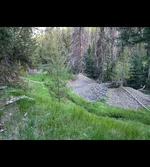
Here is a creek I found
 

Attachments

  • Screenshot_20260607_132607_Gallery.webp
    Screenshot_20260607_132607_Gallery.webp
    862.9 KB · Views: 31
Here is a creek I found
That pulverized rock came from somewhere perhaps nearby?
Don't see the diggings the rock piles come from.
If bedrock movement is killing the trees in the center there could be a fault line through there?
Bedrock may be beyond your digging abilities to get to?
Any other information that you have?
 

Users who are viewing this thread

Back
Top Bottom