What's new

Sweet little piece of vintage jewelry from Birmingham, England

tamrock

Platinum Member
Joined
Jan 16, 2013
Messages
16,407
Reaction score
34,873
Golden Thread
0
Location
Colorado
Detector(s) used
Bounty Hunter Tracker IV
Primary Interest:
All Treasure Hunting
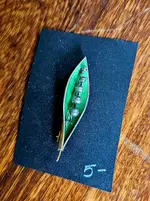
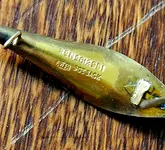
Stopped by one of the smaller thrift stores in my area and saw they put a few new pieces out. This little pin caught my eye and I instantly thought its a piece from Norway and possibly a David Andersen or Aksel Holmsen and priced for only $5.00. I only turned it still pinned to the paper to see the back and saw small marks and thinking it looks like a gold wash, I felt sure it was a Scandinavian made piece and didn't feel the need to unpin it, as the workmanship of the piece spoke for itself. It wasn't till after I payed for it and got in my truck I took a closer look and saw unfamiliar markings. I did understand that it wasn't just a gold wash when I saw it marked 9ct back. Wow its 9 carat gold, but just a thin layer I believe over silver. Looking in to the other makers mark of AJS I learned it was made by a jeweler named Arthur Johnson Smith of Birmingham. This link states he ended production in 1930 which would make it somewhat older if the information I'm using is correct.
Hopefully Red-Coat will as he does point-out any discrepancy in my findings if needed. I think its a fine addition to my collection of better jewelry pieces I find in the secondhand market.
 

Attachments

  • 20250726_140207.webp
    20250726_140207.webp
    1.5 MB · Views: 201
  • 20250726_140313.webp
    20250726_140313.webp
    830.7 KB · Views: 125
Stopped by one of the smaller thrift stores in my area and saw they put a few new pieces out. This little pin caught my eye and I instantly thought its a piece from Norway and possibly a David Andersen or Aksel Holmsen and priced for only $5.00. I only turned it still pinned to the paper to see the back and saw small marks and thinking it looks like a gold wash, I felt sure it was a Scandinavian made piece and didn't feel the need to unpin it, as the workmanship of the piece spoke for itself. It wasn't till after I payed for it and got in my truck I took a closer look and saw unfamiliar markings. I did understand that it wasn't just a gold wash when I saw it marked 9ct back. Wow its 9 carat gold, but just a thin layer I believe over silver. Looking in to the other makers mark of AJS I learned it was made by a jeweler named Arthur Johnson Smith of Birmingham. This link states he ended production in 1930 which would make it somewhat older if the information I'm using is correct.
Hopefully Red-Coat will as he does point-out any discrepancy in my findings if needed. I think its a fine addition to my collection of better jewelry pieces I find in the secondhand market.
A gorgeous piece for sure. Thank you for sharing!
 
Great find! Congratulations!
 
Nice piece and, yes, you have the maker correct. These are sometimes referred to as ‘pea-pod’ brooches, but the modelling is actually a ‘lily of the valley’.

The Patents, Designs and Trade Marks Act of 1883 introduced simple numeric design registrations to replace the former ‘lozenge’ marks (sometimes called ‘kite’marks) and number 612981 was registered in 1913. Arthur Johnson Smith also made these pieces in sterling silver with full Birmingham hallmarking and I have seen them with date letters through to the early 1920s, but a registered design can last for 25 years if renewed every 5 years,

The ’9CT BACK’ mark is, as you thought, an indication that it’s plated onto another metal on one side only, in a similar manner to rolled gold. Hallmarks can be applied to ‘mixed precious metals’ only if: an ordinary person can determine by colour which part is which metal; each precious metal meets its minimum legal standard; and the hallmark is applied to the least precious metal part, ranked in the ascending order of silver, palladium, gold and platinum.

In addition, an item is exempted from full hallmarking if it contains a gold component weighing less than 1 gram (or less than 7.78 grams for a silver).

Also, if an item contains base metal (the extent of which must be clearly visible), then the word ‘METAL’ must be applied next to the Hallmark on the precious metal part and (where practical) on the base metal part itself.
 
Last edited:
Nice piece and, yes, you have the maker correct. These are sometimes referred to as ‘pea-pod’ brooches, but the modelling is actually a ‘lily of the valley’.

The Patents, Designs and Trade Marks Act of 1883 introduced simple numeric design registrations to replace the former ‘lozenge’ marks (sometimes called ‘kite’marks) and number 612981 was registered in 1913. Arthur Johnson Smith also made these pieces in sterling silver with full Birmingham hallmarking and I have seen them with date letters through to the early 1920s, but a registered design can last for 25 years if renewed every 5 years,

The ’9CT BACK’ mark is, as you thought, an indication that it’s plated onto another metal on one side only, in a similar manner to rolled gold. Hallmarks can be applied to ‘mixed precious metals’ only if: an ordinary person can determine by colour which part is which metal; each precious metal meets its minimum legal standard; and the hallmark is applied to the least precious metal part, ranked in the ascending order of silver, palladium, gold and platinum.

In addition, an item is exempted from full hallmarking if it contains a gold component weighing less than 1 gram (or less than 7.78 grams for a silver).

Also, if an item contains base metal (the extent of which must be clearly visible), then the word ‘METAL’ must be applied next to the Hallmark on the precious metal part and (where practical) on the base metal part itself.
Your head is full of useful stuff. To your credit, you take the time to fully share your knowledge with others. That’s a worthy character trait.
 
Thank you RC. I now know even more. Also what's your thoughts on when it was possibly made. I read that AJS ended in 1930. At first I would've put this piece being made around the later 1940s to mid 1950s.
 
Thank you RC. I now know even more. Also what's your thoughts on when it was possibly made. I read that AJS ended in 1930. At first I would've put this piece being made around the later 1940s to mid 1950s.

You're welcome.

I did a little more checking, rather than relying on my memory. The registered design 612981 is actually from 1914, not 1913 as I originally said. The numbers ran from 585,707 in 1913; from 608,541 in 1914; and from 627,887 in 1915. The full-sterling hallmarked pieces seen with the date letter ‘o’ (lower case) ostensibly for 1913 must have been made in the first half of 1914. Prior to 1975, Birmingham didn’t change letters until 1st July each year rather than on 1st January.

The latest date letter I could find for this particular brooch in fully-hallmarked sterling was ‘O’ (upper case) for 1938, with the possibility of being made in the first half of 1939.

That would align with the expiry of the design registration, which is effectively a copyright protection. A registration in 1914 wouldn’t be valid after 1939. Without full hallmarking, it isn’t possible to get a more precise date, but the expiry for protection of the design itself would be the same whether produced in silver or any other metal.
 
You're welcome.

I did a little more checking, rather than relying on my memory. The registered design 612981 is actually from 1914, not 1913 as I originally said. The numbers ran from 585,707 in 1913; from 608,541 in 1914; and from 627,887 in 1915. The full-sterling hallmarked pieces seen with the date letter ‘o’ (lower case) ostensibly for 1913 must have been made in the first half of 1914. Prior to 1975, Birmingham didn’t change letters until 1st July each year rather than on 1st January.

The latest date letter I could find for this particular brooch in fully-hallmarked sterling was ‘O’ (upper case) for 1938, with the possibility of being made in the first half of 1939.

That would align with the expiry of the design registration, which is effectively a copyright protection. A registration in 1914 wouldn’t be valid after 1939. Without full hallmarking, it isn’t possible to get a more precise date, but the expiry for protection of the design itself would be the same whether produced in silver or any other metal.
Thanks again RC.
 
Nice Lily of the valley pin. The link example has hallmarks.


I saw that one and it's dated1920. Also it has some faceted white stones of some kind. The few others Ive viewed online also have the mounted white stones. Mine has these silver beads as maybe seed pods I guess they might be.
 
Your head is full of useful stuff. To your credit, you take the time to fully share your knowledge with others. That’s a worthy character trait.
In case you haven’t figured it out, @Red-Coat is a polymath. I also know another polymath pretty well.😊
 
I saw that one and it's dated1920. Also it has some faceted white stones of some kind. The few others Ive viewed online also have the mounted white stones. Mine has these silver beads as maybe seed pods I guess they might be.

That one has a lower case 't' as the date letter, which is 1918 for Birmingham although, as I explained earlier, date letters changed on 1st July, so could be from the first half of 1919.

The brooch is a stylised representation of a lily of the valley leaf with flowers or berries. The small white flowers ultimately become berries if pollinated.

Lily of the Valley.webp
 
That one has a lower case 't' as the date letter, which is 1918 for Birmingham although, as I explained earlier, date letters changed on 1st July, so could be from the first half of 1919.

The brooch is a stylised representation of a lily of the valley leaf with flowers or berries. The small white flowers ultimately become berries if pollinated.

View attachment 2218600
Right. The seller is listing it as 1920. We had a bunch of lily of the valley growing out front. Someone told my wife the were poisonous and she ask me to dig them all up. The roots are like an interconnected network.
 

Users who are viewing this thread

Back
Top Bottom